



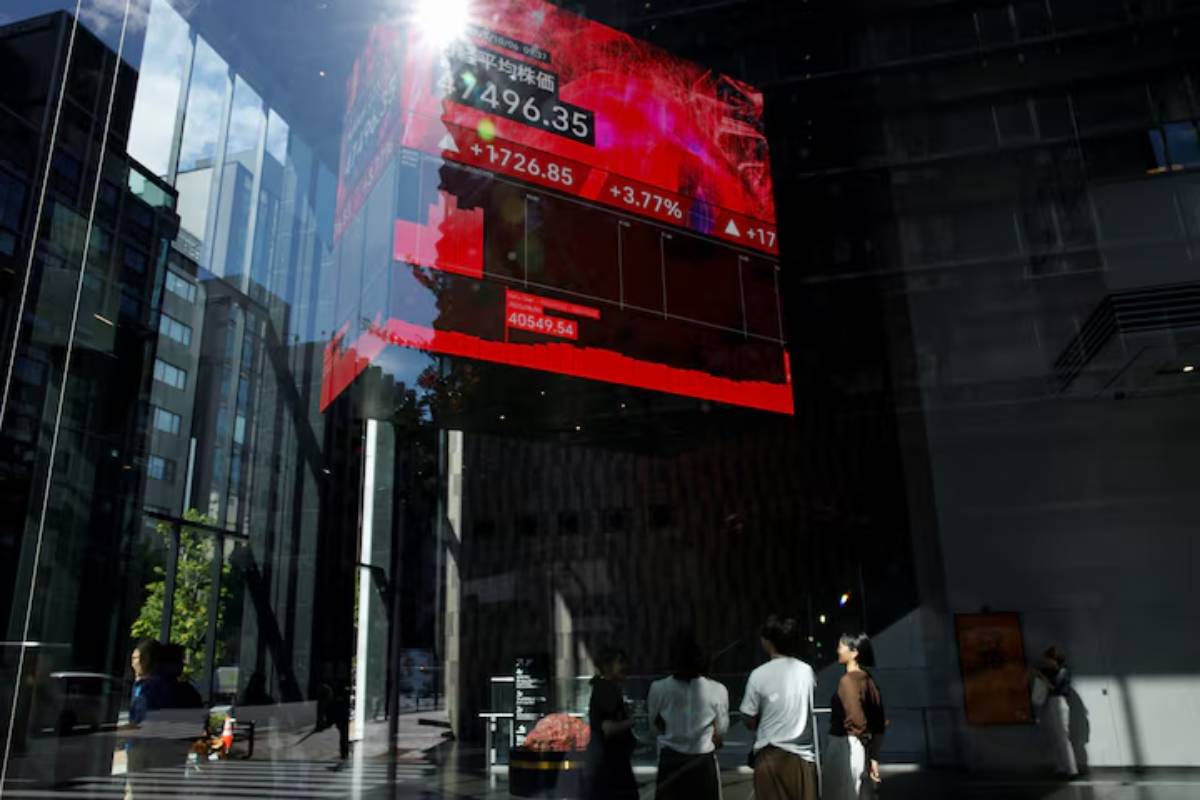
Asian equity markets staged a recovery as renewed optimism around artificial intelligence investments offset investor concerns linked to rising geopolitical tensions in the Middle East. The rebound reflects a broader risk recalibration in global financial markets, where structural growth expectations from AI innovation are increasingly competing with short-term geopolitical uncertainty.
Asian stocks climbed as investors regained confidence in technology-driven growth prospects, particularly within the artificial intelligence sector, which continues to anchor global equity sentiment.
Market participants rotated back into tech-heavy indices after earlier volatility driven by concerns over escalating tensions in the Middle East, which had triggered risk-off positioning across global asset classes.
Benchmark indices across major Asian economies recorded gains, supported by strong demand for semiconductor and AI-linked equities, which remain central to global growth narratives.
Currency and bond markets showed relative stabilization as risk appetite improved, although volatility indicators remained elevated due to ongoing geopolitical uncertainty. Energy markets remained sensitive to developments in the Middle East, but did not sustain earlier spikes as broader equity sentiment improved.
The development aligns with a broader trend across global markets where artificial intelligence has become a dominant driver of equity valuation and investor sentiment, often offsetting macroeconomic and geopolitical risks in the short term.
Over the past year, AI-related capital inflows have significantly reshaped global equity allocations, with technology giants and semiconductor manufacturers leading index performance across both developed and emerging markets.
At the same time, geopolitical tensions particularly in energy-sensitive regions such as the Middle East continue to introduce episodic volatility into global financial systems. However, markets have increasingly demonstrated a pattern of rapid recovery driven by long-term structural growth themes.
Historically, equity markets have balanced geopolitical shocks with technological innovation cycles, but the current AI-driven investment phase is notably more concentrated, with a smaller group of firms exerting disproportionate influence on index performance.
The interplay between risk sentiment and innovation-led optimism reflects a transitional phase in global financial architecture, where macro stability and technological disruption are simultaneously shaping investor behavior.
Market analysts suggest that AI remains the dominant structural narrative driving global equity performance, with investors willing to absorb short-term geopolitical shocks in anticipation of long-term productivity gains.
Financial strategists highlight that capital flows are increasingly concentrated in AI-linked sectors, particularly semiconductors, cloud infrastructure, and advanced computing platforms, which continue to outperform broader market indices.
Geopolitical risk specialists warn that while markets are currently resilient, sustained escalation in the Middle East could quickly reverse risk sentiment, particularly in energy-dependent economies.
Economists emphasize that the current market environment reflects a dual-track system: structural optimism driven by AI innovation, and cyclical volatility driven by geopolitical uncertainty.
Institutional investors reportedly continue to maintain exposure to technology equities while hedging against potential downside risks in commodities and energy-linked assets. For corporations, the sustained strength in AI-related equities reinforces continued investment momentum in digital transformation, infrastructure scaling, and automation strategies.
For investors, the market signals highlight a continued preference for growth-oriented technology assets, even amid rising geopolitical volatility, suggesting a prolonged structural re-rating of AI-linked sectors.
For policymakers, the divergence between financial optimism and geopolitical instability underscores the challenge of maintaining macroeconomic stability in an increasingly technology-driven investment landscape. For global businesses, supply chain planning and energy exposure management remain critical as geopolitical risks continue to influence input costs and operational stability.
Markets are expected to remain highly sensitive to both AI sector performance and geopolitical developments in the Middle East. Decision-makers should monitor capital flows into technology equities, energy price volatility, and central bank responses to shifting risk conditions.
The near-term outlook suggests continued coexistence of strong AI-driven growth narratives and intermittent geopolitical shocks, reinforcing a structurally volatile but innovation-led global market environment.
Source: Reuters
Date: June 2, 2026


