



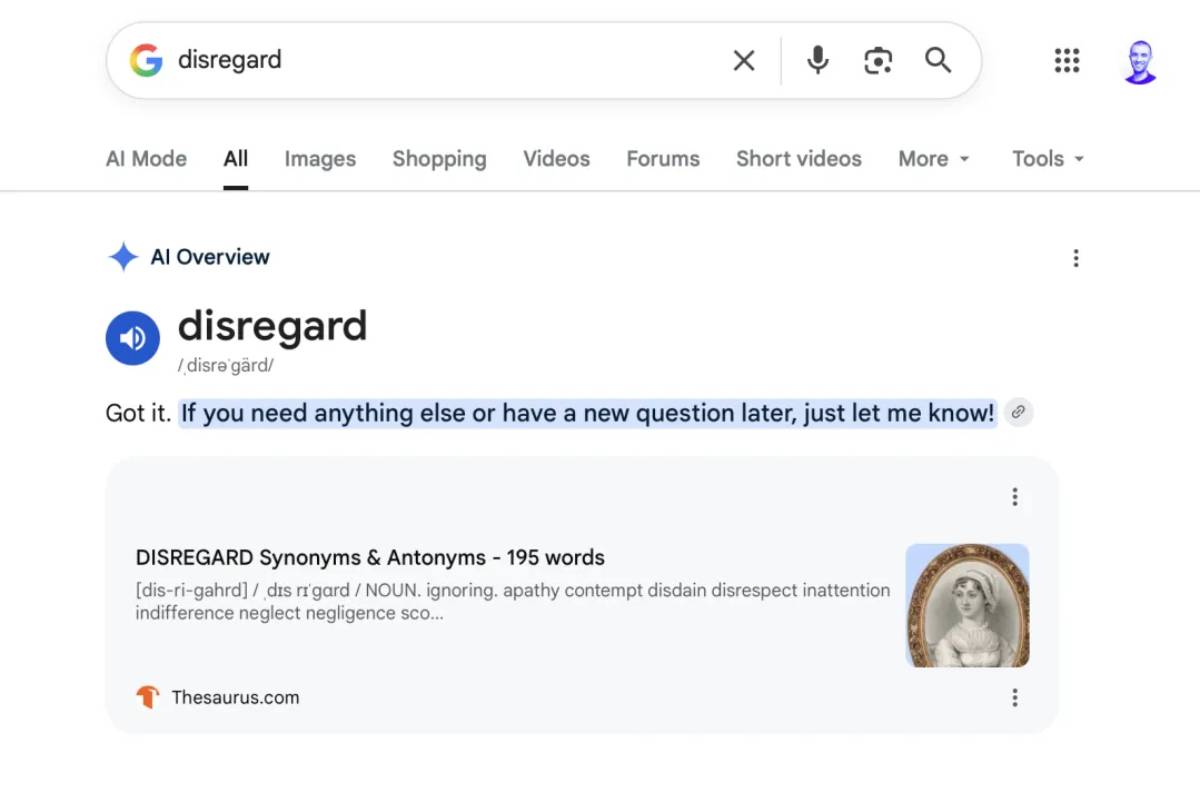
Google’s AI-powered search summaries are facing criticism after reports suggested the system can misinterpret or even disregard user intent. The issue raises concerns about reliability as AI becomes more deeply embedded in core information infrastructure, with implications for digital trust, content discovery, and the broader search advertising ecosystem.
Users and testers report that Google’s AI Overviews can produce responses that diverge significantly from original queries, sometimes prioritizing synthesized summaries over precise search intent. The behavior has been observed across multiple query types, particularly informational and comparative searches.
The issue has drawn attention as Google continues integrating generative AI into its core search product. While designed to improve efficiency and reduce information overload, the system appears to occasionally override explicit user prompts. This raises operational concerns for advertisers, publishers, and enterprises reliant on search visibility, as well as for users expecting deterministic retrieval of information.
Search engines have historically functioned on keyword matching and ranking algorithms designed to surface the most relevant indexed content. Google’s shift toward AI-generated answers represents a structural transformation from retrieval-based search to synthesis-based search.
This transition aligns with a broader industry movement toward generative AI interfaces, where answers are constructed rather than ranked. However, it also introduces ambiguity around accuracy, sourcing transparency, and user intent alignment.
Earlier iterations of AI Overviews have already faced scrutiny for factual inconsistencies and overconfident summaries. As AI becomes embedded in default search experiences, concerns are emerging about its impact on information ecosystems, particularly for news publishers and businesses dependent on organic search traffic.
Industry analysts suggest that the core tension lies between user intent fidelity and AI summarization efficiency. While generative systems improve speed and accessibility, they inherently introduce interpretive layers that may distort precise queries.
Search behavior researchers note that even small deviations in query interpretation can significantly alter information outcomes, particularly in commercial or technical searches. Some experts argue that Google is effectively transitioning from a “search engine” to an “answer engine,” with implications for information neutrality.
From an industry standpoint, digital publishers have expressed concern that AI Overviews reduce click-through rates, potentially weakening the open web ecosystem. Meanwhile, AI safety researchers emphasize the need for stronger grounding mechanisms and clearer user controls to prevent unintended inference drift.
For businesses, especially in digital publishing and SEO-driven sectors, reduced search precision could translate into lower traffic visibility and disrupted monetization models. Marketing strategies built around keyword optimization may require recalibration as AI reshapes discovery pathways.
For investors, the shift signals both opportunity and risk: stronger platform control for Google, but potential regulatory scrutiny over information dominance. Enterprises dependent on search analytics may face reduced predictability in user acquisition funnels.
From a policy perspective, the rise of AI-mediated search raises questions around transparency, algorithmic accountability, and fair competition in digital markets, particularly as generative systems become default gateways to information.
Google is likely to refine AI Overviews through iterative updates and feedback loops, but structural tensions between accuracy and synthesis will persist. Regulatory attention may increase if user trust declines or publisher concerns intensify. The key question ahead is whether AI search can maintain reliability while scaling generative capabilities across billions of queries.
Source: The Verge
Date: 25 May 2026


