



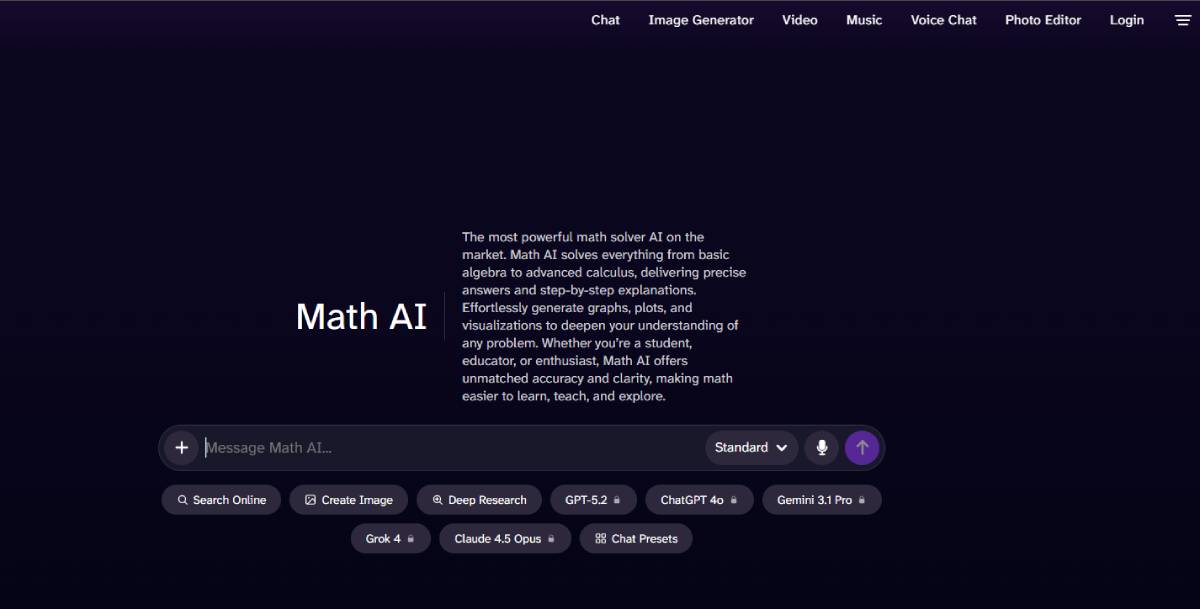
AI-powered mathematics platforms are rapidly transforming how individuals and institutions approach problem-solving, offering real-time solutions from basic algebra to advanced calculus. This shift signals a broader disruption in education technology, impacting students, educators, and enterprises while raising questions about learning integrity, skill development, and long-term workforce readiness.
AI-driven math assistants, such as those offered by platforms like DeepAI, now provide step-by-step solutions across a wide spectrum of mathematical disciplines. These tools leverage large language models and symbolic computation to deliver near-instant answers, often accompanied by explanations.
Adoption is rising among students globally, particularly in digital-first education markets. The tools are accessible via web interfaces, often free or low-cost, lowering barriers to entry.
EdTech companies, academic institutions, and AI developers are key stakeholders. The expansion aligns with growing demand for personalized, on-demand learning support, while also raising concerns around academic misuse and over-reliance on automated systems in formal education environments.
The emergence of AI-powered academic tools reflects a broader transformation within the global education sector, where generative AI is reshaping knowledge acquisition and delivery. Over the past two years, platforms integrating AI tutors, homework assistants, and automated grading systems have gained traction, particularly following the rise of large language models.
This development aligns with a broader trend across global markets where automation is extending beyond repetitive tasks into cognitive domains traditionally reserved for human expertise. Mathematics, once seen as a discipline requiring deep conceptual understanding, is increasingly being augmented or in some cases replaced by AI-driven assistance.
Historically, technological disruptions in education from calculators to online learning have faced similar scrutiny. However, the scale, accessibility, and sophistication of AI tools represent a step-change, prompting educators and policymakers to reassess frameworks around assessment, academic integrity, and skill validation.
Industry analysts suggest that AI math tools could redefine the role of educators, shifting focus from instruction to mentorship and critical thinking development. Experts argue that while such platforms enhance accessibility and efficiency, they risk undermining foundational learning if used without oversight.
EdTech leaders emphasize the potential for AI to democratize education, particularly in underserved regions where access to qualified teachers remains limited. However, academic institutions have voiced concerns about plagiarism, reduced student engagement, and the erosion of problem-solving skills.
Policy experts are increasingly calling for clear guidelines on AI usage in education, including disclosure requirements and assessment redesign. Corporate stakeholders, meanwhile, view these tools as part of a larger productivity ecosystem, integrating AI into learning, training, and workforce development pipelines.
For businesses, the rise of AI-driven math platforms opens new opportunities in the EdTech sector, particularly in subscription-based learning tools, enterprise training solutions, and AI-powered tutoring services. Investors are closely monitoring companies that can scale responsibly while maintaining credibility in education outcomes.
For policymakers, the challenge lies in balancing innovation with academic integrity. Governments and regulators may need to introduce standards governing AI-assisted learning, particularly in examination systems and certification processes.
Educational institutions must rethink curricula, assessment models, and digital literacy frameworks to ensure students develop both conceptual understanding and the ability to critically evaluate AI-generated outputs.
AI-powered math tools are expected to become increasingly sophisticated, integrating multimodal capabilities and deeper personalization. Decision-makers should watch for regulatory developments, institutional responses, and evolving user behavior. The key uncertainty remains whether these platforms will complement human learning or fundamentally reshape it. The trajectory will define the future balance between automation and human expertise in education.
Source: DeepAI
Date: April 2026


