



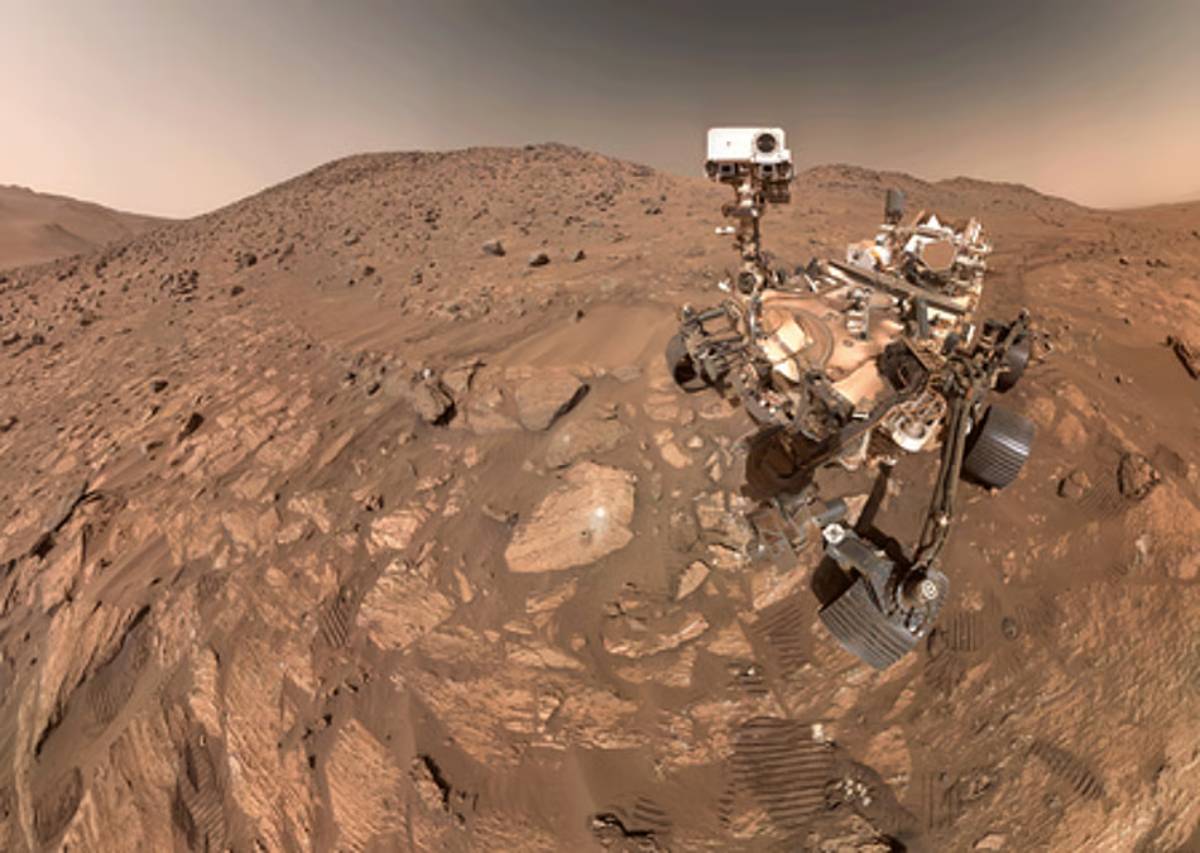
A major milestone in space exploration unfolded as NASA’s Perseverance rover successfully completed its first drive on Mars planned entirely by artificial intelligence. The achievement marks a shift toward greater autonomy in deep-space missions, with implications for future planetary exploration, space economics, and advanced robotics development.
NASA confirmed that Perseverance executed an AI-planned route without direct human input, using onboard intelligence to assess terrain, identify hazards, and select optimal paths. The system enabled the rover to travel farther in a single Martian day than previously possible under manual planning. Engineers highlighted that the AI evaluated images in real time, reducing delays caused by communication lags between Earth and Mars. The technology is designed to conserve energy, minimise risk, and accelerate scientific output. This development represents a practical deployment of autonomous decision-making in an extreme, high-stakes environment.
The development aligns with a broader trend across global technology and space programmes where autonomy is becoming essential rather than optional. With Mars located millions of kilometres from Earth, communication delays can exceed 20 minutes one way, limiting real-time control. Historically, rover movements were carefully planned by human teams, often restricting travel distances and slowing mission timelines. Advances in artificial intelligence, machine vision, and edge computing are now enabling spacecraft to operate with minimal supervision. This mirrors parallel developments in defence, logistics, and industrial automation on Earth. As space agencies and private players plan longer-duration missions to Mars and beyond, autonomous systems are increasingly viewed as critical infrastructure rather than experimental tools.
NASA scientists describe the AI-driven drive as a turning point in robotic exploration. Mission engineers note that autonomy allows rovers to focus more time on science rather than navigation logistics. Space technology analysts argue that the breakthrough demonstrates how AI platforms can deliver measurable efficiency gains in environments where human intervention is constrained or impossible. Industry experts also highlight potential spillover benefits for terrestrial sectors such as autonomous vehicles, mining, and disaster response. While officials stress that human oversight remains essential, many agree that this balance between autonomy and control will define the next generation of exploration systems.
For businesses, the success underscores the commercial potential of AI systems capable of operating independently in harsh conditions. Aerospace firms, robotics manufacturers, and AI developers may see increased demand for autonomous navigation and decision-making technologies. Investors could view space-grade AI as a validation of real-world reliability, not just theoretical promise. From a policy perspective, governments may expand funding for autonomous research tied to national space strategies. The development also raises governance questions around accountability, safety, and standards for AI-driven systems operating beyond Earth.
Looking ahead, NASA is expected to expand the use of autonomous planning across Perseverance’s remaining mission and future lunar and Martian projects. Decision-makers will watch how reliably the system performs over extended periods and varied terrain. As autonomy deepens, the boundary between human-led and machine-led exploration will continue to evolve, reshaping how humanity explores and operates in space.
Source & Date
Source: The News Minute
Date: January 2026


