
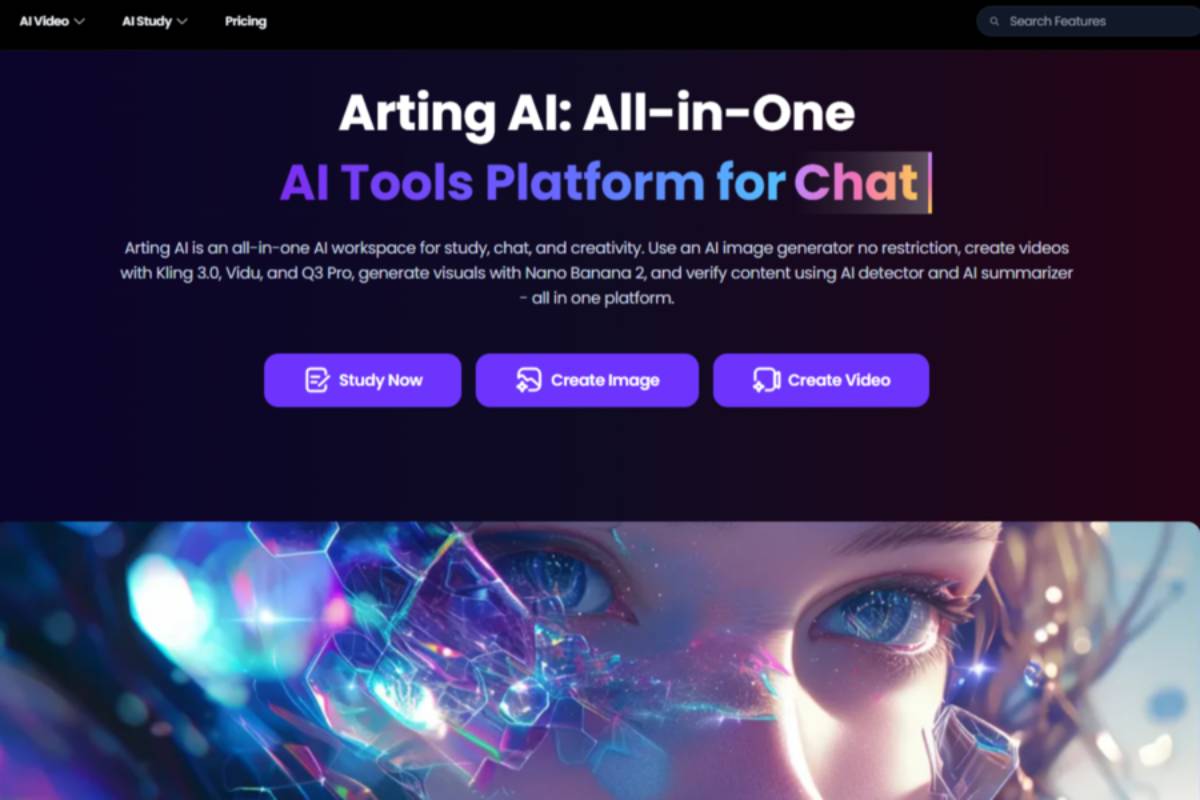
Arting AI Advances Generative Visual Creation

Arting AI brings several creative capabilities into a unified environment, including text-to-image and image-to-image generation, image enhancement.

August 12, 2026
|

Arting AI is advancing the generative content landscape with a platform that combines AI-powered image generation, image editing, video creation and broader productivity capabilities. The approach reflects the growing enterprise demand for consolidated AI workflows, potentially helping creators, marketers, designers and business teams produce and manage digital content more efficiently.

Arting AI brings several creative capabilities into a unified environment, including text-to-image and image-to-image generation, image enhancement, background removal, resizing, watermark removal and image extension. Its video capabilities include text-to-video, image-to-video and AI animation tools.

Beyond visual creation, the platform incorporates AI chat, writing assistance, document summarization, mathematical support and content-analysis capabilities. This broader functionality positions Arting AI beyond a conventional image-generation application.

The platform is designed for creators, marketers, designers, agencies, developers, students and businesses. Its centralized approach aims to reduce the need for users to switch between multiple specialized AI applications during creative and productivity workflows.

Generative AI is rapidly moving from individual-purpose applications toward broader platforms capable of supporting complete digital workflows. Image generation was among the earliest mainstream creative applications, but demand has expanded toward video production, editing, content development and automated productivity.

Arting AI's model reflects this transition by combining visual-generation capabilities with editing and broader AI utilities. Users can move from generating an image to enhancing, resizing or modifying it, while also accessing video-generation and productivity features within the same environment.

This consolidation trend is increasingly relevant for businesses seeking to control technology costs and simplify employee workflows. Marketing departments, creative agencies and content teams often use multiple applications to complete a single campaign. Unified AI platforms could reduce that fragmentation.

However, consolidation also creates new questions around quality, model selection, data handling, intellectual property and content governance. These factors will remain central as organizations evaluate increasingly broad AI platforms.

The growing appeal of unified AI platforms is closely connected to workflow efficiency. Rather than treating image generation, editing, video creation and writing as separate processes, organizations increasingly want AI systems that support multiple stages of production.

Arting AI's broad functionality reflects this direction. Its combination of visual-generation tools and productivity features can potentially provide users with a more centralized environment for creative work.

For business leaders, however, breadth alone does not determine strategic value. Organizations must assess output quality, consistency, reliability, integration capabilities and governance requirements. Specialized applications may continue to outperform general platforms in particular professional workflows.

The competitive landscape is therefore likely to focus on how effectively platforms balance convenience with professional-grade results. AI providers that can combine multiple capabilities without sacrificing quality or control could gain an advantage as businesses increasingly standardize generative AI across departments.

For businesses, a consolidated generative AI platform could simplify creative workflows and reduce the number of applications required for content production. Marketing teams could potentially generate campaign visuals, modify assets and develop video content through a more centralized process.

For executives, the primary consideration will be productivity balanced against governance. Organizations adopting generative AI need policies covering intellectual property, brand consistency, confidential information, content authenticity and responsible use.

The rise of AI-generated visual content also has implications for regulators and digital platforms. Questions surrounding transparency, copyright, synthetic media and content provenance are likely to become increasingly important as AI-generated assets enter commercial and public-facing environments.

Arting AI's future prospects will depend on its ability to maintain high-quality outputs while expanding across image, video and productivity workflows. Competition will intensify as major AI providers and specialized platforms broaden their capabilities. For business decision-makers, the most important measure will be whether unified AI tools deliver measurable productivity improvements while maintaining quality, security, governance and creative control.

Source: Crozdesk
Date: August 12, 2026

  • Featured tools
Figstack AI
Free

Figstack AI is an intelligent assistant for developers that explains code, generates docstrings, converts code between languages, and analyzes time complexity helping you work smarter, not harder.

#
Coding
Learn more
Surfer AI
Free

Surfer AI is an AI-powered content creation assistant built into the Surfer SEO platform, designed to generate SEO-optimized articles from prompts, leveraging data from search results to inform tone, structure, and relevance.

#
SEO
Learn more

Learn more about future of AI

Join 80,000+ Ai enthusiast getting weekly updates on exciting AI tools.
Thank you! Your submission has been received!
Oops! Something went wrong while submitting the form.

Arting AI Advances Generative Visual Creation

August 12, 2026

Arting AI brings several creative capabilities into a unified environment, including text-to-image and image-to-image generation, image enhancement.

Arting AI is advancing the generative content landscape with a platform that combines AI-powered image generation, image editing, video creation and broader productivity capabilities. The approach reflects the growing enterprise demand for consolidated AI workflows, potentially helping creators, marketers, designers and business teams produce and manage digital content more efficiently.

Arting AI brings several creative capabilities into a unified environment, including text-to-image and image-to-image generation, image enhancement, background removal, resizing, watermark removal and image extension. Its video capabilities include text-to-video, image-to-video and AI animation tools.

Beyond visual creation, the platform incorporates AI chat, writing assistance, document summarization, mathematical support and content-analysis capabilities. This broader functionality positions Arting AI beyond a conventional image-generation application.

The platform is designed for creators, marketers, designers, agencies, developers, students and businesses. Its centralized approach aims to reduce the need for users to switch between multiple specialized AI applications during creative and productivity workflows.

Generative AI is rapidly moving from individual-purpose applications toward broader platforms capable of supporting complete digital workflows. Image generation was among the earliest mainstream creative applications, but demand has expanded toward video production, editing, content development and automated productivity.

Arting AI's model reflects this transition by combining visual-generation capabilities with editing and broader AI utilities. Users can move from generating an image to enhancing, resizing or modifying it, while also accessing video-generation and productivity features within the same environment.

This consolidation trend is increasingly relevant for businesses seeking to control technology costs and simplify employee workflows. Marketing departments, creative agencies and content teams often use multiple applications to complete a single campaign. Unified AI platforms could reduce that fragmentation.

However, consolidation also creates new questions around quality, model selection, data handling, intellectual property and content governance. These factors will remain central as organizations evaluate increasingly broad AI platforms.

The growing appeal of unified AI platforms is closely connected to workflow efficiency. Rather than treating image generation, editing, video creation and writing as separate processes, organizations increasingly want AI systems that support multiple stages of production.

Arting AI's broad functionality reflects this direction. Its combination of visual-generation tools and productivity features can potentially provide users with a more centralized environment for creative work.

For business leaders, however, breadth alone does not determine strategic value. Organizations must assess output quality, consistency, reliability, integration capabilities and governance requirements. Specialized applications may continue to outperform general platforms in particular professional workflows.

The competitive landscape is therefore likely to focus on how effectively platforms balance convenience with professional-grade results. AI providers that can combine multiple capabilities without sacrificing quality or control could gain an advantage as businesses increasingly standardize generative AI across departments.

For businesses, a consolidated generative AI platform could simplify creative workflows and reduce the number of applications required for content production. Marketing teams could potentially generate campaign visuals, modify assets and develop video content through a more centralized process.

For executives, the primary consideration will be productivity balanced against governance. Organizations adopting generative AI need policies covering intellectual property, brand consistency, confidential information, content authenticity and responsible use.

The rise of AI-generated visual content also has implications for regulators and digital platforms. Questions surrounding transparency, copyright, synthetic media and content provenance are likely to become increasingly important as AI-generated assets enter commercial and public-facing environments.

Arting AI's future prospects will depend on its ability to maintain high-quality outputs while expanding across image, video and productivity workflows. Competition will intensify as major AI providers and specialized platforms broaden their capabilities. For business decision-makers, the most important measure will be whether unified AI tools deliver measurable productivity improvements while maintaining quality, security, governance and creative control.

Source: Crozdesk
Date: August 12, 2026

Promote Your Tool

Copy Embed Code

Similar Blogs

August 12, 2026
|

FixMe.IT Advances Digital IT Management

FixMe.IT provides organizations with tools for managing IT help desk operations, service requests, incidents, problems and technology assets.
Read more
August 12, 2026
|

Vyond Advances AI Enterprise Video Creation

Vyond provides organizations with tools for creating animated, mixed-media and AI-assisted videos across business functions.
Read more
August 12, 2026
|

QuickBooks Strengthens Enterprise Business

QuickBooks Desktop Enterprise is designed for businesses that require more advanced accounting capabilities than entry-level financial software typically provides.
Read more
August 12, 2026
|

SureCost Advances Intelligent Pharmacy Supply

SureCost brings pharmacy procurement, inventory management and supply intelligence into a centralized technology environment.
Read more
August 12, 2026
|

Arting AI Advances Generative Visual Creation

Arting AI brings several creative capabilities into a unified environment, including text-to-image and image-to-image generation, image enhancement.
Read more
August 12, 2026
|

Loomly Strengthens Social Media Management Tools

Loomly brings core social media activities into a unified workspace, covering content calendars, post creation, scheduling, collaboration and publishing.
Read more