



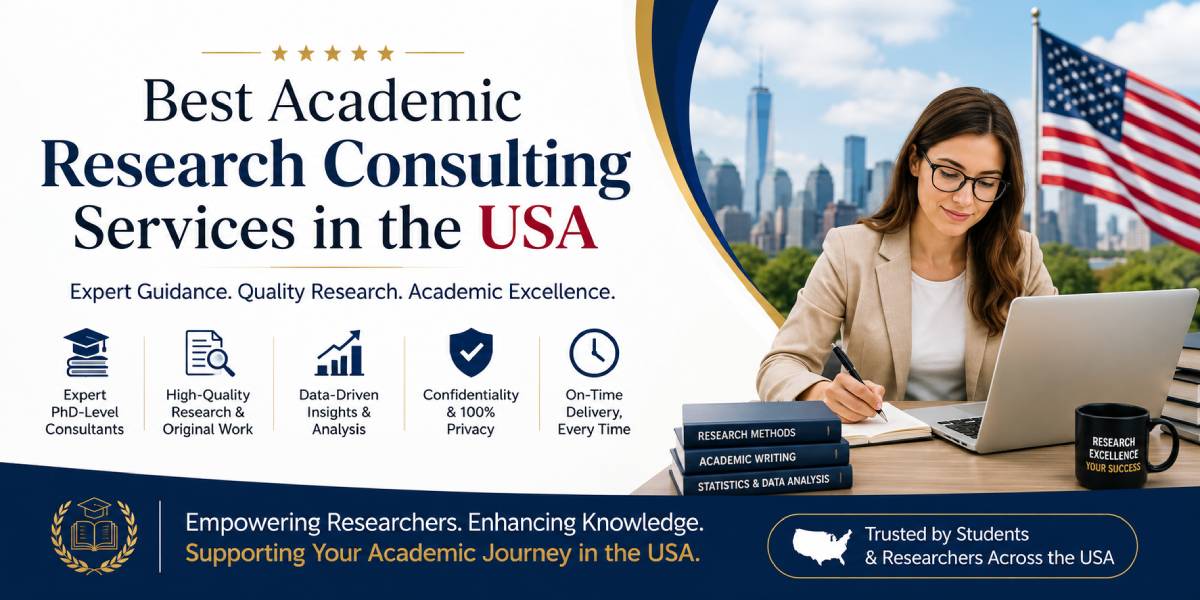
Whether you're a doctoral candidate refining a dissertation chapter, a faculty member navigating a competitive grant cycle, or a research team wrestling with complex datasets, the right consulting partner can be the difference between a rejected submission and a published breakthrough.
Academic research consulting in the United States has matured considerably over the past decade. What once meant basic proofreading or light data assistance has evolved into a sophisticated professional ecosystem covering methodological design, advanced statistical modeling, qualitative inquiry, and strategic funding acquisition. Today's top consultants don't just polish manuscripts they serve as intellectual partners, helping researchers transform original ideas into studies that are publishable, fundable, and genuinely impactful.
This guide highlights a carefully selected group of US-based academic research consulting firms and independent advisors who stand out for their transparency, domain expertise, and track record of measurable client outcomes.
Selection Criteria: How These Providers Were Chosen
Each consulting service featured below was evaluated against three core standards:
Evidence-Based Practice - Documented methodologies, published case studies, or verifiable client outcomes demonstrating real-world research impact.
Client Credibility - Positive testimonials, improved publication rates, successful grant awards, or demonstrated value recognized within the academic community.
US-Based Leadership - Founded or actively led by US-based professionals with direct, sustained ties to the academic sector and an understanding of American institutional standards.
Featured Academic Research Consulting Services in the USA
1. Stark Statistical Consulting
What they offer: End-to-end statistical consulting support, from hypothesis development and IRB preparation through data analysis and manuscript integration — tailored specifically for academic researchers.
Clients served: STEM researchers, clinical investigators, doctoral candidates, and educational institutions.
Engagement model: A direct one-on-one model featuring custom-built data solutions, annotated feedback loops, and real-time communication throughout the research process.
Why they stand out: Full-cycle support from study design to journal resubmission, with a proven record of improving both publication acceptance rates and grant application outcomes.
Leadership: Glenn Alan Stark Founder. With over 15 years of experience, Glenn specializes in translating dense, complex data into clear, reviewer-ready outputs using tools including R, SPSS, and SAS. Researchers consistently credit him with demystifying statistical analysis and reducing costly revision rounds.
2. Cambridge Academic Consulting Group
What they offer: Strategic guidance across grant writing, research design, academic publishing, and professional coaching for scholars at all career stages.
Clients served: Academic professionals, grant-seeking researchers, and higher education institutions.
Engagement model: Clients are matched with domain-specific consultants whose expertise closely aligns with their field's publication standards and funding landscape.
Why they stand out: A personalized pairing model that ensures genuine disciplinary alignment, complemented by documented grant success histories and peer-review simulation techniques that strengthen a researcher's ability to respond to critical feedback.
Leadership: Francisco Jaimes Executive Director. A veteran in research strategy and university-led consulting, Francisco brings structured, no-nonsense guidance to manuscript preparation and proposal development. He is widely respected for helping researchers clarify their arguments and build institutional credibility.
3. Academic Writer
What they offer: Academic editing, content restructuring, and formatting services for dissertations, theses, and journal articles — with particular sensitivity to preserving each researcher's individual academic voice.
Clients served: Graduate students, doctoral candidates, and academic researchers — especially those writing in English as a second language.
Engagement model: Iterative editing cycles with personalized written feedback, tracked changes, and reusable structural frameworks for future writing projects.
Why they stand out: Enhances clarity without sacrificing scholarly tone, delivers fast turnarounds without cutting corners, and equips researchers with frameworks they can apply independently going forward.
Leadership: Jon Griffin Academic Writer, Editor & Research Writing Assistant. Jon's background in academic publishing and manuscript preparation makes him a trusted resource for researchers navigating tight submission deadlines. He is recognized for providing actionable editorial feedback and producing polished, submission-ready documents.
4. American Foreign Academic Research (AFAR)
What they offer: Coordination of international field research opportunities for US academic institutions, with a specialization in archaeology, anthropology, and cultural heritage studies.
Clients served: Universities, cultural heritage organizations, international academic collaborators, and field researchers seeking credit-bearing overseas programs.
Engagement model: A US-based nonprofit structure overseeing globally managed field research programs with embedded academic credit and deep local institutional partnerships.
Why they stand out: A pioneer in bridging American academia and international fieldwork, with long-standing relationships with museums, ministries of culture, and overseas universities. Programs meet US academic credit standards while delivering genuine cultural immersion and scholarly rigor.
Leadership: Mat Saunders Founder & Executive Director. An experienced academic program architect and cultural heritage strategist, Mat has spent decades designing and leading overseas research initiatives. Under his direction, AFAR has become a respected gateway for American scholars seeking meaningful, credit-eligible international field experience.
5. Cannabis Research Center & Coalition
What they offer: Evidence-based cannabis cultivation research focused on optimizing plant health, cannabinoid production profiles, and sustainable agricultural practices.
Clients served: Cannabis producers, agri-tech companies, universities, and policy organizations seeking peer-reviewed research to inform practice and regulation.
Engagement model: A collaborative, coalition-based research structure that connects academic institutions directly with commercial cultivators for applied, real-world study.
Why they stand out: Brings scientific rigor to a sector that has historically lacked it publishing peer-reviewed studies on cannabinoid development and building bridges between controlled academic research and commercial grow operations.
Leadership: Dr. Allison Justice, Ph.D. Founder & CEO. A nationally recognized plant scientist with a doctoral background in horticulture, Dr. Justice has advanced research in cannabinoid expression and agricultural best practices within regulated environments. Her coalition-style research model has raised the standard for evidence-based practice across the cannabis industry.
6. CRISPR QC
What they offer: CRISPR gene-editing analysis, validation services, and R&D support for biotech and academic research teams requiring reproducible, trustworthy results.
Clients served: Biotech companies, academic research labs, and pharmaceutical R&D teams.
Engagement model: Standardized quality control assays and custom CRISPR validation workflows with rapid turnaround times, real-time delivery dashboards, and continuously updated benchmarking protocols.
Why they stand out: A pioneer in quality control for CRISPR-based gene editing, offering validated protocols and transparent reporting that give academic and commercial labs confidence in the integrity of their genome editing outcomes.
Leadership: Ross Bundy President, Co-Founder & CEO. With a background in cellular analytics and diagnostics, Ross built CRISPR QC into a leader in gene-editing validation. His work centers on bringing transparency and reproducibility to a field where experimental integrity is paramount.
7. InteliSpark
What they offer: Specialized consulting for securing non-dilutive government funding through programs including SBIR (Small Business Innovation Research) and STTR (Small Business Technology Transfer).
Clients served: Startups, universities, venture capital firms, and economic development programs looking to convert innovative ideas into funded research projects.
Engagement model: Proposal coaching, writing, and review services, with outcome-aligned fee structures that tie compensation to client success.
Why they stand out: A success-oriented model where incentives align with client outcomes, paired with highly tailored support for early-stage companies navigating complex federal funding landscapes.
Leadership: Kirk Macolini Founder, President & Principal Consultant. With more than 20 years of experience and a record of helping fund over 500 projects with agencies including NIH, NSF, DoD, and NASA, Kirk is a recognized authority on non-dilutive funding strategy. He holds graduate and undergraduate degrees in Computer Science from UMass Amherst.
Why Academic Research Consulting Matters More Than Ever
The US academic research consulting landscape represents a wide-ranging network of specialists from statistical analysts to international field coordinators to biotech validation experts united by a shared commitment to research integrity, methodological rigor, and measurable outcomes. As funding competition intensifies and publication standards rise, the value of expert consulting support has never been clearer.
Source: Digital Reference
Date: March 21, 2026


