



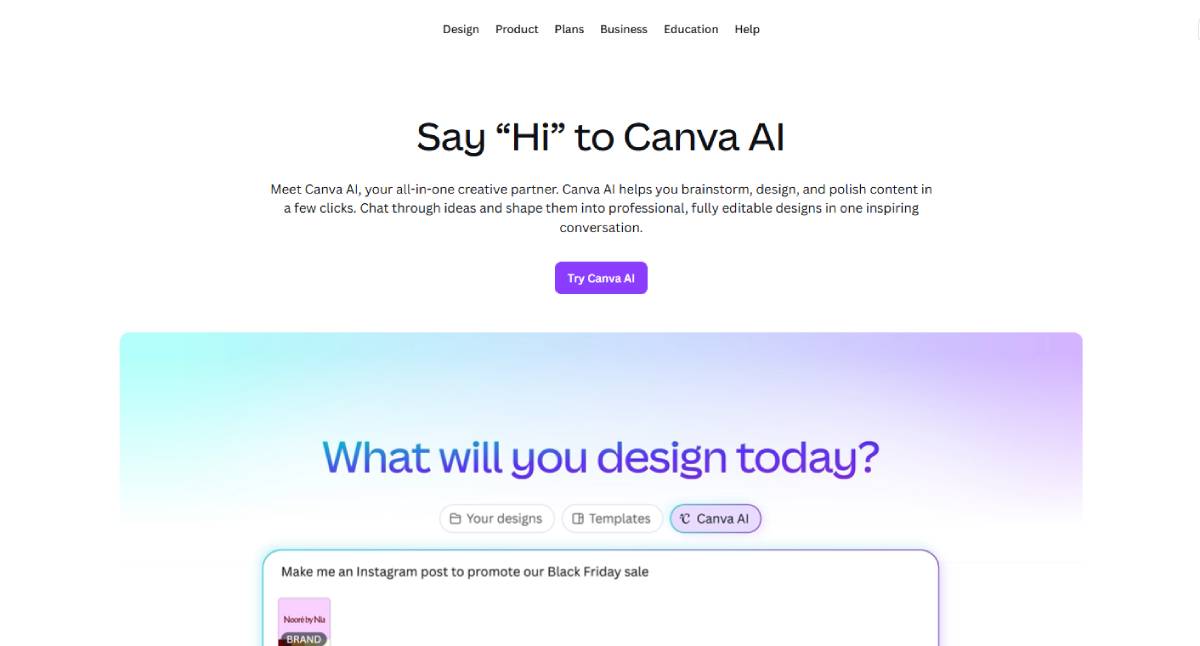
A major development in the creative software industry has emerged as Canva expands its artificial intelligence capabilities through an all-in-one AI assistant designed to streamline content creation. The move signals a strategic shift toward unified, AI-driven creative workflows, with implications for designers, marketers, and enterprise content teams globally.
Canva has introduced an AI assistant integrated directly into its design platform, enabling users to generate, edit, and optimize visual content through natural language prompts. The tool consolidates multiple creative functions, including image generation, copywriting support, and layout design automation.
The assistant is designed to reduce workflow complexity by allowing users to execute end-to-end design tasks within a single interface. This reflects Canva’s broader strategy of embedding AI deeply into its productivity ecosystem.
The rollout aligns with increasing demand for faster, scalable content production across marketing, education, and enterprise communications, where speed and consistency are becoming critical performance metrics.
The development aligns with a broader global trend where creative software platforms are rapidly integrating generative AI to enhance productivity and democratize design capabilities. Companies such as Adobe have also expanded AI-driven features in design and media editing tools, intensifying competition in the creative technology sector.
Historically, professional design workflows required specialized tools and technical expertise. However, the rise of intuitive, AI-powered platforms has significantly lowered the barrier to entry, enabling non-designers to produce high-quality visual content.
This shift is closely tied to the explosion of digital marketing, social media content demand, and enterprise communication needs. Organizations now require continuous content generation at scale, pushing platforms like Canva to evolve from static design tools into intelligent creative ecosystems powered by generative AI and automation.
Industry analysts suggest that Canva’s AI assistant represents a major step toward “agentic design systems,” where AI not only assists but actively executes multi-step creative workflows. Experts note that this could significantly reduce production time for marketing and content teams.
Technology commentators emphasize that embedding AI directly into design platforms enhances accessibility while also reshaping professional creative roles. Designers may increasingly shift from manual execution to oversight and creative direction.
Market observers highlight that competition in the creative software sector is intensifying, with major players racing to build end-to-end AI ecosystems. Analysts caution, however, that issues such as content originality, copyright compliance, and brand consistency will remain key challenges as AI-generated content scales globally.
For global executives, Canva’s AI integration signals a shift toward automated content pipelines that can dramatically reduce marketing production costs and accelerate campaign deployment. Enterprises may need to reassess creative workflows and workforce structures as AI takes on more execution-heavy tasks.
Investors are likely to view AI-powered creative platforms as high-growth segments within the SaaS industry. Meanwhile, marketing teams may benefit from faster iteration cycles and personalized content generation at scale. However, policymakers and regulators may increasingly scrutinize AI-generated content for intellectual property compliance, authenticity, and transparency in digital media ecosystems.
Looking ahead, Canva’s success will depend on how effectively its AI assistant integrates into enterprise workflows and maintains creative quality at scale. Decision-makers should monitor adoption across marketing, education, and corporate communication sectors.
As AI-driven design becomes mainstream, the creative industry is expected to transition toward fully automated content ecosystems, where human roles increasingly focus on strategy, branding, and oversight rather than execution.
Source: Canva Official AI Assistant Page
Date: April 2026


