



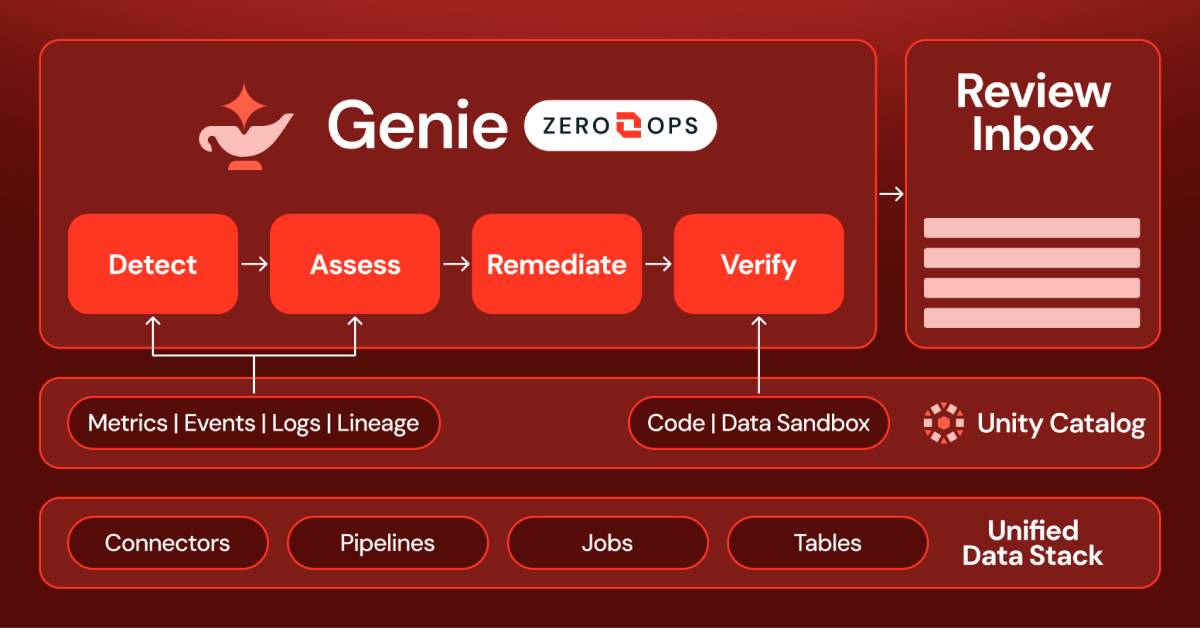
A significant development in enterprise artificial intelligence emerged as Databricks unveiled Genie ZeroOps, a platform designed to automate data and AI operations across organizations. The move signals the next phase of enterprise AI adoption, where businesses seek to reduce operational complexity, improve efficiency, and accelerate AI deployment at scale.
Databricks introduced Genie ZeroOps as a new capability aimed at simplifying the management of data infrastructure, analytics pipelines, and AI workloads. The platform leverages AI agents and automation technologies to handle operational tasks that traditionally require extensive human oversight.
The launch comes amid growing enterprise demand for autonomous systems that can optimize performance, monitor data environments, identify issues, and recommend corrective actions. Databricks positions the offering as a way to help organizations reduce operational burdens while improving reliability and scalability.
The announcement further strengthens Databricks’ strategy of expanding beyond data analytics into full-scale AI operations management, a rapidly growing segment of the enterprise technology market.
The introduction of Genie ZeroOps reflects a broader transformation taking place across enterprise technology. As organizations invest heavily in artificial intelligence, many face growing challenges related to managing increasingly complex data environments, machine learning models, and cloud infrastructure.
Industry leaders have begun embracing AI-powered operations platforms capable of automating repetitive tasks, reducing downtime, and improving system performance. This trend mirrors earlier waves of automation in software development, cybersecurity, and IT operations, where intelligent systems gradually assumed responsibilities once handled manually.
The development also comes as enterprises seek measurable returns from their AI investments. While companies continue to spend billions on AI infrastructure and model development, executives are increasingly focused on operational efficiency and productivity gains. Solutions that reduce management overhead while accelerating deployment are becoming critical components of enterprise AI strategies.
Databricks’ latest move highlights the industry's shift from experimentation toward large-scale AI operationalization. Industry analysts view autonomous operations as one of the most promising areas within enterprise AI. Organizations often struggle with fragmented data ecosystems, governance challenges, and resource-intensive maintenance requirements. AI-driven operational platforms aim to address these issues by providing continuous monitoring and automated optimization.
Databricks executives have emphasized that Genie ZeroOps is intended to make sophisticated AI and data systems easier to manage, enabling teams to focus on innovation rather than infrastructure maintenance. The company argues that automation can improve system reliability while reducing operational costs.
Technology experts note that the rise of AI agents capable of handling operational workflows represents a natural evolution of enterprise software. Rather than simply generating insights, modern AI systems are increasingly expected to take action, execute tasks, and manage workflows independently.
This shift is driving significant investment across the AI infrastructure and operations ecosystem. For business leaders, Genie ZeroOps represents a potential pathway toward lower operational costs and faster AI deployment cycles. Organizations managing large-scale data and machine learning environments may benefit from reduced administrative workloads and improved resource utilization.
Investors are closely monitoring platforms that enable enterprise AI adoption because operational efficiency remains a major determinant of long-term returns on AI spending. Vendors capable of automating complex infrastructure management could gain a competitive advantage as enterprise demand expands.
From a governance perspective, increasing reliance on autonomous operational systems may prompt greater focus on transparency, accountability, and oversight. Regulators and enterprise risk teams will likely seek assurances regarding decision-making processes, security controls, and compliance management within AI-driven operations.
The launch of Genie ZeroOps underscores a broader industry shift toward autonomous enterprise technology environments. Going forward, decision-makers will watch adoption rates, customer outcomes, and measurable productivity gains generated by AI-driven operations platforms. Competition among enterprise software providers is expected to intensify as automation becomes a central differentiator. The next phase of enterprise AI may be defined not only by model capabilities but by how effectively organizations can operate them at scale.
Source: Databricks
Date: June 2026


