
Disney Imagineering Uses Adobe Firefly AI Design

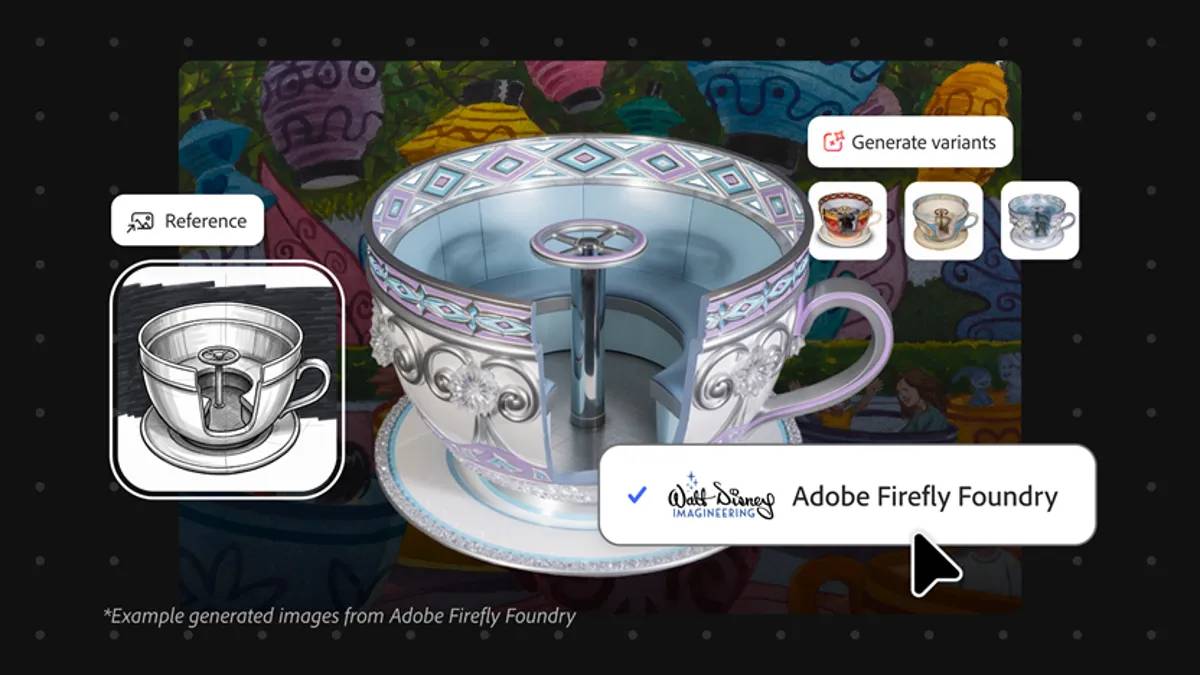
Disney Imagineers are using Adobe Firefly to generate early-stage visual concepts for rides, environments, and immersive storytelling experiences.

June 17, 2026
|
Image Source: CNET

Disney’s Imagineering division is adopting Adobe’s Firefly generative AI to support the conceptual design of theme park rides and attractions. The collaboration signals a shift toward AI-assisted creativity in large-scale entertainment engineering, where generative tools are increasingly influencing early-stage ideation, visual prototyping, and immersive experience development.

Disney Imagineers are using Adobe Firefly to generate early-stage visual concepts for rides, environments, and immersive storytelling experiences. The tool helps designers rapidly iterate on themes, layouts, and aesthetic directions before moving into full engineering and production phases.

Adobe Firefly, designed for commercially safe generative content creation, integrates into creative workflows used across film, gaming, and experience design industries. Disney’s adoption indicates increasing trust in AI-assisted ideation for high-value intellectual property environments. The system is not replacing human designers but augmenting early creative stages, enabling faster experimentation and broader conceptual exploration across attraction development pipelines.

The entertainment and theme park industry has long relied on highly specialized creative teams combining storytelling, architecture, and engineering. However, rising production complexity and demand for immersive experiences have pushed studios to explore AI-assisted workflows.

Generative AI tools like Adobe Firefly are increasingly being integrated into creative industries as productivity enhancers rather than replacements for human creativity. Disney’s Imagineering unit, known for designing globally recognized attractions, represents one of the most influential use cases for experiential design innovation.

This development aligns with a broader industry trend where media, gaming, and entertainment companies are adopting generative AI to accelerate ideation cycles, reduce pre-production timelines, and explore more design variations at lower cost. It also reflects the growing convergence between creative technology and industrial-scale experience engineering.

Industry analysts view Disney’s adoption of Firefly as a significant validation of generative AI in high-end creative production environments. Unlike consumer-facing AI applications, theme park design requires high fidelity, brand consistency, and strict intellectual property control.

Creative technology experts note that Adobe’s positioning of Firefly as a commercially safe model makes it particularly suitable for enterprise-grade entertainment workflows. This reduces legal uncertainty around training data and output usage, which has been a key concern in creative industries.

Design strategists suggest that AI tools will increasingly function as “idea accelerators,” enabling designers to explore hundreds of conceptual variations before narrowing down to production-ready assets. However, experts emphasize that human storytelling judgment remains central to final attraction design decisions.

For entertainment companies, this shift could significantly reduce early-stage design cycles and increase experimentation in attraction development, potentially lowering conceptual costs while expanding creative output. It may also influence how theme parks plan future immersive experiences.

For technology vendors like Adobe, partnerships with legacy entertainment giants strengthen the enterprise positioning of generative AI tools beyond marketing or content creation into industrial design and spatial experience engineering.

From a policy perspective, increased reliance on generative AI in creative IP environments may raise questions about authorship, originality, and intellectual property ownership, especially as AI-generated concepts move closer to production pipelines in high-value entertainment sectors.

The next phase of adoption will likely focus on deeper integration of generative AI into 3D modeling, spatial simulation, and ride engineering workflows. The key variable will be how far AI-generated concepts influence final production decisions versus remaining in ideation stages. If successful, Disney’s approach could set a precedent for AI-driven creative pipelines across global entertainment and experience design industries.

Source: CNET
Date: June 2026

  • Featured tools
Wonder AI
Free

Wonder AI is a versatile AI-powered creative platform that generates text, images, and audio with minimal input, designed for fast storytelling, visual creation, and audio content generation

#
Art Generator
Learn more
Murf Ai
Free

Murf AI Review – Advanced AI Voice Generator for Realistic Voiceovers

#
Text to Speech
Learn more

Learn more about future of AI

Join 80,000+ Ai enthusiast getting weekly updates on exciting AI tools.
Thank you! Your submission has been received!
Oops! Something went wrong while submitting the form.

Disney Imagineering Uses Adobe Firefly AI Design

June 17, 2026

Disney Imagineers are using Adobe Firefly to generate early-stage visual concepts for rides, environments, and immersive storytelling experiences.

Image Source: CNET

Disney’s Imagineering division is adopting Adobe’s Firefly generative AI to support the conceptual design of theme park rides and attractions. The collaboration signals a shift toward AI-assisted creativity in large-scale entertainment engineering, where generative tools are increasingly influencing early-stage ideation, visual prototyping, and immersive experience development.

Disney Imagineers are using Adobe Firefly to generate early-stage visual concepts for rides, environments, and immersive storytelling experiences. The tool helps designers rapidly iterate on themes, layouts, and aesthetic directions before moving into full engineering and production phases.

Adobe Firefly, designed for commercially safe generative content creation, integrates into creative workflows used across film, gaming, and experience design industries. Disney’s adoption indicates increasing trust in AI-assisted ideation for high-value intellectual property environments. The system is not replacing human designers but augmenting early creative stages, enabling faster experimentation and broader conceptual exploration across attraction development pipelines.

The entertainment and theme park industry has long relied on highly specialized creative teams combining storytelling, architecture, and engineering. However, rising production complexity and demand for immersive experiences have pushed studios to explore AI-assisted workflows.

Generative AI tools like Adobe Firefly are increasingly being integrated into creative industries as productivity enhancers rather than replacements for human creativity. Disney’s Imagineering unit, known for designing globally recognized attractions, represents one of the most influential use cases for experiential design innovation.

This development aligns with a broader industry trend where media, gaming, and entertainment companies are adopting generative AI to accelerate ideation cycles, reduce pre-production timelines, and explore more design variations at lower cost. It also reflects the growing convergence between creative technology and industrial-scale experience engineering.

Industry analysts view Disney’s adoption of Firefly as a significant validation of generative AI in high-end creative production environments. Unlike consumer-facing AI applications, theme park design requires high fidelity, brand consistency, and strict intellectual property control.

Creative technology experts note that Adobe’s positioning of Firefly as a commercially safe model makes it particularly suitable for enterprise-grade entertainment workflows. This reduces legal uncertainty around training data and output usage, which has been a key concern in creative industries.

Design strategists suggest that AI tools will increasingly function as “idea accelerators,” enabling designers to explore hundreds of conceptual variations before narrowing down to production-ready assets. However, experts emphasize that human storytelling judgment remains central to final attraction design decisions.

For entertainment companies, this shift could significantly reduce early-stage design cycles and increase experimentation in attraction development, potentially lowering conceptual costs while expanding creative output. It may also influence how theme parks plan future immersive experiences.

For technology vendors like Adobe, partnerships with legacy entertainment giants strengthen the enterprise positioning of generative AI tools beyond marketing or content creation into industrial design and spatial experience engineering.

From a policy perspective, increased reliance on generative AI in creative IP environments may raise questions about authorship, originality, and intellectual property ownership, especially as AI-generated concepts move closer to production pipelines in high-value entertainment sectors.

The next phase of adoption will likely focus on deeper integration of generative AI into 3D modeling, spatial simulation, and ride engineering workflows. The key variable will be how far AI-generated concepts influence final production decisions versus remaining in ideation stages. If successful, Disney’s approach could set a precedent for AI-driven creative pipelines across global entertainment and experience design industries.

Source: CNET
Date: June 2026

Promote Your Tool

Copy Embed Code

Similar Blogs

June 19, 2026
|

Apple iPhone Camera Controls Expand AI

The report outlines how users can modify or disable AI-assisted camera functions on Apple iPhone devices, particularly features that influence image processing and computational enhancements.
Read more
June 19, 2026
|

Samsung Expands Galaxy AI Controls Push

The guide details how users can adjust or disable AI-driven features on Samsung Galaxy smartphones, including tools integrated into Samsung Galaxy smartphones.
Read more
June 19, 2026
|

Google Expands Smart Home Ecosystem

The latest compilation of Google voice commands focuses on how users can interact with Google Assistant and connected smart home systems. Commands span entertainment, home automation, productivity, navigation.
Read more
June 19, 2026
|

AI Dating Apps Face User Backlash

Survey data indicates that while adoption of AI-based dating assistants and companion tools is increasing, user sentiment is becoming increasingly polarized.
Read more
June 19, 2026
|

Apple Signals Price Hikes Amid Cost Pressures

Apple CEO Tim Cook indicated that escalating costs tied to components such as memory, advanced processors, and logistics are becoming structurally embedded across the company’s manufacturing pipeline.
Read more
June 19, 2026
|

Adobe Embeds AI Assistants Across Tools

Adobe is positioning these assistants as task-oriented agents capable of handling repetitive editing workflows such as object removal.
Read more