
Flint AI Advances Autonomous Web Platform for Marketers

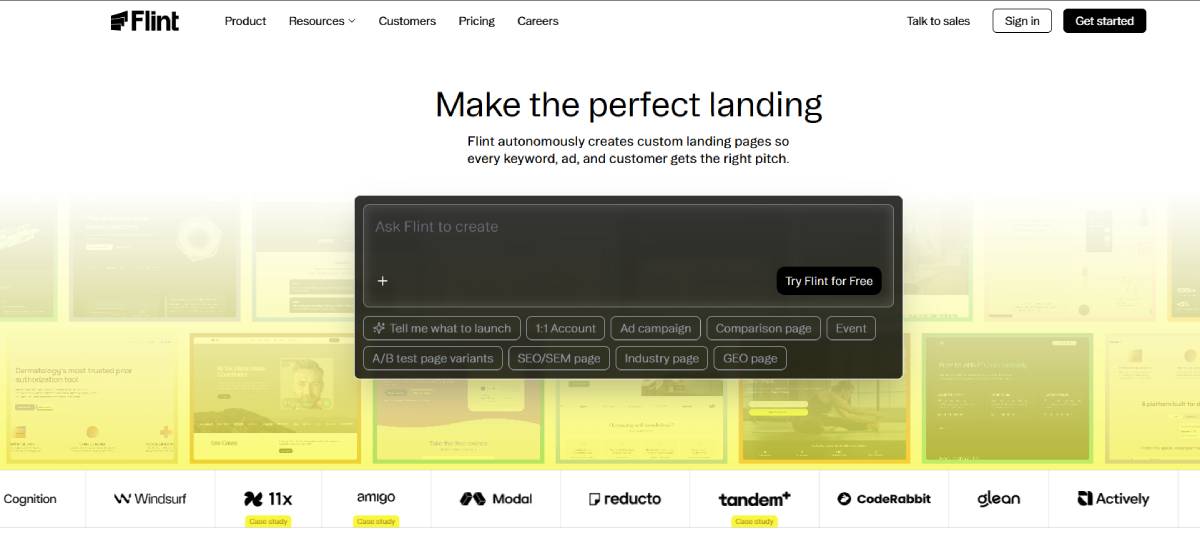
Flint AI positions itself as an AI-native infrastructure layer for marketing teams, enabling automated website creation, content deployment, performance tracking, and optimisation workflows.

March 4, 2026
|

A major development unfolded in the martech sector as Flint AI introduced its autonomous web platform designed to help marketing teams build, manage, and optimise digital experiences with minimal manual intervention. The shift signals a strategic redefinition of how enterprises deploy AI to drive growth, conversion, and operational efficiency.

Flint AI positions itself as an AI-native infrastructure layer for marketing teams, enabling automated website creation, content deployment, performance tracking, and optimisation workflows.

The platform leverages machine learning to analyse user behaviour, generate dynamic landing pages, and iterate campaigns in real time. By reducing dependency on traditional development cycles, Flint AI aims to compress go-to-market timelines for startups and enterprise brands alike.

Its expansion comes as companies worldwide seek scalable digital acquisition strategies amid tightening budgets and rising customer acquisition costs. The company’s model reflects a broader push toward AI-driven autonomy in enterprise operations.

The development aligns with a broader global trend where artificial intelligence is increasingly embedded in marketing technology stacks. Over the past decade, digital transformation initiatives have shifted advertising and customer engagement online, but execution often remained resource-intensive.

The post-pandemic acceleration of e-commerce and digital-first consumer behaviour has intensified competition for online visibility. At the same time, macroeconomic pressures have forced companies to demand measurable ROI from marketing spend.

Historically, marketing automation focused on email campaigns and CRM workflows. The new frontier extends automation to full-stack web operations content generation, UX testing, conversion optimisation, and analytics integration. Platforms like Flint AI reflect the evolution from tool-based marketing to AI-orchestrated digital ecosystems.

For CXOs, the convergence of AI and martech represents not just incremental efficiency, but structural cost transformation. Industry analysts argue that autonomous web platforms could redefine marketing team structures. Experts suggest solutions such as Flint AI may reduce reliance on large in-house development and design teams by automating repetitive digital tasks.

Digital strategy consultants highlight the growing appeal of AI-powered optimisation engines capable of continuous A/B testing and adaptive content personalisation. However, governance experts caution that algorithmic marketing decisions must align with brand integrity, data privacy regulations, and consumer protection standards.

Martech investors note that platforms integrating AI directly into revenue-generation channels are likely to attract sustained capital interest. The competitive differentiator, analysts say, will hinge on data security, performance transparency, and seamless integration with enterprise CRM and analytics systems.

For global executives, AI-driven web autonomy could significantly reduce operational overhead and accelerate digital scaling strategies. Marketing leaders may shift focus from execution management to strategic oversight and performance analytics.

Investors are expected to evaluate AI-native marketing infrastructure providers as potential high-growth assets within the broader SaaS ecosystem. Meanwhile, regulators may intensify scrutiny around automated decision-making in advertising, particularly concerning consumer data usage and transparency.

Enterprises adopting such platforms will need to reassess workforce structures, vendor dependencies, and compliance protocols in an increasingly AI-mediated digital economy. As AI penetration deepens across enterprise functions, autonomous marketing platforms are likely to evolve toward full revenue-stack integration. Decision-makers should monitor adoption metrics, cross-border regulatory developments, and competitive responses from established martech giants.

The broader question remains whether AI autonomy will complement marketing teams or fundamentally restructure how digital growth strategies are executed worldwide.

Source: Flint AI Official Website
Date: March 4, 2026

  • Featured tools
Wonder AI
Free

Wonder AI is a versatile AI-powered creative platform that generates text, images, and audio with minimal input, designed for fast storytelling, visual creation, and audio content generation

#
Art Generator
Learn more
Kreateable AI
Free

Kreateable AI is a white-label, AI-driven design platform that enables logo generation, social media posts, ads, and more for businesses, agencies, and service providers.

#
Logo Generator
Learn more

Learn more about future of AI

Join 80,000+ Ai enthusiast getting weekly updates on exciting AI tools.
Thank you! Your submission has been received!
Oops! Something went wrong while submitting the form.

Flint AI Advances Autonomous Web Platform for Marketers

March 4, 2026

Flint AI positions itself as an AI-native infrastructure layer for marketing teams, enabling automated website creation, content deployment, performance tracking, and optimisation workflows.

A major development unfolded in the martech sector as Flint AI introduced its autonomous web platform designed to help marketing teams build, manage, and optimise digital experiences with minimal manual intervention. The shift signals a strategic redefinition of how enterprises deploy AI to drive growth, conversion, and operational efficiency.

Flint AI positions itself as an AI-native infrastructure layer for marketing teams, enabling automated website creation, content deployment, performance tracking, and optimisation workflows.

The platform leverages machine learning to analyse user behaviour, generate dynamic landing pages, and iterate campaigns in real time. By reducing dependency on traditional development cycles, Flint AI aims to compress go-to-market timelines for startups and enterprise brands alike.

Its expansion comes as companies worldwide seek scalable digital acquisition strategies amid tightening budgets and rising customer acquisition costs. The company’s model reflects a broader push toward AI-driven autonomy in enterprise operations.

The development aligns with a broader global trend where artificial intelligence is increasingly embedded in marketing technology stacks. Over the past decade, digital transformation initiatives have shifted advertising and customer engagement online, but execution often remained resource-intensive.

The post-pandemic acceleration of e-commerce and digital-first consumer behaviour has intensified competition for online visibility. At the same time, macroeconomic pressures have forced companies to demand measurable ROI from marketing spend.

Historically, marketing automation focused on email campaigns and CRM workflows. The new frontier extends automation to full-stack web operations content generation, UX testing, conversion optimisation, and analytics integration. Platforms like Flint AI reflect the evolution from tool-based marketing to AI-orchestrated digital ecosystems.

For CXOs, the convergence of AI and martech represents not just incremental efficiency, but structural cost transformation. Industry analysts argue that autonomous web platforms could redefine marketing team structures. Experts suggest solutions such as Flint AI may reduce reliance on large in-house development and design teams by automating repetitive digital tasks.

Digital strategy consultants highlight the growing appeal of AI-powered optimisation engines capable of continuous A/B testing and adaptive content personalisation. However, governance experts caution that algorithmic marketing decisions must align with brand integrity, data privacy regulations, and consumer protection standards.

Martech investors note that platforms integrating AI directly into revenue-generation channels are likely to attract sustained capital interest. The competitive differentiator, analysts say, will hinge on data security, performance transparency, and seamless integration with enterprise CRM and analytics systems.

For global executives, AI-driven web autonomy could significantly reduce operational overhead and accelerate digital scaling strategies. Marketing leaders may shift focus from execution management to strategic oversight and performance analytics.

Investors are expected to evaluate AI-native marketing infrastructure providers as potential high-growth assets within the broader SaaS ecosystem. Meanwhile, regulators may intensify scrutiny around automated decision-making in advertising, particularly concerning consumer data usage and transparency.

Enterprises adopting such platforms will need to reassess workforce structures, vendor dependencies, and compliance protocols in an increasingly AI-mediated digital economy. As AI penetration deepens across enterprise functions, autonomous marketing platforms are likely to evolve toward full revenue-stack integration. Decision-makers should monitor adoption metrics, cross-border regulatory developments, and competitive responses from established martech giants.

The broader question remains whether AI autonomy will complement marketing teams or fundamentally restructure how digital growth strategies are executed worldwide.

Source: Flint AI Official Website
Date: March 4, 2026

Promote Your Tool

Copy Embed Code

Similar Blogs

March 4, 2026
|

Monica Launches Unified AI Assistant with GPT-5.2, Claude, Gemini

Monica’s new platform unifies three leading AI models into a single interface, allowing users to leverage generative text, contextual reasoning, and multi-modal insights.
Read more
March 4, 2026
|

CrowdStrike Boosts Earnings Outlook Amid AI Cybersecurity Surge

CrowdStrike reported stronger-than-expected guidance for the upcoming fiscal year, reflecting accelerated adoption of AI-powered threat detection and response tools.
Read more
March 4, 2026
|

Gemini AI Targets Grocery, Ride-Hailing, Challenges Instacart Uber

Gemini AI is preparing to launch features allowing users to order groceries and schedule rides through conversational AI interfaces.
Read more
March 4, 2026
|

Meta Forms Dedicated AI Unit to Accelerate Model Development

Meta has created a dedicated artificial intelligence division aimed at speeding up research, productization, and deployment of advanced AI models.
Read more
March 4, 2026
|

Digital Realty Eyes $10 Billion Revenue Amid AI Boom

Digital Realty, one of the world’s largest data center real estate investment trusts (REITs), has projected it will surpass $10 billion in annual revenue for the first time.
Read more
March 4, 2026
|

Google Ties Pixel Customization to AI, Reinforcing Platform Control Strategy

Google is rolling out AI-generated custom app icons for Pixel users, but the functionality is tied exclusively to its proprietary AI tools rather than open customization frameworks.
Read more