
Google Advances Medical AI Frontier

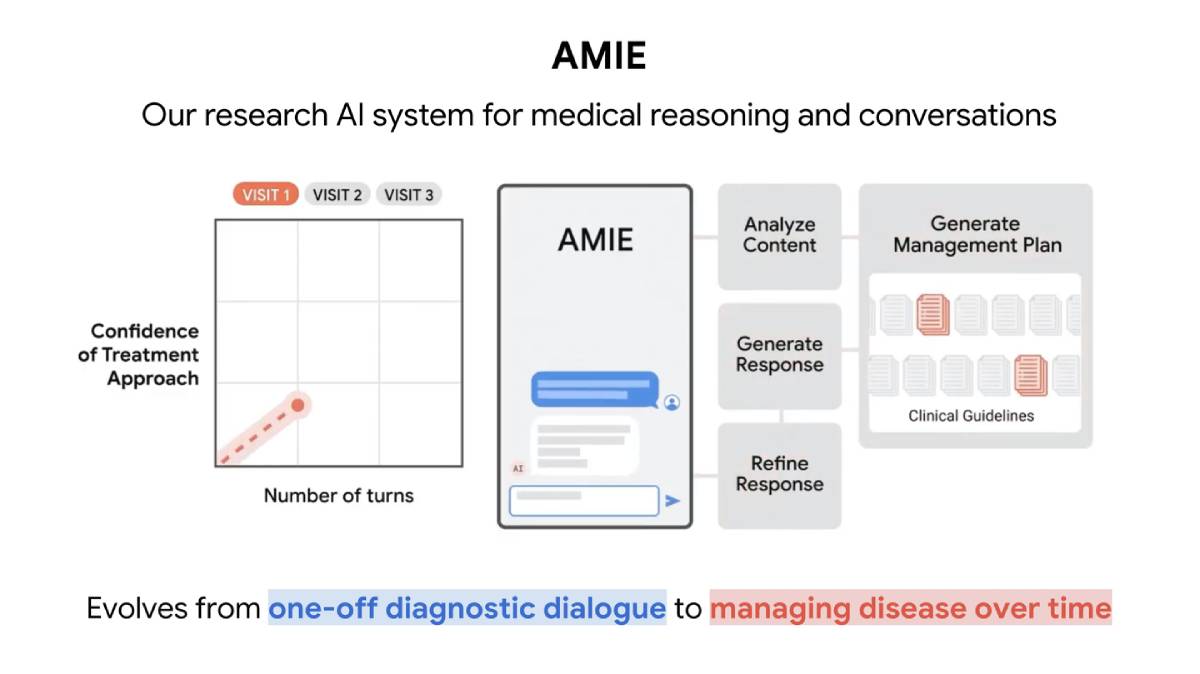
Google’s research into its AI medical assistant AMIE demonstrates potential applications in supporting disease management through conversational diagnostics, patient interaction, and clinical reasoning assistance.

June 18, 2026
|

A major development in healthcare artificial intelligence has emerged as Google research highlights new findings showing how its medical AI system, AMIE, could assist in managing health conditions. The advancement signals a strategic shift toward AI-supported clinical decision-making, with implications for healthcare providers, patients, regulators, and the broader digital health ecosystem globally.

Google’s research into its AI medical assistant AMIE demonstrates potential applications in supporting disease management through conversational diagnostics, patient interaction, and clinical reasoning assistance.

The study explores how AMIE can simulate diagnostic conversations and provide structured medical guidance, potentially enhancing healthcare accessibility and supporting clinicians in routine case management. The research is positioned as an experimental step toward integrating AI into clinical workflows rather than replacing medical professionals.

Key stakeholders include Google Research, healthcare providers, patients, medical institutions, and regulatory authorities overseeing digital health technologies. The development reflects increasing interest in applying large language models to healthcare challenges such as triage support, chronic disease management, and patient engagement.

The findings also highlight ongoing efforts to validate AI systems in real-world medical contexts under controlled and ethically supervised conditions. The development aligns with a broader trend across global markets where artificial intelligence is increasingly being applied to healthcare delivery and medical research. Over the past decade, digital health tools have evolved from basic telemedicine platforms to advanced AI-assisted diagnostic systems capable of analyzing complex patient data.

Historically, healthcare systems have faced persistent challenges including physician shortages, uneven access to care, rising costs, and increasing demand from aging populations. AI-driven tools are being explored as a potential solution to improve efficiency and expand access to basic medical support services.

Geopolitically, healthcare innovation has become a strategic priority for governments seeking to improve public health infrastructure and reduce system burdens. Countries are investing heavily in digital health ecosystems, AI diagnostics, and data-driven healthcare platforms.

Google’s AMIE research builds on a broader wave of AI experimentation in medicine, where systems are being tested for applications ranging from radiology interpretation to patient triage and chronic disease monitoring.

Medical AI researchers suggest that systems like AMIE could play a significant role in augmenting healthcare delivery by assisting clinicians with structured decision support and patient interaction workflows. Experts emphasize that such systems are not intended to replace doctors but to enhance efficiency and accessibility in clinical environments.

Healthcare analysts note that conversational AI models may help reduce administrative burden on medical professionals, allowing them to focus more on complex cases requiring human judgment. However, they also stress the importance of rigorous validation, clinical trials, and regulatory oversight before widespread deployment.

Ethical and medical governance experts highlight concerns around accuracy, bias, patient safety, and accountability in AI-driven healthcare systems. They argue that transparency in model training data and decision logic will be critical for clinical adoption.

Industry observers point out that major technology firms are increasingly collaborating with healthcare institutions to test AI systems under real-world conditions, signaling a gradual shift toward AI-integrated healthcare ecosystems.

For global executives in healthcare and technology, the shift could redefine digital health strategies, particularly in telemedicine, diagnostics, and patient engagement platforms. Healthcare providers may increasingly adopt AI tools to improve efficiency and expand service capacity.

Investors are likely to view medical AI as a high-growth sector, with strong long-term potential driven by demand for scalable healthcare solutions. However, regulatory uncertainty and clinical validation requirements may influence adoption timelines.

From a policy perspective, governments and health regulators will need to establish robust frameworks for AI-driven medical tools, focusing on safety, accountability, and ethical use. Healthcare systems may also need to update guidelines for integrating AI into clinical workflows.

The future of AI in healthcare will depend on clinical validation, regulatory approval, and real-world performance outcomes. Decision-makers should monitor advancements in medical AI trials, integration into hospital systems, and evolving healthcare regulations. While tools like AMIE show strong potential, widespread adoption will require careful balancing of innovation with patient safety and ethical responsibility. Organizations that successfully align AI with clinical standards are likely to lead the next phase of healthcare transformation.

Source: Google Blog
Date: June 18, 2026

  • Featured tools
Figstack AI
Free

Figstack AI is an intelligent assistant for developers that explains code, generates docstrings, converts code between languages, and analyzes time complexity helping you work smarter, not harder.

#
Coding
Learn more
Outplay AI
Free

Outplay AI is a dynamic sales engagement platform combining AI-powered outreach, multi-channel automation, and performance tracking to help teams optimize conversion and pipeline generation.

#
Sales
Learn more

Learn more about future of AI

Join 80,000+ Ai enthusiast getting weekly updates on exciting AI tools.
Thank you! Your submission has been received!
Oops! Something went wrong while submitting the form.

Google Advances Medical AI Frontier

June 18, 2026

Google’s research into its AI medical assistant AMIE demonstrates potential applications in supporting disease management through conversational diagnostics, patient interaction, and clinical reasoning assistance.

A major development in healthcare artificial intelligence has emerged as Google research highlights new findings showing how its medical AI system, AMIE, could assist in managing health conditions. The advancement signals a strategic shift toward AI-supported clinical decision-making, with implications for healthcare providers, patients, regulators, and the broader digital health ecosystem globally.

Google’s research into its AI medical assistant AMIE demonstrates potential applications in supporting disease management through conversational diagnostics, patient interaction, and clinical reasoning assistance.

The study explores how AMIE can simulate diagnostic conversations and provide structured medical guidance, potentially enhancing healthcare accessibility and supporting clinicians in routine case management. The research is positioned as an experimental step toward integrating AI into clinical workflows rather than replacing medical professionals.

Key stakeholders include Google Research, healthcare providers, patients, medical institutions, and regulatory authorities overseeing digital health technologies. The development reflects increasing interest in applying large language models to healthcare challenges such as triage support, chronic disease management, and patient engagement.

The findings also highlight ongoing efforts to validate AI systems in real-world medical contexts under controlled and ethically supervised conditions. The development aligns with a broader trend across global markets where artificial intelligence is increasingly being applied to healthcare delivery and medical research. Over the past decade, digital health tools have evolved from basic telemedicine platforms to advanced AI-assisted diagnostic systems capable of analyzing complex patient data.

Historically, healthcare systems have faced persistent challenges including physician shortages, uneven access to care, rising costs, and increasing demand from aging populations. AI-driven tools are being explored as a potential solution to improve efficiency and expand access to basic medical support services.

Geopolitically, healthcare innovation has become a strategic priority for governments seeking to improve public health infrastructure and reduce system burdens. Countries are investing heavily in digital health ecosystems, AI diagnostics, and data-driven healthcare platforms.

Google’s AMIE research builds on a broader wave of AI experimentation in medicine, where systems are being tested for applications ranging from radiology interpretation to patient triage and chronic disease monitoring.

Medical AI researchers suggest that systems like AMIE could play a significant role in augmenting healthcare delivery by assisting clinicians with structured decision support and patient interaction workflows. Experts emphasize that such systems are not intended to replace doctors but to enhance efficiency and accessibility in clinical environments.

Healthcare analysts note that conversational AI models may help reduce administrative burden on medical professionals, allowing them to focus more on complex cases requiring human judgment. However, they also stress the importance of rigorous validation, clinical trials, and regulatory oversight before widespread deployment.

Ethical and medical governance experts highlight concerns around accuracy, bias, patient safety, and accountability in AI-driven healthcare systems. They argue that transparency in model training data and decision logic will be critical for clinical adoption.

Industry observers point out that major technology firms are increasingly collaborating with healthcare institutions to test AI systems under real-world conditions, signaling a gradual shift toward AI-integrated healthcare ecosystems.

For global executives in healthcare and technology, the shift could redefine digital health strategies, particularly in telemedicine, diagnostics, and patient engagement platforms. Healthcare providers may increasingly adopt AI tools to improve efficiency and expand service capacity.

Investors are likely to view medical AI as a high-growth sector, with strong long-term potential driven by demand for scalable healthcare solutions. However, regulatory uncertainty and clinical validation requirements may influence adoption timelines.

From a policy perspective, governments and health regulators will need to establish robust frameworks for AI-driven medical tools, focusing on safety, accountability, and ethical use. Healthcare systems may also need to update guidelines for integrating AI into clinical workflows.

The future of AI in healthcare will depend on clinical validation, regulatory approval, and real-world performance outcomes. Decision-makers should monitor advancements in medical AI trials, integration into hospital systems, and evolving healthcare regulations. While tools like AMIE show strong potential, widespread adoption will require careful balancing of innovation with patient safety and ethical responsibility. Organizations that successfully align AI with clinical standards are likely to lead the next phase of healthcare transformation.

Source: Google Blog
Date: June 18, 2026

Promote Your Tool

Copy Embed Code

Similar Blogs

June 18, 2026
|

AI Paradox Deepens as Skepticism Grows

Recent survey findings indicate that while Americans are increasingly cautious about the long-term impact of artificial intelligence, actual usage of AI tools continues to expand across professional and personal contexts.
Read more
June 18, 2026
|

Illinois Restricts Smart Glasses While Driving

Illinois lawmakers are evaluating legislation that would prohibit the use of smart glasses while operating a vehicle, citing concerns over distraction and impaired driver attention.
Read more
June 18, 2026
|

Anthropic Unifies AI Coding Design Workflow

Anthropic has expanded its Claude platform to bring together AI-assisted design and coding functionalities into a more integrated developer experience.
Read more
June 18, 2026
|

Creator Camera Wars Intensify Premium Segment

The Insta360 Luna Ultra and DJI Osmo Pocket 4 represent the latest generation of compact, high-performance cameras designed for vloggers, filmmakers, and social media content creators.
Read more
June 18, 2026
|

VSCO Targets Premium Creator Economy Push

VSCO has introduced “Studio Pro,” a mobile-first photo editing application designed to provide advanced creative tools for professional photographers, content creators, and digital media teams.
Read more
June 18, 2026
|

Apple Pricing Shift on Rising RAM Costs

Apple leadership has pointed to escalating memory (RAM) costs as a key driver of financial pressure within its hardware supply chain, suggesting that future product pricing adjustments may be necessary to maintain margins.
Read more