



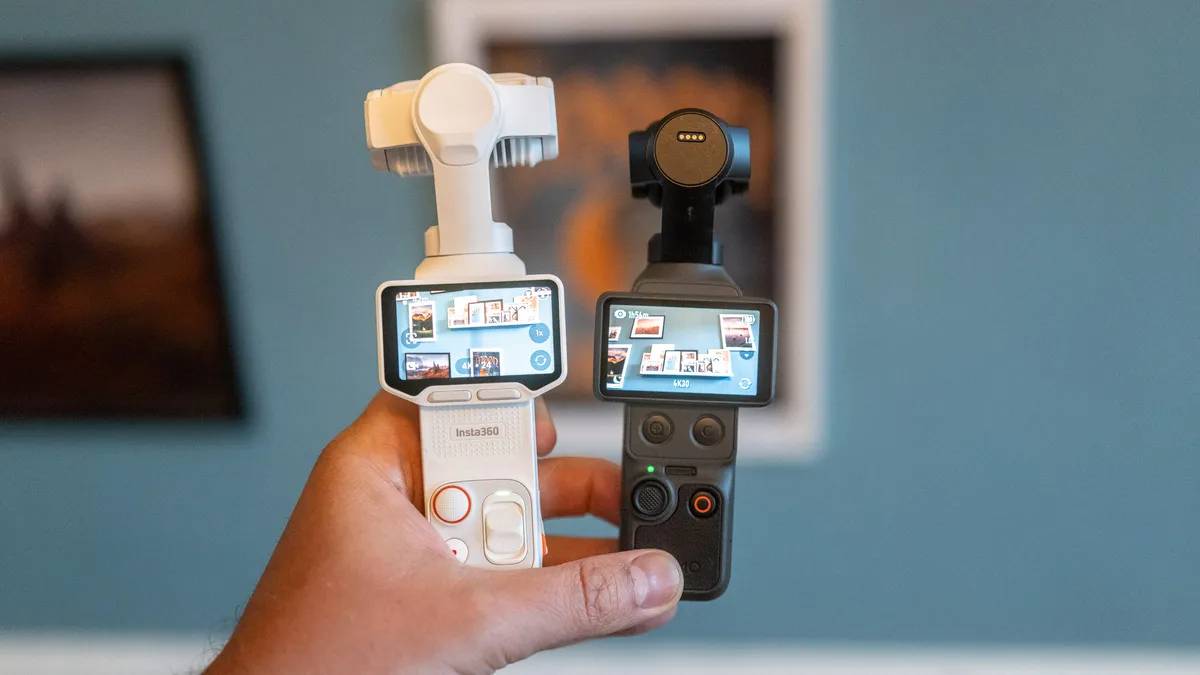
A major development in the compact creator camera market has emerged as Insta360’s Luna Ultra enters direct competition with DJI’s Osmo Pocket 4, signaling a strategic escalation in the battle for dominance in portable content creation devices. The comparison highlights intensifying innovation in mobile filmmaking tools, with implications for creators, tech manufacturers, and the rapidly expanding digital content economy.
The Insta360 Luna Ultra and DJI Osmo Pocket 4 represent the latest generation of compact, high-performance cameras designed for vloggers, filmmakers, and social media content creators.
Recent hands-on comparisons indicate that both devices are competing closely in areas such as stabilization, low-light performance, AI-assisted shooting modes, and portability. The devices aim to deliver professional-grade video capture in pocket-sized form factors, targeting creators who prioritize mobility without sacrificing quality.
Key stakeholders include Insta360, DJI, content creators, influencer marketing agencies, and consumer electronics distributors. The competition reflects a broader push among hardware manufacturers to capture market share in the growing creator economy, where demand for high-quality, mobile-first production tools continues to rise.
The rivalry also underscores increasing integration of AI features into imaging devices, including automated framing, subject tracking, and intelligent scene optimization. The development aligns with a broader trend across global markets where the creator economy is driving rapid innovation in compact imaging technology. Over the past decade, traditional DSLR and mirrorless systems have increasingly been complemented or in some cases replaced by lightweight, AI-enhanced portable cameras optimized for digital-first platforms.
Historically, camera innovation has shifted from professional studio equipment to consumer-friendly devices as platforms like YouTube, TikTok, and Instagram have transformed content creation into a mainstream economic activity. This has created sustained demand for devices that balance quality, portability, and automation.
Geopolitically and economically, consumer electronics manufacturers are competing in a highly saturated global market, where differentiation increasingly depends on software capabilities rather than hardware alone. AI-driven imaging features are becoming a key battleground for product differentiation.
In this context, both Insta360 and DJI are positioning themselves as leaders in next-generation content creation ecosystems, where hardware and AI software are deeply integrated.
Industry analysts suggest that the compact camera market is entering a phase of intense competition driven by AI-enhanced functionality rather than purely hardware improvements. Experts note that stabilization, computational photography, and real-time editing capabilities are now central to product differentiation.
Creative technology reviewers emphasize that DJI has historically dominated the handheld stabilization segment, while Insta360 has gained traction through innovation in 360-degree capture and software-based imaging tools. The convergence of these strengths is intensifying competition.
Market observers highlight that creator demand is increasingly shaped by platform algorithms that reward high-quality, short-form video content, pushing manufacturers to optimize devices for speed, automation, and social media integration.
Industry commentators also point out that AI-assisted shooting features could become the defining factor in next-generation cameras, as creators prioritize ease of use alongside professional output quality.
For global executives, the shift could redefine product strategy in the consumer electronics and imaging industries, particularly as AI becomes a core differentiator in hardware design. Companies may need to invest more heavily in software ecosystems alongside physical devices.
Investors are likely to view the creator hardware segment as a high-growth niche, driven by sustained demand from influencers, brands, and digital media companies. Competitive positioning will depend on innovation speed and ecosystem integration.
From a policy perspective, consumer electronics competition is expected to remain market-driven, though data privacy concerns may emerge as AI-enabled cameras increasingly process user content in real time.
The competition between Insta360 and DJI is expected to intensify as both companies push deeper into AI-powered imaging and software integration. Decision-makers should watch for product ecosystem expansions, firmware-driven feature upgrades, and creator adoption trends. While hardware performance remains important, the future of compact cameras will likely be defined by AI-driven creative capabilities and platform compatibility.
Source: CNET
Date: June 18, 2026


