



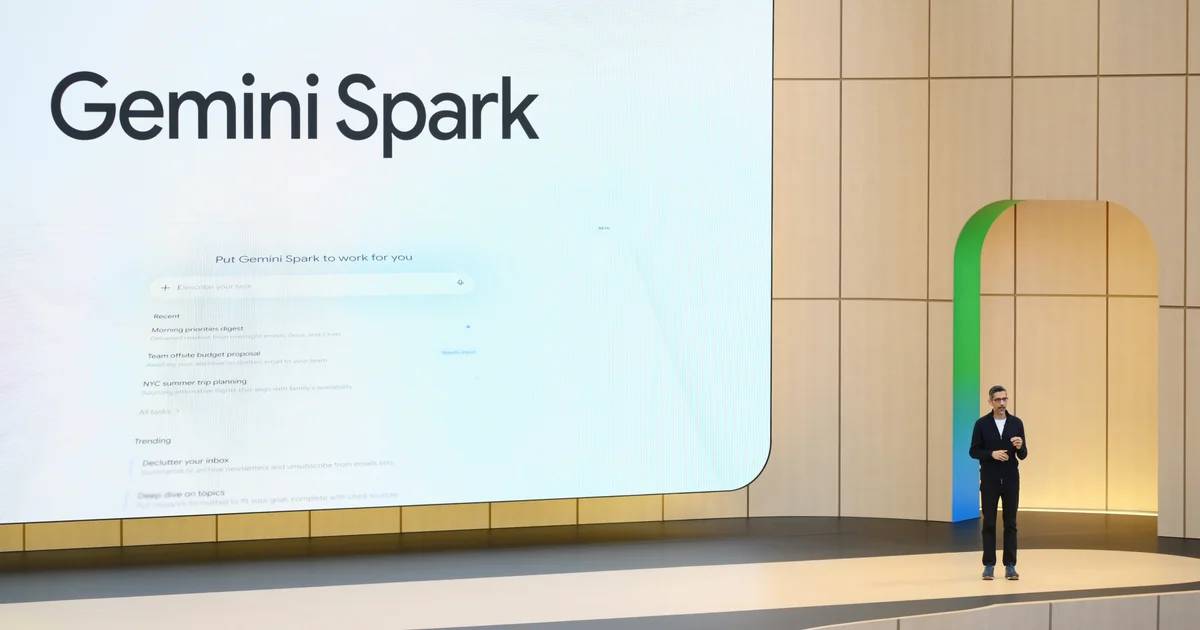
Google is drawing attention with its Gemini Spark AI agent, a new system designed to function as a more autonomous and context-aware digital assistant across tasks, workflows, and user interactions. The development underscores accelerating competition in agentic AI systems, where technology firms are moving beyond chat-based models toward tools capable of executing complex multi-step actions for consumers and enterprises.
Gemini Spark is being positioned as an AI agent capable of handling more advanced reasoning and task execution compared to traditional conversational models. The system is designed to assist users with multi-stage workflows, integrating planning, information retrieval, and action-oriented outputs within a single interface. Google’s approach reflects its broader strategy of embedding AI deeply across its ecosystem, including search, productivity tools, and enterprise services.
The launch comes as major technology companies race to develop “agentic AI” systems, a category of artificial intelligence designed to perform tasks with greater autonomy, moving beyond passive response generation toward active digital assistance.
The emergence of AI agents such as Gemini Spark reflects a broader shift in artificial intelligence development from conversational models to autonomous systems capable of executing complex digital tasks. This transition is widely viewed as the next phase in AI evolution, following the rapid adoption of large language models.
AI agents are being developed to perform functions such as scheduling, research synthesis, workflow automation, decision support, and multi-step task completion without continuous user prompting. This represents a significant shift in how individuals and organizations interact with digital systems.
The competitive landscape is intensifying as companies including OpenAI, Microsoft, and Anthropic invest heavily in agent-based AI architectures. These systems are increasingly seen as foundational to future workplace productivity platforms and enterprise software ecosystems.
From a historical perspective, the development of AI agents parallels earlier technological transitions such as the shift from desktop computing to mobile ecosystems and from static software tools to cloud-based platforms. Each phase has fundamentally reshaped productivity, communication, and digital workflows.
The broader economic context is equally significant. Businesses are under growing pressure to improve efficiency, reduce operational costs, and automate complex workflows, making AI agents a potentially transformative force across industries including finance, healthcare, logistics, and professional services.
Industry analysts say AI agents like Gemini Spark represent a strategic inflection point in the evolution of artificial intelligence. Experts argue that while chatbots improved access to information, agentic systems aim to fundamentally change how work is executed by automating sequences of tasks rather than individual responses.
Technology observers note that the success of AI agents will depend heavily on reliability, safety, and integration with existing digital ecosystems. Concerns remain around errors in autonomous decision-making, data privacy, and the potential for unintended actions when systems operate with reduced human oversight.
Enterprise analysts highlight strong commercial potential, particularly in productivity software, enterprise resource planning, and customer service automation. Companies are expected to explore AI agents as a way to reduce manual workloads and increase operational efficiency across knowledge-based roles.
However, experts also caution that widespread adoption will require robust governance frameworks. Issues such as accountability, transparency, and user control will be critical in determining whether AI agents can be safely deployed at scale in business and consumer environments.
Google executives emphasize that Gemini Spark is designed to enhance user productivity by combining intelligence with structured task execution, while maintaining oversight mechanisms to ensure responsible use.
For businesses, Gemini Spark signals a shift toward AI-driven automation of end-to-end workflows rather than isolated tasks. This could significantly impact productivity software, enterprise operations, and digital service delivery models across industries.
Investors are likely to view agentic AI as one of the most important emerging segments in the technology sector, with potential to reshape enterprise software markets and cloud computing demand. Companies that successfully integrate AI agents into scalable platforms may gain substantial competitive advantages.
From a policy perspective, regulators may increasingly focus on the risks associated with autonomous AI systems, particularly around accountability, data security, and decision-making transparency. Governments are expected to examine how agentic systems interact with sensitive information and critical infrastructure.
Attention will now shift toward real-world performance, adoption rates, and safety outcomes as Gemini Spark and similar AI agents move from demonstration to deployment. Businesses and policymakers will closely monitor how effectively these systems integrate into existing workflows without introducing operational risk.
The broader trajectory suggests that AI is entering a new phase where systems do not just respond to users—but actively execute tasks on their behalf, reshaping the structure of digital productivity itself.
Source: CBS News
Date: May 2026


