



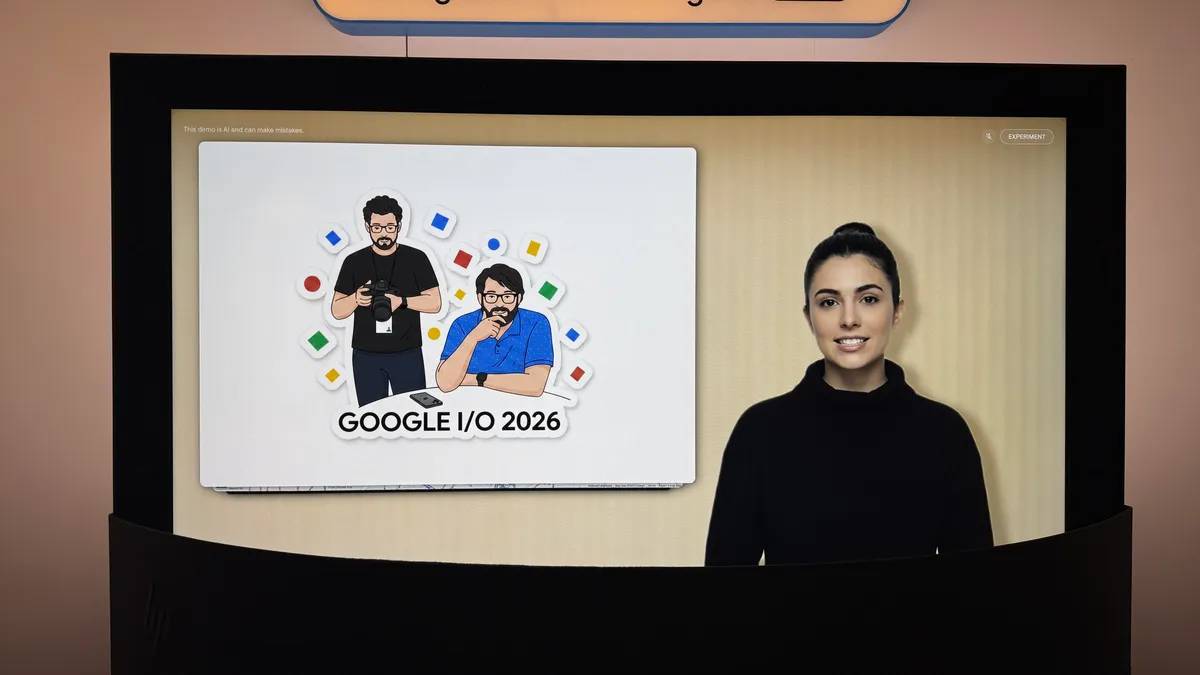
Google’s latest demonstration of a lifelike AI companion highlights a rapid evolution in human–machine interaction, moving beyond text-based assistants toward embodied, conversational agents. The development underscores how AI is increasingly designed to simulate presence and social interaction, with implications for communication platforms, enterprise collaboration, and consumer engagement models globally.
At Google I/O, the company showcased a lifesize, hyperreal AI companion designed to engage users through natural conversation, facial expression simulation, and real-time responsiveness. The system integrates multimodal AI, combining voice, vision, and contextual reasoning to create an interactive presence that mimics human-like engagement. The demo emphasized use cases such as remote collaboration, virtual assistance, and immersive communication.
Engineers highlighted improvements in latency reduction and emotional tone modeling, enabling more fluid dialogue. While still experimental, the system represents a step toward AI agents that operate as persistent digital entities rather than task-based tools, expanding potential applications across consumer and enterprise environments.
The development reflects a broader industry shift toward “embodied AI,” where systems are designed not just to process language but to simulate presence and interaction. Over the past few years, AI assistants have evolved from static chat interfaces to voice-driven systems embedded in devices, but remain largely task-oriented. The introduction of hyperreal agents builds on advancements in generative video, real-time speech synthesis, and spatial computing.
This trend aligns with increasing demand for immersive digital experiences across remote work, education, and entertainment sectors. Historically, breakthroughs in human–computer interaction have reshaped productivity platforms from graphical user interfaces to mobile-first ecosystems and AI-driven embodiment may represent the next structural shift in how users perceive and interact with software systems.
Technology analysts suggest that lifelike AI agents could redefine digital communication by reducing friction in remote collaboration and enabling more intuitive interfaces. However, researchers also caution that hyperreal systems introduce concerns around emotional manipulation, user dependency, and authenticity of interaction. Some AI ethicists argue that as agents become more human-like, clear disclosure mechanisms will be essential to prevent user confusion.
Industry observers note that enterprises may adopt such systems for customer service, training simulations, and executive assistance, particularly where scalable human-like interaction is valuable. At the same time, product strategists emphasize that trust and transparency will determine adoption rates, especially in regulated industries where AI-driven representation must be clearly defined and auditable.
For businesses, hyperreal AI companions could significantly reduce operational costs in customer engagement, internal communications, and training environments. Enterprises may deploy such systems as always-on digital representatives, reshaping workforce structures and service delivery models. However, the shift also raises reputational and compliance risks if users misinterpret AI-generated interactions as human.
Investors are likely to monitor monetization potential in enterprise SaaS, telecom, and consumer hardware markets. From a policy perspective, regulators may need to establish guidelines on disclosure, identity labeling, and emotional AI safeguards. The broader concern is the normalization of synthetic presence in everyday digital interaction.
Future iterations are expected to focus on improving realism, reducing latency, and integrating persistent memory systems for long-term user interaction. The next phase will likely determine whether hyperreal AI companions become mainstream productivity tools or remain niche applications. Key uncertainties include user acceptance, ethical regulation, and the boundaries between assistive AI and emotionally persuasive systems.
Source: CNET
Date: May 2026


