
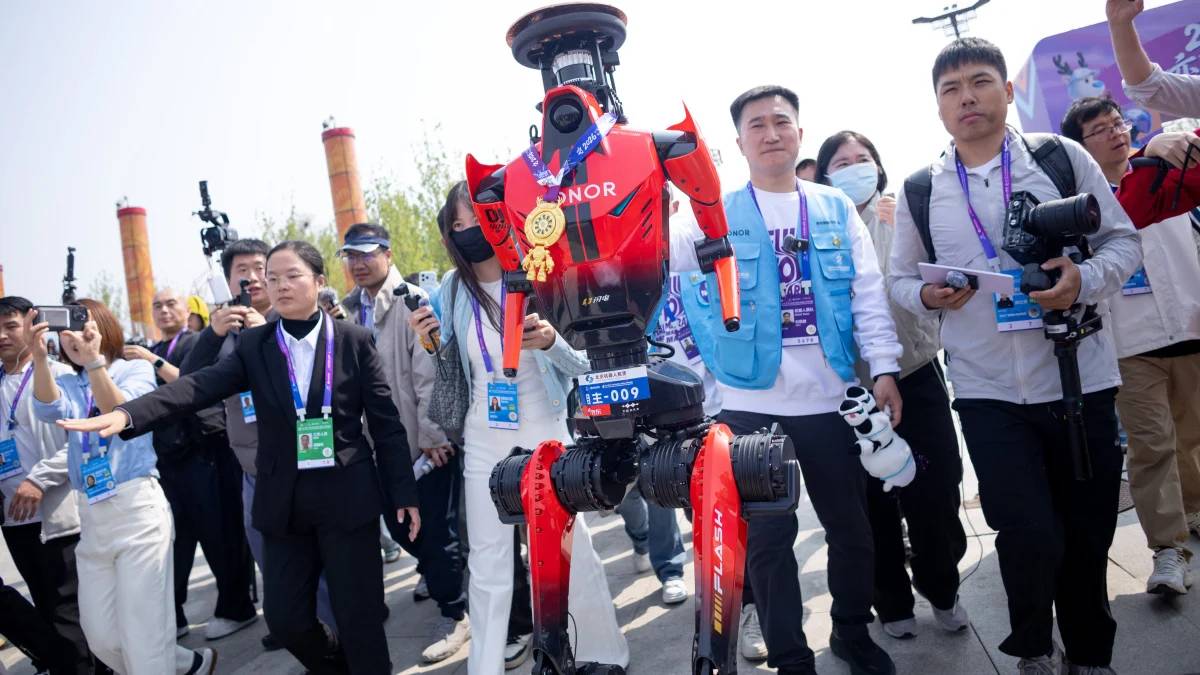
Humanoid Robot Completes Half-Marathon in China

The humanoid robot participated in a structured half-marathon event, successfully completing the course and demonstrating endurance, balance, and real-time motion control.

April 21, 2026
|
Image Source: Mashable

A humanoid robot has completed a half-marathon in China, marking a notable milestone in robotics and embodied artificial intelligence. The achievement highlights rapid advances in physical AI systems, with implications for manufacturing, logistics, and future human–machine collaboration across industries.

The humanoid robot participated in a structured half-marathon event, successfully completing the course and demonstrating endurance, balance, and real-time motion control. The project was developed by a Chinese robotics team focused on advancing mobility and autonomous coordination in humanoid systems.

The robot’s performance included sustained running over long distances, adaptive navigation, and stability in dynamic conditions. Engineers monitored its movement systems and energy efficiency throughout the race. The event is being viewed as a benchmark demonstration for embodied AI, where machines operate in physical environments with increasing autonomy and precision.

The development aligns with a broader trend across global markets where robotics and artificial intelligence are converging into “physical AI” systems capable of interacting with real-world environments. Humanoid robotics has become a strategic focus area for both private companies and governments investing in next-generation automation.

China has been actively expanding its robotics sector, positioning itself as a global leader in industrial automation and AI-driven manufacturing. Similar efforts are underway in the United States, Japan, and South Korea, where companies are developing humanoid systems for logistics, healthcare, and service industries.

Historically, robotics has been limited to controlled industrial settings. However, recent advances in machine learning, sensor fusion, and actuator design are enabling robots to operate in more complex and unstructured environments, including public spaces.

Robotics experts view the achievement as a symbolic step forward rather than immediate commercial readiness. Analysts suggest that endurance performance in real-world environments demonstrates progress in motion control, energy efficiency, and system integration.

Industry researchers emphasize that humanoid robotics remains in an experimental phase, with challenges related to safety, cost, and scalability. However, they note that such demonstrations are critical for accelerating innovation cycles.

Technology observers highlight that embodied AI is increasingly seen as the next frontier beyond generative AI, with potential applications in logistics, elder care, and hazardous environments. Experts also caution that regulatory frameworks will need to evolve alongside deployment to address safety and ethical considerations.

For global executives, the milestone signals accelerating progress in robotics that could reshape labor-intensive industries. Businesses in manufacturing, warehousing, and logistics may eventually integrate humanoid systems to enhance productivity and reduce operational costs.

Investors are likely to increase interest in robotics and embodied AI firms as the sector moves closer to commercial viability. However, timelines for widespread adoption remain uncertain.

From a policy perspective, governments may need to consider safety standards, liability frameworks, and workforce transition strategies as humanoid systems become more capable. The evolution of physical AI could also influence industrial competitiveness at a national level.

Looking ahead, further advancements in humanoid robotics will focus on improving endurance, dexterity, and autonomous decision-making. Stakeholders should watch for transitions from controlled demonstrations to real-world deployments in industrial and service environments.

As embodied AI matures, the competition to define standards and lead commercialization is expected to intensify globally.

Source: Wired
Date: April 2026

  • Featured tools
Tome AI
Free

Tome AI is an AI-powered storytelling and presentation tool designed to help users create compelling narratives and presentations quickly and efficiently. It leverages advanced AI technologies to generate content, images, and animations based on user input.

#
Presentation
#
Startup Tools
Learn more
Figstack AI
Free

Figstack AI is an intelligent assistant for developers that explains code, generates docstrings, converts code between languages, and analyzes time complexity helping you work smarter, not harder.

#
Coding
Learn more

Learn more about future of AI

Join 80,000+ Ai enthusiast getting weekly updates on exciting AI tools.
Thank you! Your submission has been received!
Oops! Something went wrong while submitting the form.

Humanoid Robot Completes Half-Marathon in China

April 21, 2026

The humanoid robot participated in a structured half-marathon event, successfully completing the course and demonstrating endurance, balance, and real-time motion control.

Image Source: Mashable

A humanoid robot has completed a half-marathon in China, marking a notable milestone in robotics and embodied artificial intelligence. The achievement highlights rapid advances in physical AI systems, with implications for manufacturing, logistics, and future human–machine collaboration across industries.

The humanoid robot participated in a structured half-marathon event, successfully completing the course and demonstrating endurance, balance, and real-time motion control. The project was developed by a Chinese robotics team focused on advancing mobility and autonomous coordination in humanoid systems.

The robot’s performance included sustained running over long distances, adaptive navigation, and stability in dynamic conditions. Engineers monitored its movement systems and energy efficiency throughout the race. The event is being viewed as a benchmark demonstration for embodied AI, where machines operate in physical environments with increasing autonomy and precision.

The development aligns with a broader trend across global markets where robotics and artificial intelligence are converging into “physical AI” systems capable of interacting with real-world environments. Humanoid robotics has become a strategic focus area for both private companies and governments investing in next-generation automation.

China has been actively expanding its robotics sector, positioning itself as a global leader in industrial automation and AI-driven manufacturing. Similar efforts are underway in the United States, Japan, and South Korea, where companies are developing humanoid systems for logistics, healthcare, and service industries.

Historically, robotics has been limited to controlled industrial settings. However, recent advances in machine learning, sensor fusion, and actuator design are enabling robots to operate in more complex and unstructured environments, including public spaces.

Robotics experts view the achievement as a symbolic step forward rather than immediate commercial readiness. Analysts suggest that endurance performance in real-world environments demonstrates progress in motion control, energy efficiency, and system integration.

Industry researchers emphasize that humanoid robotics remains in an experimental phase, with challenges related to safety, cost, and scalability. However, they note that such demonstrations are critical for accelerating innovation cycles.

Technology observers highlight that embodied AI is increasingly seen as the next frontier beyond generative AI, with potential applications in logistics, elder care, and hazardous environments. Experts also caution that regulatory frameworks will need to evolve alongside deployment to address safety and ethical considerations.

For global executives, the milestone signals accelerating progress in robotics that could reshape labor-intensive industries. Businesses in manufacturing, warehousing, and logistics may eventually integrate humanoid systems to enhance productivity and reduce operational costs.

Investors are likely to increase interest in robotics and embodied AI firms as the sector moves closer to commercial viability. However, timelines for widespread adoption remain uncertain.

From a policy perspective, governments may need to consider safety standards, liability frameworks, and workforce transition strategies as humanoid systems become more capable. The evolution of physical AI could also influence industrial competitiveness at a national level.

Looking ahead, further advancements in humanoid robotics will focus on improving endurance, dexterity, and autonomous decision-making. Stakeholders should watch for transitions from controlled demonstrations to real-world deployments in industrial and service environments.

As embodied AI matures, the competition to define standards and lead commercialization is expected to intensify globally.

Source: Wired
Date: April 2026

Promote Your Tool

Copy Embed Code

Similar Blogs

June 25, 2026
|

SolvaPay Builds AI Finance Infrastructure

SolvaPay has secured €2.4 million in funding to develop payment rails tailored for AI-driven transactions. The company is focused on creating financial infrastructure that enables autonomous AI agents to execute payments.
Read more
June 25, 2026
|

Corti Advances Medical Coding AI

Danish health-tech company Corti has introduced Symphony, an AI-powered medical coding solution built specifically for healthcare workflows.
Read more
June 25, 2026
|

KONGSBERG Launches AI Sonar Operator

Norwegian technology leader KONGSBERG has developed an AI-powered sonar operator designed to automate and enhance sonar interpretation for maritime users.
Read more
June 25, 2026
|

AI Startup Fights Invoice Fraud

Njordium has unveiled an AI-driven fraud detection platform focused on identifying suspicious invoices and vendor-related anomalies before payments are processed.
Read more
June 25, 2026
|

Gothenburg Builds Nvidia AI Hub

Gothenburg has announced the launch of a large-scale AI hub supported by Nvidia, one of the world's leading AI infrastructure providers.
Read more
June 25, 2026
|

Antrino Labs Expands AI Video Intelligence

Antrino Labs has secured SEK 40 million in fresh funding to accelerate the deployment of its AI-driven video intelligence platform, PreventAI.
Read more