



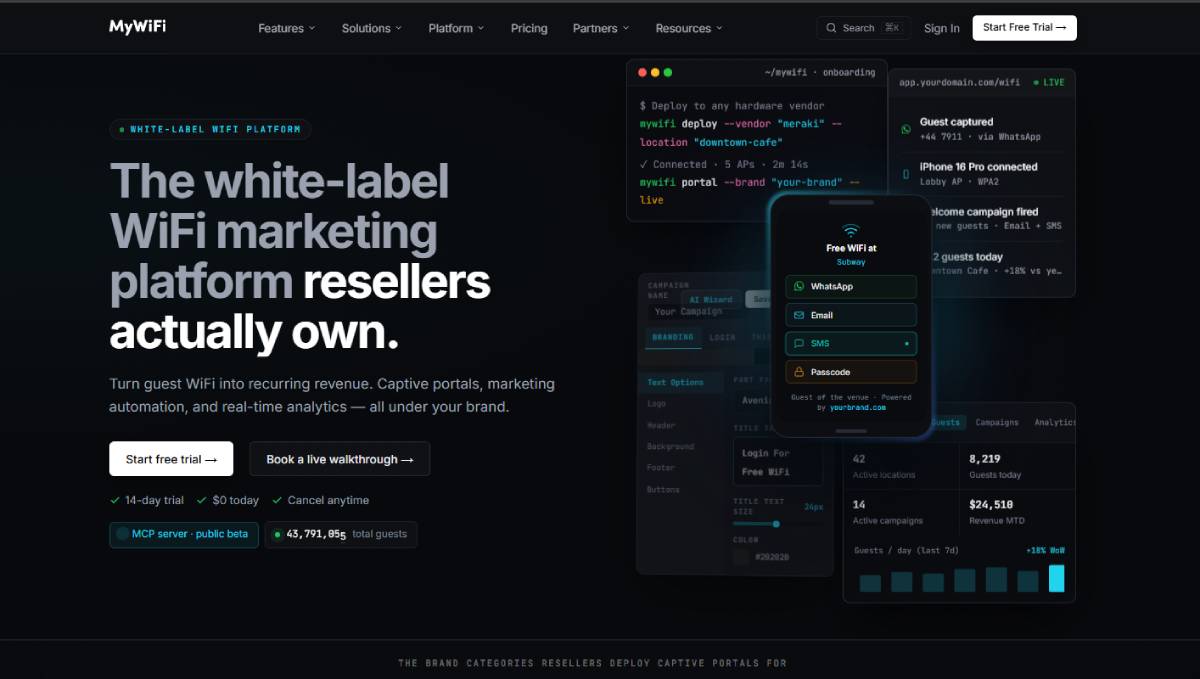
MyWiFi Networks is positioned in the growing managed Wi-Fi technology market, offering tools designed to help businesses deploy, manage and monetize wireless networks. Its approach reflects a broader shift toward intelligent connectivity infrastructure as enterprises, service providers and public venues seek greater control over network performance, customer engagement and digital services.
MyWiFi Networks provides a cloud-based platform focused on managing Wi-Fi networks and connected user experiences. Its capabilities are designed to support network configuration, centralized management, user authentication, analytics and engagement functions.
The platform is particularly relevant to organizations operating customer-facing wireless environments, where Wi-Fi can serve as more than basic connectivity. Businesses can use network access as an opportunity to understand usage patterns, communicate with customers and support digital services.
The broader market is being shaped by growing demand for reliable wireless connectivity across hospitality, retail, education, public venues and other commercial environments. For executives, managed Wi-Fi is increasingly viewed as part of the customer experience and operational infrastructure rather than a standalone IT utility.
The development aligns with the rapid expansion of connected environments. Businesses increasingly depend on wireless networks to support employees, customers, connected devices and digital applications. As network usage grows, organizations require more sophisticated tools for monitoring performance, managing access and understanding user behavior.
Traditional Wi-Fi management can involve separate hardware interfaces, manual configurations and limited visibility into network activity. Cloud-based platforms are changing this model by allowing administrators to manage multiple locations and network environments through centralized systems.
The rise of guest Wi-Fi has also created new commercial opportunities. Retailers, hospitality businesses and public venues can use network access to improve customer engagement while collecting operational insights.
For executives, the strategic importance extends beyond connectivity. A reliable wireless network can influence customer satisfaction, employee productivity and the performance of connected services. As digital experiences become increasingly dependent on connectivity, network management is becoming a more visible component of business strategy.
Industry specialists increasingly view managed Wi-Fi as an important part of broader digital infrastructure. The shift toward cloud-managed networks allows organizations to simplify administration while gaining greater visibility across distributed locations.
MyWiFi Networks' positioning reflects this evolution by combining network management with user engagement and analytics capabilities. This approach can help businesses treat Wi-Fi as an operational and customer-facing platform rather than simply a technical service.
For technology leaders, however, performance and reliability remain fundamental. A network platform must provide appropriate security controls, stable connectivity and effective management capabilities before engagement features can deliver meaningful value.
Data governance is also becoming increasingly important. Wi-Fi platforms can process information about users, devices and network activity, requiring organizations to establish appropriate policies for collection, storage and use.
The broader market is therefore moving toward solutions that combine connectivity, centralized administration, analytics and customer engagement while maintaining strong security and privacy practices.
For businesses, managed Wi-Fi can reduce network administration workloads while improving visibility across locations and users. Customer-facing organizations may also use wireless infrastructure to create more personalized digital experiences and better understand network usage.
For executives, the technology can contribute to operational efficiency and customer engagement, particularly for businesses managing multiple physical locations. Centralized management may also reduce the complexity associated with maintaining separate network environments.
Consumers increasingly expect reliable and convenient connectivity, making network performance an important component of the overall customer experience. From a policy perspective, organizations must consider cybersecurity, privacy, data retention and user consent when collecting information through connected networks. Strong access controls and responsible data practices will become increasingly important as Wi-Fi platforms become more intelligent.
Managed Wi-Fi is likely to evolve toward greater automation, artificial intelligence, predictive network management and deeper integration with connected-device ecosystems. Future platforms may increasingly identify performance issues before they disrupt users while providing more detailed operational and engagement insights.
Decision-makers should watch how providers balance network intelligence with security and privacy. The strongest solutions will be those that transform wireless connectivity into a reliable, measurable and strategically valuable component of the modern digital business.
Source: Crozdesk
Date: August 11, 2026


