



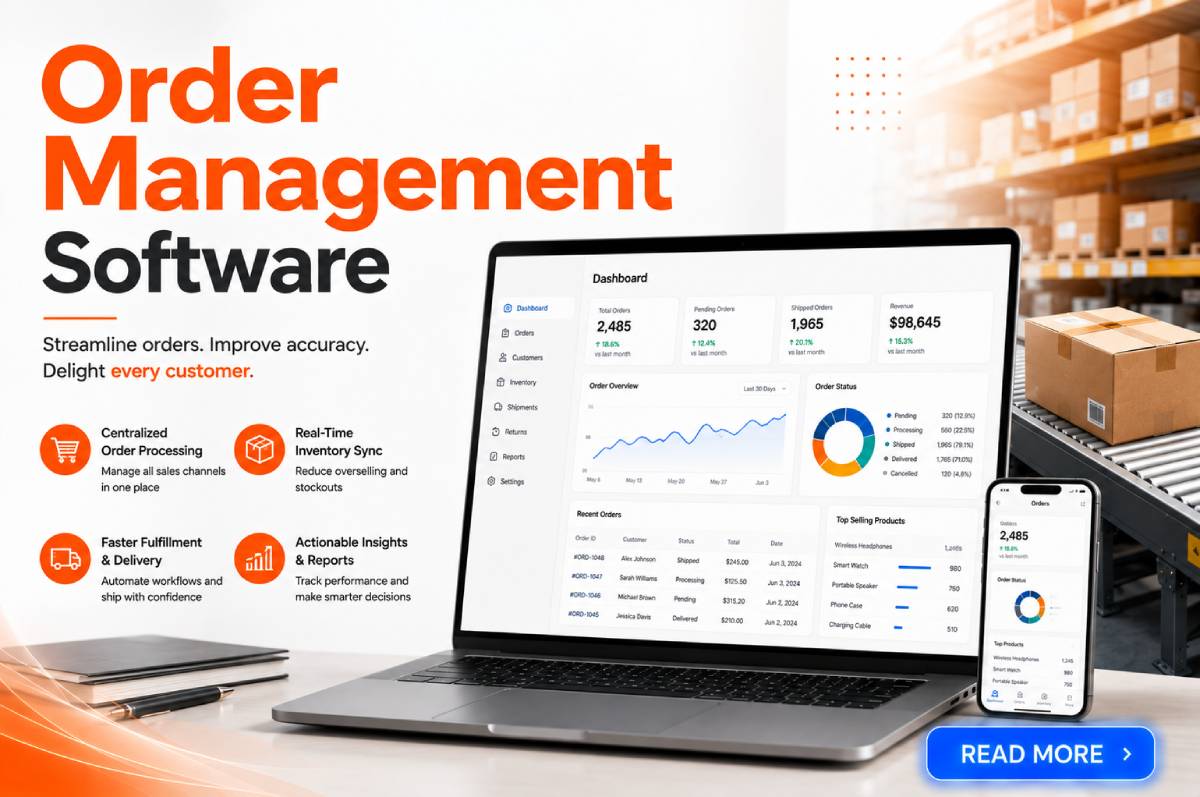
Order management software is emerging as a strategic technology for businesses seeking tighter control over increasingly complex commerce operations. The growing category reflects demand for centralized order processing, inventory visibility, fulfillment coordination and system integration, affecting retailers, e-commerce companies, warehouses and other organizations managing high-volume, multi-channel transactions.
The order management software landscape encompasses platforms designed to coordinate the full lifecycle of customer orders, from placement and processing to fulfillment and delivery. Leading solutions increasingly combine order processing with inventory tracking, customer management, shipping coordination, supplier management and external integrations.
The category also reflects growing demand for API connectivity and compatibility with broader enterprise technology environments. These capabilities allow organizations to synchronize information across commerce platforms, warehouses, suppliers and logistics operations. For executives, the emphasis is shifting from simply processing orders toward creating a connected operational infrastructure capable of supporting faster decisions and more consistent customer experiences.
The development aligns with a broader transformation across global commerce. Businesses now operate through multiple sales channels, including websites, marketplaces, mobile applications and physical stores. This fragmented environment creates challenges around inventory accuracy, fulfillment visibility and coordination between departments.
Order management platforms have consequently moved closer to the center of digital commerce infrastructure. Instead of managing individual transactions through disconnected systems, organizations can use centralized platforms to coordinate order information and connect it with inventory, customer and shipping processes.
The trend also reflects increasing pressure on businesses to deliver faster and more transparent fulfillment. Customers increasingly expect accurate availability information, flexible delivery options and timely updates. At the same time, companies face pressure to control operating costs and minimize fulfillment errors. These competing demands are strengthening the strategic role of order management technology across modern commerce operations.
Industry analysis increasingly points toward integration and automation as defining characteristics of modern order management. Technology leaders are evaluating platforms not simply on their ability to record orders, but on how effectively they connect order data with inventory, logistics, customer information and enterprise applications.
The growing importance of APIs, data exchange and external integrations indicates that interoperability is becoming a critical purchasing consideration. Businesses operating across multiple channels need systems capable of maintaining consistent information while supporting different fulfillment models.
From an executive perspective, the strongest platforms are likely to be those that combine operational visibility with scalability and automation. Analysts and technology buyers will also need to consider implementation complexity, data security, system compatibility and long-term flexibility.
As the market develops, differentiation is expected to increasingly come from analytics, workflow automation and the ability to coordinate increasingly sophisticated fulfillment networks. For global executives, order management software can become a critical component of operational strategy. Better coordination between orders, inventory and fulfillment can help organizations reduce manual work, improve visibility and respond faster to changing demand.
Investors and technology buyers should examine integration capabilities, scalability, automation, data portability and compatibility with existing enterprise systems. A platform that cannot connect effectively with surrounding infrastructure may limit the value of broader digital transformation investments.
Consumers could benefit through more accurate inventory information, improved delivery coordination and greater order transparency. Meanwhile, governments and regulators may increasingly focus on data governance, cybersecurity, interoperability and responsible handling of customer information as commerce operations become more digitally connected.
The order management software market is likely to remain closely linked to the expansion of digital commerce and increasingly distributed supply chains. Decision-makers should watch developments in automation, artificial intelligence, analytics, API connectivity and cross-channel fulfillment. As operational complexity grows, businesses will favor platforms capable of providing a unified view of orders while connecting seamlessly with inventory, logistics and enterprise systems.
Source: Crozdesk
Date: August 10, 2026


