



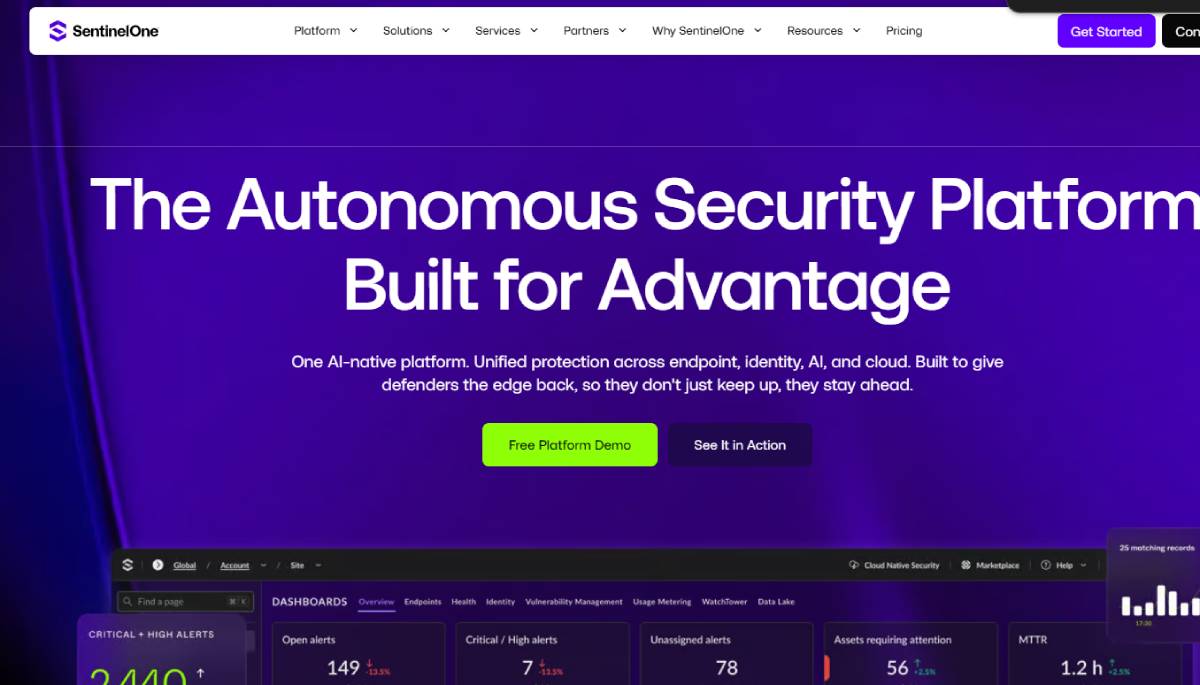
SentinelOne is strengthening its AI-driven cybersecurity strategy as enterprises confront increasingly sophisticated attacks across endpoints, cloud environments, identities and emerging AI workloads. Its unified security platform is designed to automate threat detection, investigation and response, giving organizations a more centralized approach to managing complex cyber risks while reducing pressure on security teams.
SentinelOne's Singularity Platform brings together endpoint security, cloud security, identity protection, security operations and AI security within a unified architecture. The platform combines behavioral AI, automated protection and investigation capabilities to help organizations identify and respond to threats across multiple environments.
The company's Purple AI capabilities further emphasize automated security operations by helping analysts investigate incidents and accelerate response workflows. SentinelOne is also expanding its focus toward protecting enterprise AI adoption, including AI applications, autonomous agents, AI infrastructure and employee use of external AI tools.
This broader approach reflects a shift from isolated security products toward integrated platforms capable of addressing multiple attack surfaces. The cybersecurity landscape is changing rapidly as enterprises adopt cloud services, distributed workforces, artificial intelligence and increasingly autonomous digital systems. At the same time, cybercriminals are using automation and AI to increase the speed and scale of attacks, creating additional pressure on security operations centers.
Traditional endpoint protection alone is therefore becoming insufficient for many organizations. Security leaders increasingly require visibility across devices, identities, cloud workloads and applications while maintaining the ability to respond quickly when threats emerge.
SentinelOne's strategy aligns with this industry movement toward AI-native cybersecurity. Its platform seeks to combine prevention, detection, investigation and response in a unified environment rather than requiring organizations to manage disconnected security tools.
The emergence of enterprise AI creates another layer of complexity. Companies must now protect not only conventional infrastructure but also AI applications, agents, SentinelOne positions artificial intelligence as a fundamental component of its cybersecurity architecture. The company argues that AI can help security teams process large volumes of security signals and accelerate investigations while allowing human experts to remain responsible for strategic decisions and governance.
Its Purple AI technology is designed to assist analysts with security investigations, threat hunting and incident response. The company has also expanded its AI-security capabilities to address risks associated with enterprise adoption of generative and agentic AI.
For technology executives, the larger industry signal is significant: AI is becoming both a security tool and a new attack surface. Organizations therefore need cybersecurity strategies capable of protecting AI systems while simultaneously using AI to improve defensive operations.
This creates a competitive environment in which cybersecurity providers will increasingly be judged on automation, accuracy, visibility, integration and governance rather than detection capabilities alone.
For businesses, SentinelOne's unified approach could help reduce security-tool fragmentation and give IT and security teams broader visibility across their digital environments. Faster automated investigation and response may also help organizations manage growing alert volumes without increasing security staffing at the same pace.
For CIOs and CISOs, the expansion into AI security is particularly important. Enterprises adopting generative AI and autonomous agents must consider data leakage, unauthorized access, malicious prompts, identity risks and uncontrolled automated actions.
From a policy perspective, organizations will need governance frameworks that cover both traditional cybersecurity and emerging AI risks. Executives should therefore evaluate whether their security architecture can provide automation while maintaining appropriate human oversight, access controls, auditability and compliance.
SentinelOne's strategy reflects a broader transformation toward AI-native enterprise cybersecurity. The next phase will likely focus on deeper automation, broader protection across AI environments and tighter integration between security operations and enterprise infrastructure. The key question for decision-makers will be whether AI-driven security can deliver faster responses while preserving transparency, reliability and human control. As enterprise AI adoption accelerates, securing autonomous systems is likely to become a central C-suite priority.
Source: Crozdesk
Date: August 12, 2026


