



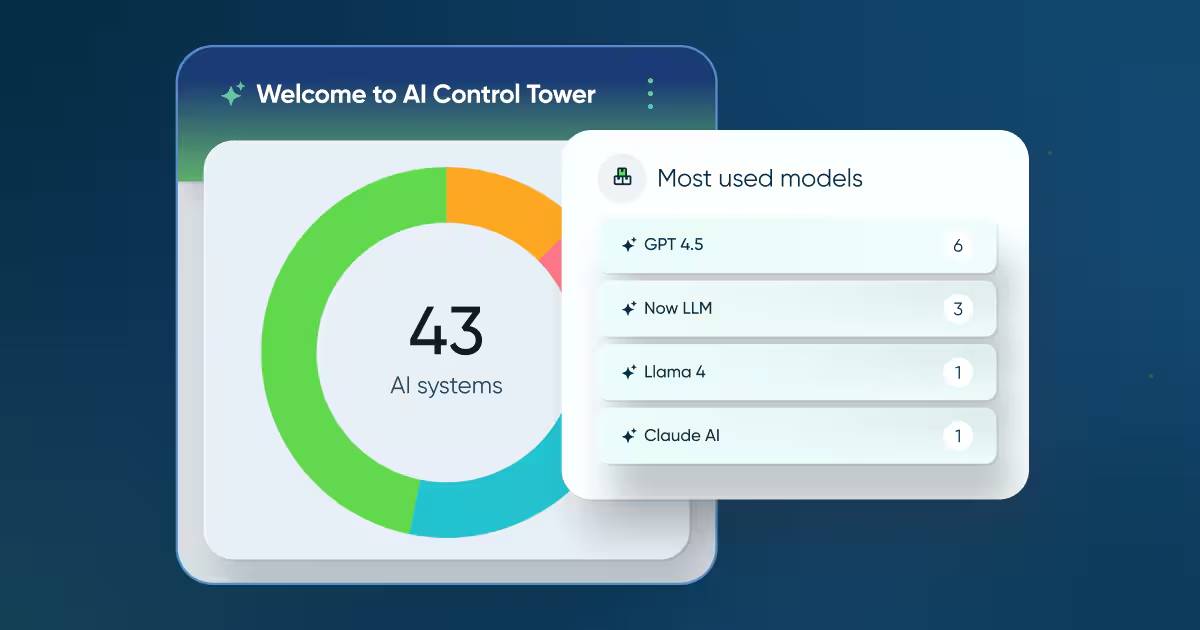
ServiceNow has expanded its AI Control Tower platform to provide enterprises with unified capabilities to discover, govern, secure, and measure AI systems across organizational environments. The update reflects growing demand for centralized oversight as companies scale artificial intelligence deployment across complex digital infrastructures.
ServiceNow announced enhancements to its AI Control Tower, extending its ability to monitor and manage AI systems deployed across enterprise environments. The platform now supports end-to-end visibility, governance, and risk management for AI applications operating across multiple systems.
The update enables organizations to track AI usage, enforce compliance policies, and assess performance metrics in real time. It also integrates security and operational controls to reduce fragmentation in AI deployment.
The expansion targets large enterprises managing multiple AI tools and models, addressing challenges related to oversight, compliance, and operational consistency in increasingly AI-driven workflows.
As enterprises accelerate AI adoption, managing distributed systems has become a critical operational challenge. Organizations are increasingly deploying multiple AI models across departments, creating governance gaps and security risks.
ServiceNow’s expansion of its AI Control Tower reflects a broader industry shift toward centralized AI governance frameworks. Companies are seeking tools that provide visibility across fragmented AI ecosystems while ensuring compliance with internal and regulatory standards.
This trend is being driven by the rapid proliferation of generative AI and agent-based systems, which are often deployed without unified oversight structures. As a result, enterprises face challenges in tracking usage, ensuring accountability, and measuring performance impact.
The development aligns with a wider push toward enterprise AI orchestration platforms that unify governance, security, and operational monitoring in a single framework. Industry analysts note that AI governance is emerging as a critical enterprise requirement as organizations scale adoption of generative and autonomous systems. Experts suggest that platforms like ServiceNow’s AI Control Tower are addressing a growing gap in enterprise architecture.
Technology observers highlight that fragmented AI deployments increase risks related to compliance failures, data leakage, and inconsistent performance outcomes. Centralized governance tools are therefore seen as essential for enterprise-scale AI management.
Analysts also emphasize that demand for AI observability and control platforms is expected to grow as regulatory scrutiny intensifies. Enterprises are increasingly required to demonstrate transparency in AI usage, particularly in regulated industries such as finance, healthcare, and public services.
The expansion is viewed as part of a broader evolution toward “AI operations management” as a core enterprise function. For businesses, the expansion provides enhanced capability to manage AI systems at scale, reducing operational risk and improving governance consistency. Enterprises adopting multiple AI tools may benefit from improved visibility and standardized control frameworks.
For investors, the development highlights growing demand for enterprise AI infrastructure and governance solutions, positioning AI orchestration platforms as a key segment in the broader AI economy.
For policymakers, the rise of centralized AI governance systems supports regulatory objectives around transparency, accountability, and risk management. Governments may increasingly expect enterprises to demonstrate controlled and auditable AI deployment practices.
AI governance platforms are expected to become foundational components of enterprise digital infrastructure as AI adoption expands. Future enhancements will likely focus on deeper automation, predictive risk management, and tighter integration with regulatory frameworks. The evolution of tools like ServiceNow’s AI Control Tower will be closely watched as organizations balance innovation with operational control and compliance demands.
Source: ServiceNow Newsroom
Date: May 2026


