



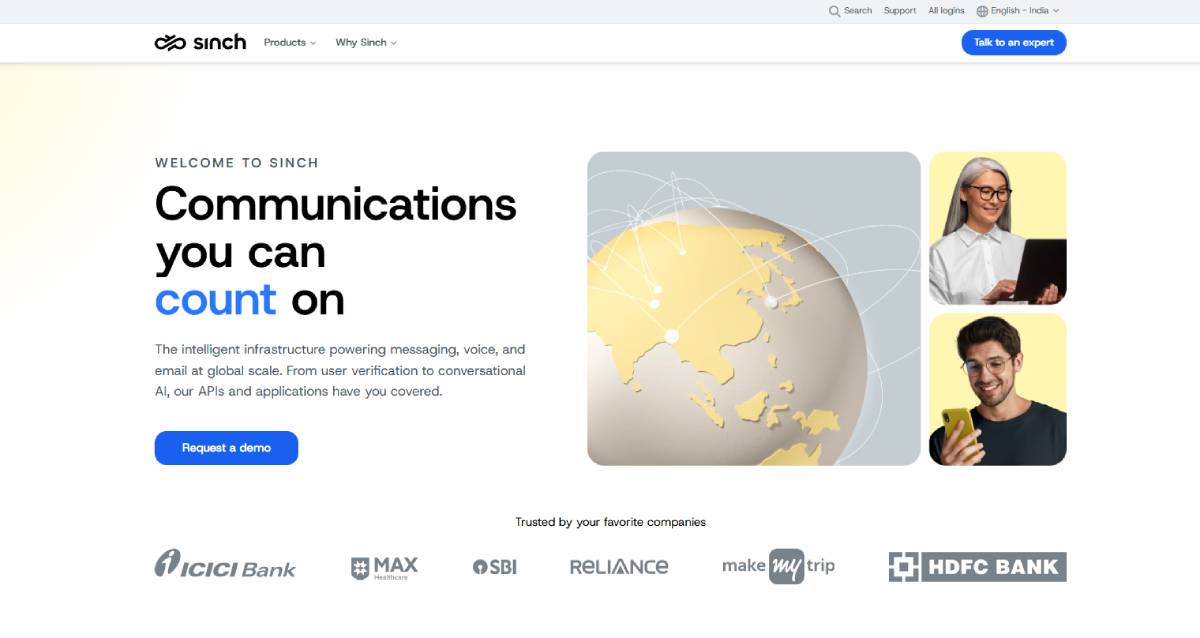
A leadership transition has unfolded at Sinch as its Chief Financial Officer steps into the role of Acting Chief Executive Officer, marking a pivotal moment for the cloud communications firm. The interim appointment underscores strategic uncertainty and succession planning considerations, with implications for corporate governance, investor sentiment, and operational continuity across global messaging markets.
Sinch has appointed its CFO, Jonas Dahlberg, as Acting CEO following a leadership transition at the top of the organization. The move is framed as temporary, with the “acting” designation signaling an interim structure while the company evaluates long-term executive leadership.
The decision comes at a time when Sinch continues to expand its cloud communications and customer engagement platforms globally. The company has not indicated a permanent replacement timeline, but the shift places financial leadership at the center of strategic decision-making.
Market observers view the transition as a stabilizing measure designed to maintain operational continuity during a sensitive period for growth and restructuring. The leadership change at Sinch reflects broader governance trends in the global technology and SaaS communications sector, where CFO-to-CEO transitions are increasingly used as interim stabilizers during periods of strategic reassessment.
Sinch operates in the competitive cloud communications infrastructure space, providing messaging, verification, and customer engagement APIs to enterprises worldwide. This sector has experienced rapid consolidation, margin pressure, and shifting demand patterns as AI-driven communication tools reshape enterprise workflows.
The appointment of Jonas Dahlberg as Acting CEO suggests the board is prioritizing financial discipline and operational oversight while evaluating long-term leadership direction. Historically, companies in transition often appoint internal financial leaders to ensure continuity, especially when investor confidence and execution stability are critical.
This development also aligns with a wider European tech governance trend where boards opt for interim internal leadership rather than external disruption during restructuring cycles. Corporate governance analysts suggest that the appointment of Jonas Dahlberg as Acting CEO of Sinch signals a “risk-managed transition strategy,” where boards prioritize continuity over aggressive leadership change during volatile market conditions.
Industry experts note that CFOs stepping into CEO roles often indicate a phase of cost optimization, portfolio rationalization, or strategic recalibration. In the cloud communications sector, where pricing pressure and platform competition are intensifying, financial leadership is increasingly central to executive decision-making.
While no formal public statement detailing long-term succession plans has been disclosed, market commentators expect the board to evaluate both internal and external candidates before confirming a permanent CEO. Analysts also highlight that investor reaction will likely depend on whether the transition is perceived as stability-driven or uncertainty-driven.
For stakeholders in Sinch, the leadership transition introduces both stability and ambiguity. While interim CFO-led leadership may reassure investors about financial discipline, it may also raise questions about strategic direction in a rapidly evolving communications market.
For investors, the move signals a possible focus on margin protection and operational efficiency. For competitors, it may create a window of strategic opportunity if execution slows during the transition phase.
From a governance perspective, the shift underscores the increasing reliance on internal executive pipelines in European tech firms. Policymakers tracking digital infrastructure resilience may view leadership continuity in key communications providers as critical to enterprise and public-sector reliability.
The next phase for Sinch will depend on how quickly the board defines a permanent leadership structure and whether interim management can sustain strategic momentum. Investors will closely monitor revenue stability, margin performance, and strategic clarity during this transition period. A decisive CEO appointment is expected to be a key catalyst for restoring long-term visibility and reinforcing market confidence in the company’s growth trajectory.
Source: Nordic Tech News
Date: July 1, 2026


