



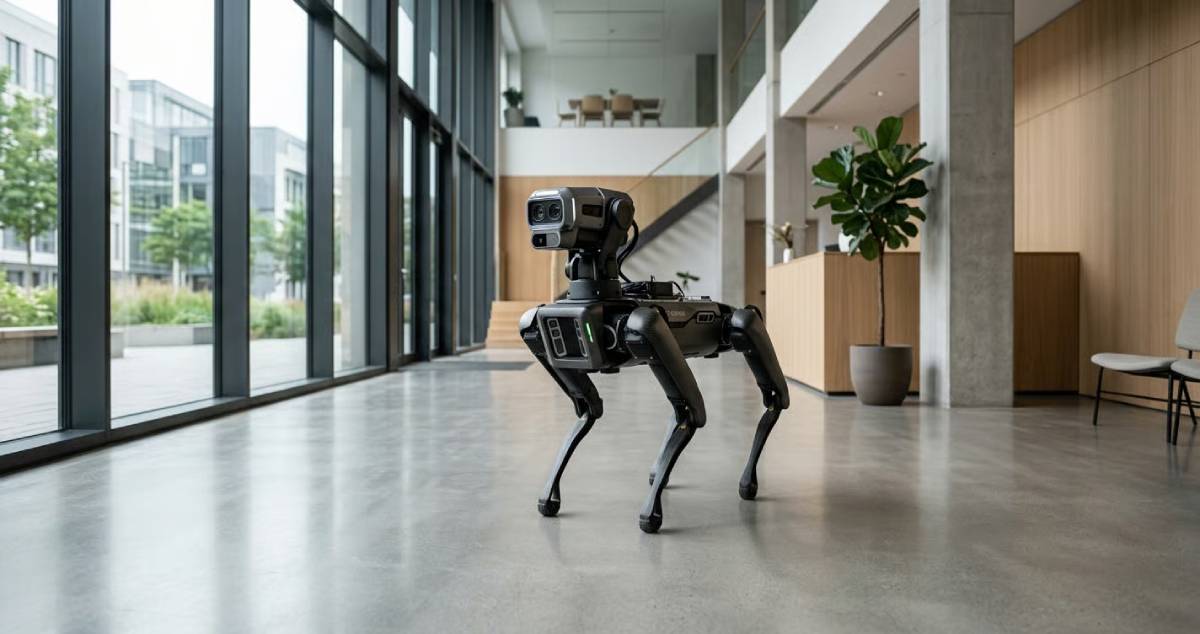
A Stockholm-based robotics venture, Surwera, is drawing attention for an unconventional hardware bet: a conversational, expressive robot dog designed to blend physical robotics with interactive AI. The project highlights how European robotics startups are increasingly experimenting beyond industrial use cases, targeting consumer interaction and embodied AI experiences.
Surwera’s robot dog represents a shift from traditional industrial robotics toward emotionally responsive, AI-enabled consumer machines. The system integrates voice interaction, motion-based responses, and adaptive behavioural modeling to simulate lifelike engagement.
Key stakeholders include the founding robotics team in Stockholm and early ecosystem backers within Sweden’s deep-tech network. While commercial deployment details remain limited, the prototype is positioned as an experimental platform for human–robot interaction research and potential entertainment or companion robotics markets. The development underscores a growing Nordic trend of blending AI models with physical robotics platforms beyond factory or logistics applications.
Robotics innovation in Europe has historically concentrated on industrial automation, manufacturing efficiency, and logistics optimization. However, the emergence of advanced AI models has expanded the scope toward embodied intelligence machines capable of interacting socially with humans in dynamic environments.
Surwera’s approach reflects a broader shift in Stockholm’s tech ecosystem, where startups are increasingly exploring expressive robotics, edge AI systems, and human-machine interaction layers. Globally, similar trends are visible in Japan and the United States, where companion robotics and interactive AI devices are gaining renewed investor interest.
The “robot dog” category, once dominated by research prototypes and novelty products, is now being reframed as a testbed for next-generation multimodal AI systems that combine perception, language, and movement into unified behavioral intelligence frameworks.
Robotics researchers note that expressive robotics represents a critical bridge between digital AI systems and real-world deployment. Unlike purely software-based models, embodied AI must operate under physical constraints, making reliability, safety, and interaction design central challenges.
Industry analysts suggest that investor interest in such projects is driven less by immediate commercial viability and more by long-term positioning in the human-robot interface economy. Venture observers also highlight that Nordic startups are increasingly leveraging smaller-scale experimental robotics to differentiate from large industrial automation incumbents.
While Surwera’s leadership has emphasized experimentation and interaction design as core goals, the broader interpretation among ecosystem watchers is that the project sits at the intersection of AI research, robotics prototyping, and future consumer device exploration.
For businesses, the development signals an expanding definition of robotics markets from factory automation to consumer-facing AI companions and interactive systems. This could open new product categories in entertainment, education, and service robotics.
For investors, early-stage embodied AI startups represent high-risk but potentially high-reward opportunities tied to long-term shifts in human-machine interaction. Policymakers may also need to consider updated frameworks for safety, privacy, and behavioral transparency in socially interactive robots.
The broader implication is structural: robotics is no longer confined to productivity gains alone but is increasingly entering cognitive and emotional interaction domains. Surwera’s next phase will likely focus on refining interaction models and validating real-world use cases beyond prototyping. The key uncertainty is whether consumer demand will materialize for emotionally responsive robotics at scale. Watch for increased convergence between AI foundation models and robotics hardware, particularly in Nordic and East Asian innovation hubs, where experimentation in embodied AI is accelerating.
Source: NordicTech
Date: July 3, 2026


