



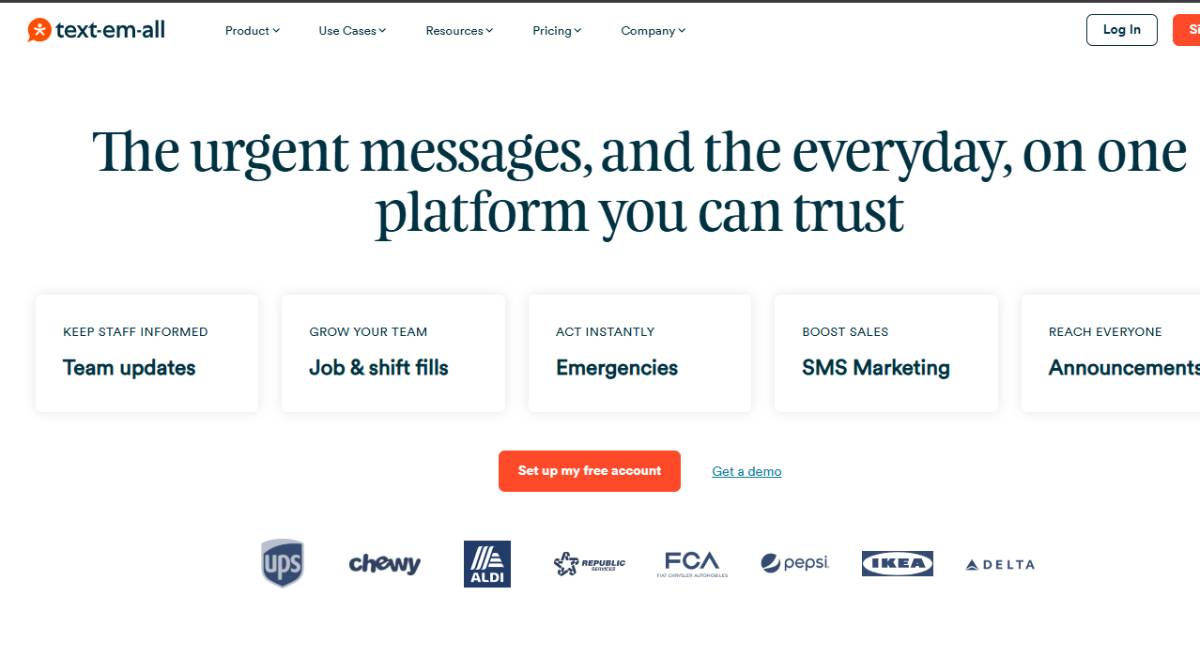
Text-Em-All is strengthening automated mass communication with technology designed to help organizations deliver voice calls, text messages and alerts at scale. The platform addresses growing demand for faster, more reliable communication across businesses, schools, government agencies and community organizations, where timely information can influence operational continuity and stakeholder engagement.
Text-Em-All focuses on automated communication, enabling organizations to send large-scale voice and text messages without relying on manual calling processes. Its capabilities are designed for use cases such as emergency notifications, operational announcements, appointment reminders, employee communications and customer outreach. Automated delivery can help organizations distribute information consistently while reducing the administrative workload associated with one-to-one communication.
The platform's relevance extends across multiple sectors, including education, healthcare, government, nonprofit organizations and businesses managing distributed workforces or customer bases. Mass communication technology has become increasingly important as organizations seek to reach stakeholders quickly across multiple channels.
The broader shift is toward automated, measurable communication that combines speed, scalability and centralized management. Organizations increasingly operate in environments where timely communication is critical. Schools must notify families about schedule changes, businesses may need to reach employees during operational disruptions, and public-sector organizations can require rapid distribution of important information.
Traditional communication methods such as phone trees, manual emails and individual calls can become inefficient when thousands of recipients must be contacted simultaneously. Automated notification platforms address this challenge by allowing organizations to distribute standardized messages at scale.
Text-Em-All operates within this broader evolution toward multi-channel communication infrastructure. Combining voice and SMS capabilities can provide organizations with additional flexibility when recipients may not immediately respond through one communication channel.
The economic value extends beyond convenience. Faster communication can reduce administrative costs, improve response times and limit operational disruption. For executives, communication infrastructure is increasingly viewed as part of business continuity and stakeholder-management strategy. Reliable messaging can help organizations maintain coordination during routine operations as well as unexpected events.
The growing adoption of automated notification systems reflects a broader recognition that communication speed can directly influence operational effectiveness. Automation enables organizations to distribute consistent messages without requiring employees to manually contact every recipient.
Text messaging can be particularly effective for time-sensitive notifications because mobile devices provide a direct channel to recipients. Voice communication remains valuable when organizations need to deliver longer messages or reach audiences that may be less responsive to text-based communication.
However, effective mass communication requires more than technical delivery. Organizations need accurate contact databases, clear message policies and appropriate safeguards against excessive or inappropriate messaging.
Data protection is another important consideration. Communication platforms may process phone numbers and other recipient information, making security and privacy controls essential.
From a management perspective, analytics and delivery reporting can also provide valuable insight into whether messages are reaching intended recipients. These capabilities can help organizations refine communication strategies and improve response rates over time.
For businesses, automated mass communication can reduce the administrative burden associated with large-scale notifications while improving the speed and consistency of stakeholder outreach.
For schools and public organizations, the technology can support emergency alerts, schedule updates and community communications. Employers can also use automated messaging to coordinate distributed workforces and communicate operational changes.
The policy implications center on privacy, consent and responsible messaging practices. Organizations must ensure that recipient data is protected and that communications comply with applicable telecommunications and privacy requirements.
Executives should evaluate delivery reliability, scalability, reporting, security, message customization and integration capabilities before implementing automated communication technology. The strategic priority should be building a communication system that remains fast and dependable without compromising recipient trust or data governance.
Mass communication platforms are likely to become increasingly intelligent as organizations adopt automation, analytics and AI-assisted message management. Text-Em-All is positioned within the broader shift toward scalable digital communication infrastructure. Decision-makers should monitor multi-channel capabilities, personalization, analytics, privacy controls and integration with existing business systems. The long-term opportunity is to make critical stakeholder communication faster, more measurable and more resilient across everyday operations and high-pressure situations.
Source: Text-Em-All and Serchen
Date: August 14, 2026


