



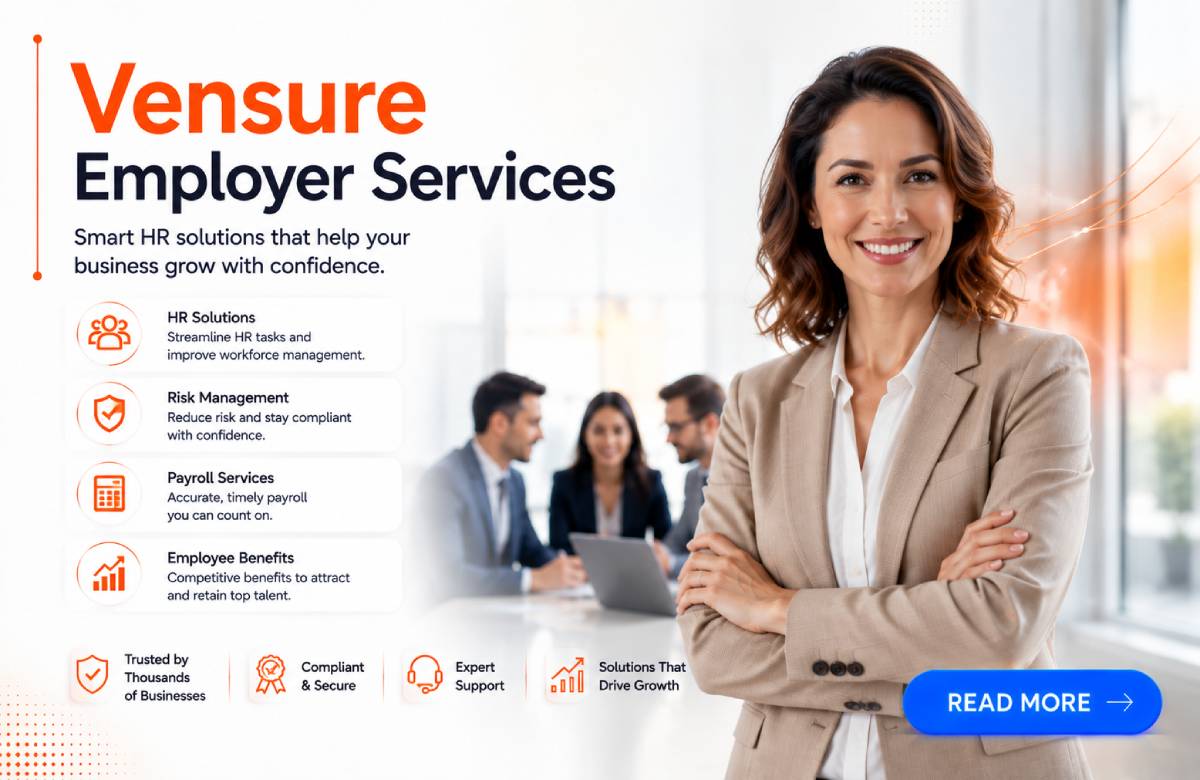
Vensure Employer Services continues to strengthen its position in the competitive employer-services market by combining human resources, payroll, benefits, risk management and compliance support. Its integrated model targets businesses seeking to simplify workforce administration while controlling operational complexity, signaling the growing importance of technology-enabled outsourced HR services.
Vensure Employer Services operates as a professional employer organization and workforce-management provider, supporting businesses across multiple administrative and compliance functions. Its service portfolio is designed to consolidate payroll processing, employee benefits, HR administration, workers’ compensation and related employer responsibilities.
The company’s approach reflects growing demand for centralized workforce infrastructure, particularly among small and midsized businesses that may lack extensive internal HR teams. By combining administrative services with technology and professional support, Vensure aims to help employers manage increasingly complex workforce requirements while allowing leadership teams to focus more heavily on growth and core operations.
The development comes as employers face a more complicated operating environment shaped by changing labor regulations, rising benefit costs, talent shortages and increasing expectations around employee experience. These pressures have encouraged businesses to reconsider whether workforce administration should remain entirely in-house.
Professional employer organizations have consequently become an important part of the broader HR-services ecosystem. By pooling certain administrative functions and providing specialized expertise, PEOs can potentially reduce the burden placed on internal teams.
Vensure’s integrated model fits this broader transformation. Rather than treating payroll, benefits, compliance and HR as separate functions, businesses increasingly seek connected platforms and service providers capable of managing the workforce lifecycle. The trend is particularly relevant for growing companies expanding across jurisdictions, where regulatory requirements and administrative workloads can increase rapidly.
Industry analysts generally view integrated employer services as a response to the increasing complexity of workforce management. For business leaders, the appeal lies less in outsourcing individual administrative tasks and more in creating a unified operating framework covering employees from onboarding through payroll, benefits and compliance.
The strategic value of providers such as Vensure is therefore closely linked to execution. Employers increasingly expect service partners to combine human expertise with digital tools, accurate data management and responsive support.
At the same time, executives must evaluate providers carefully. Service quality, data security, compliance capabilities, pricing transparency and integration with existing business systems can significantly influence the value of an outsourced HR model.
Vensure’s positioning highlights an industry-wide shift toward HR infrastructure becoming a strategic business function rather than simply an administrative responsibility. For businesses, integrated employer services can potentially reduce administrative workloads and give management teams greater visibility into workforce operations. Smaller organizations may particularly benefit from access to specialized HR, benefits and compliance expertise without building large internal departments.
For investors and corporate decision-makers, the broader opportunity reflects continued demand for recurring business services tied to essential workforce functions. However, dependence on external providers also creates considerations around service continuity, employee data protection and regulatory accountability.
Policymakers will continue to influence this sector through employment, benefits, tax, privacy and workplace regulations. As outsourcing expands, employers will need to maintain clear accountability even when operational responsibilities are delegated to third-party providers.
The employer-services market is likely to remain closely tied to the evolution of workplace regulation, technology and workforce expectations. Decision-makers should watch how providers integrate automation, analytics, employee-support capabilities and compliance services while maintaining service reliability. For Vensure and its peers, sustained growth will depend on demonstrating measurable value as employers increasingly demand simpler, more connected workforce operations.
Source: Serchen
Date: August 14, 2026


