



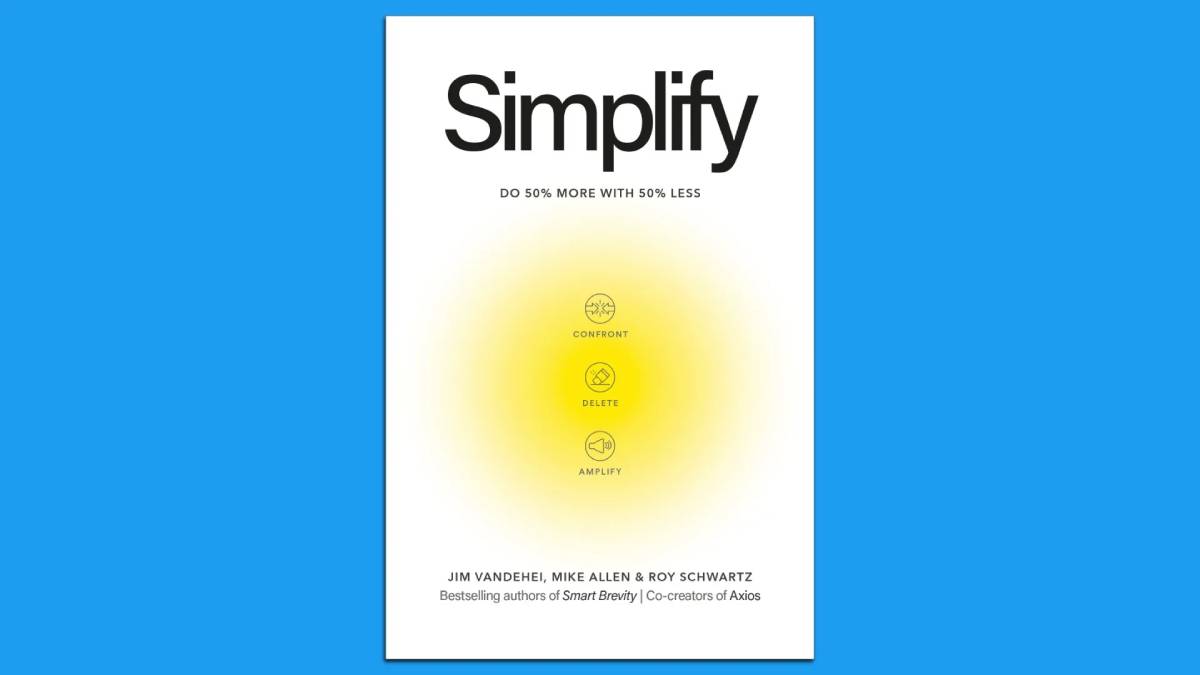
A new productivity framework is gaining traction as leaders adopt an AI-driven “Simplify You” playbook to restructure workflows. The approach centered on controlling, deleting, and amplifying tasks signals a strategic shift in how professionals and organizations adapt to artificial intelligence, with implications for workforce design, efficiency, and competitive advantage.
The “Simplify You” framework outlines a three-step AI productivity model: control essential workflows, delete low-value tasks, and amplify high-impact activities using AI tools. The concept is designed to help individuals and organizations integrate AI into daily operations more effectively.
The model emphasizes prioritization and intentional automation, encouraging users to identify repetitive or low-return work suitable for elimination or delegation to AI systems. It also highlights the importance of focusing human effort on strategic and creative outputs.
The framework reflects a broader shift toward structured AI adoption strategies, moving beyond experimentation into measurable productivity optimization across professional environments.
As artificial intelligence becomes embedded across industries, organizations are increasingly seeking frameworks to operationalize its impact on productivity. While early AI adoption focused on experimentation and isolated use cases, the current phase is characterized by systematic integration into workflows.
The “Simplify You” model aligns with a broader trend toward human-AI collaboration, where technology augments rather than replaces human capabilities. Companies are re-evaluating job roles, task allocation, and productivity metrics to reflect this new dynamic.
Historically, productivity frameworks have focused on time management and efficiency. However, the rise of AI introduces a new dimension: task elimination and intelligent delegation. This marks a shift from optimizing human effort alone to optimizing the entire human-machine system. The framework reflects growing demand for practical strategies that help professionals navigate AI-driven workplace transformation.
Industry analysts suggest that structured AI productivity frameworks are becoming essential as organizations scale adoption. Experts note that without clear strategies, AI implementation can lead to inefficiencies, duplication, or underutilization of capabilities.
The “control, delete, amplify” model is viewed as a simplified but effective approach to prioritizing AI integration. Analysts highlight that the “delete” component is particularly significant, as it challenges traditional productivity models that emphasize doing more rather than doing less.
Workplace strategists also point out that AI-driven productivity requires a cultural shift, where employees are encouraged to rethink their roles and focus on high-value contributions. However, experts caution that successful implementation depends on training, change management, and alignment with organizational goals.
The framework is seen as part of a broader movement toward redefining productivity in an AI-first economy. For businesses, the “Simplify You” framework offers a structured approach to integrating AI into operations, potentially improving efficiency and reducing operational costs. Organizations may increasingly adopt similar models to guide workforce transformation and productivity optimization.
For employees, the shift could redefine job roles, emphasizing strategic thinking, creativity, and oversight of AI systems. This may require reskilling and continuous learning to remain competitive.
From a policy perspective, widespread adoption of AI productivity frameworks could influence labor markets, prompting discussions around job displacement, workforce reskilling, and education system alignment. Governments may need to support transitions through training programs and digital skill development initiatives.
AI-driven productivity frameworks are expected to evolve as organizations refine best practices for human-machine collaboration. Future models may incorporate more advanced automation strategies and performance metrics tailored to AI-integrated workflows. Decision-makers will closely monitor how effectively such frameworks translate into measurable productivity gains while maintaining workforce engagement and adaptability.
Source: Axios
Date: May 6, 2026


