



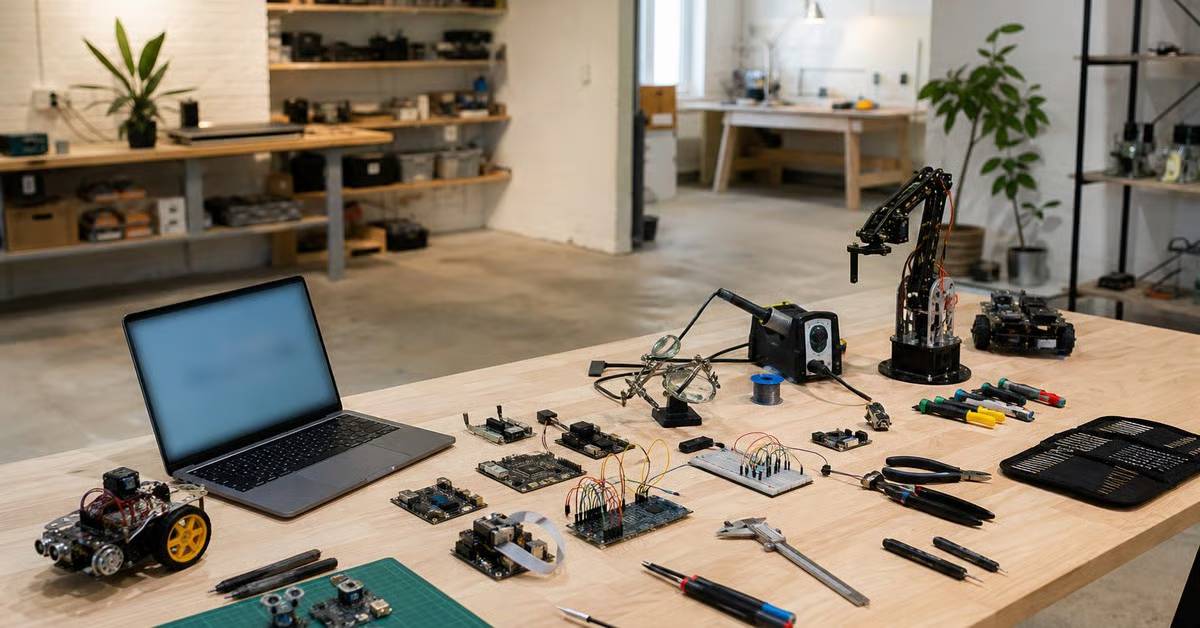
Atech is positioning itself at the intersection of hardware design and artificial intelligence, arguing that physical products are entering a “Lovable moment” similar to software’s AI transformation. The shift signals a broader industry push to make hardware development faster, more intuitive, and emotionally resonant, with implications for product innovation cycles and global manufacturing strategy.
Atech is advocating a new approach to hardware development where AI tools streamline design, prototyping, and iteration cycles. The company’s thesis centers on making hardware creation as fluid and user-driven as modern software development platforms.
The concept of a “Lovable moment” refers to a phase where technology becomes not only functional but highly user-centric and emotionally engaging. Atech argues that AI can compress traditional hardware development timelines, reduce prototyping costs, and enable faster product-market fit validation.
The approach reflects increasing convergence between industrial design, AI modeling, and consumer experience engineering. Hardware development has traditionally lagged behind software in terms of speed, iteration, and adaptability due to manufacturing constraints and high capital requirements. However, advances in AI-driven design tools, simulation systems, and digital twins are narrowing this gap.
The idea of “AI-native hardware” aligns with a broader industrial trend where software intelligence is embedded directly into physical product design cycles. This is particularly relevant in sectors such as consumer electronics, robotics, and smart devices, where rapid iteration is becoming a competitive advantage.
Historically, hardware innovation cycles could span years. Today, companies are attempting to compress these timelines to months or even weeks using AI-assisted design platforms. Atech’s positioning reflects this structural shift in how physical products are conceived, tested, and scaled in global markets.
Industry analysts suggest that Atech’s framing reflects a growing convergence between product design, AI simulation, and user experience engineering. Rather than treating hardware as a static engineering discipline, companies are increasingly viewing it as an iterative software-like process.
Experts in industrial design note that AI can significantly reduce early-stage design friction by automating concept generation, structural testing, and material optimization. However, they caution that manufacturing constraints and supply chain realities still impose hard limits on full abstraction.
While Atech has not released detailed technical benchmarks, the concept has drawn attention from venture investors tracking “AI for physical world” startups. The broader consensus is that the next wave of hardware innovation will be defined less by hardware alone and more by the intelligence layer embedded in its creation process.
For hardware startups and manufacturers, AI-driven design workflows could significantly reduce R&D costs and shorten time-to-market cycles. This may enable smaller players to compete with established hardware giants by accelerating prototyping and iteration.
For investors, the theme reinforces growing interest in AI applications beyond software into physical product ecosystems. Capital is increasingly flowing toward companies that bridge design intelligence with industrial execution.
From a policy perspective, regulators may need to consider how AI-generated hardware designs impact safety certification, intellectual property frameworks, and liability attribution. As design cycles accelerate, governance systems may need to evolve to keep pace with automated innovation processes.
The next phase of Atech’s vision will depend on how effectively AI can move from concept generation to manufacturing-ready design systems. If successful, it could redefine how hardware products are imagined and built globally. The broader industry will be watching whether “AI-native hardware” becomes a scalable model or remains an aspirational framework limited to specific product categories.
Source: nordictech.news
Date: June 24, 2026


