
Appointy Appoint.ly Drive Smarter Scheduling

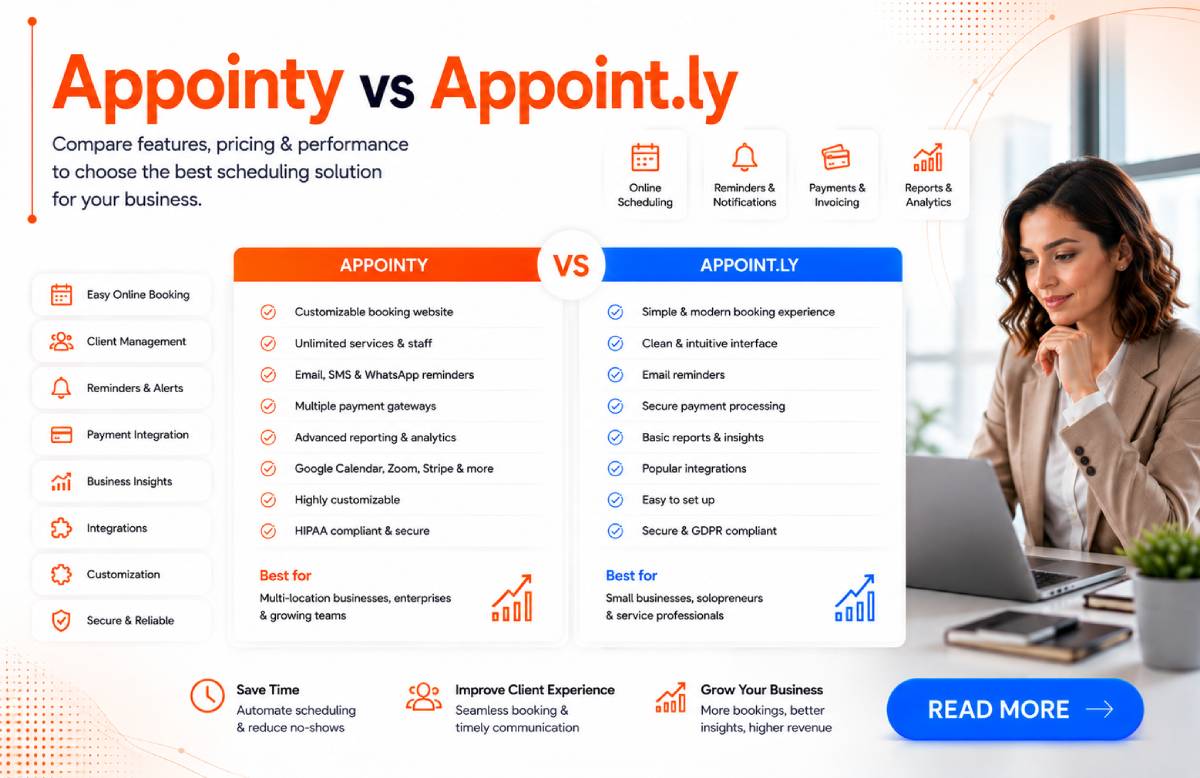
Appointy is positioned as a comprehensive appointment-management platform for businesses that need scheduling, customer management, reminders, payments and related operational capabilities.

August 13, 2026
|

The comparison between Appointy and Appoint.ly highlights the growing role of digital appointment scheduling in modern business operations. Both platforms aim to simplify booking and calendar management, but their different feature sets reflect rising demand for automated scheduling, customer convenience and more efficient use of employee time across service-driven organizations.

Appointy is positioned as a comprehensive appointment-management platform for businesses that need scheduling, customer management, reminders, payments and related operational capabilities. It serves service-based organizations seeking to manage appointments through a centralized system.

Appoint.ly takes a more focused scheduling approach, enabling users to share availability and allow others to select suitable meeting times. Its model is particularly relevant to professionals and teams that primarily need streamlined meeting coordination.

The comparison highlights two segments of the scheduling market: broader business-management platforms and lightweight scheduling tools. Both address a common operational challenge reducing the time and administrative effort required to coordinate appointments and meetings.

The growth of online scheduling technology reflects a broader shift toward digital-first customer and workforce interactions. Businesses increasingly expect customers, clients and employees to arrange meetings without lengthy email exchanges or manual calendar coordination.

For service businesses, appointment scheduling can directly affect revenue, customer satisfaction and workforce utilization. Missed appointments, double bookings and inefficient calendar management can create measurable operational costs.

Appointy addresses this wider operational challenge by combining appointment scheduling with additional business-management functions. Appoint.ly represents a more streamlined model centered on sharing availability and simplifying meeting coordination.

The distinction is increasingly relevant as organizations adopt hybrid work and digital customer experiences. Scheduling is no longer simply an administrative task; it can become part of the customer journey and an important productivity mechanism.

For executives, the strategic consideration is how scheduling technology can reduce friction while improving resource utilization, customer access and operational visibility. The comparison illustrates an important distinction in scheduling technology: businesses may require either a comprehensive appointment-management system or a simpler tool focused primarily on coordinating meetings.

Appointy's broader functionality can be valuable for organizations managing recurring appointments, customers, services and operational workflows. Appoint.ly's streamlined model may appeal to professionals who want to share availability without introducing a larger business-management system.

Industry trends indicate that modern scheduling platforms increasingly compete on automation, integrations, reminders, payments and ease of use. Calendar synchronization and automated notifications have become particularly important as organizations manage increasingly complex schedules.

For business leaders, usability remains a critical factor. A scheduling system only generates operational value when employees and customers actually use it consistently. Integration with existing calendars, CRM systems and communication platforms can therefore be as important as the scheduling interface itself.

For businesses, automated scheduling can reduce administrative workload, minimize booking conflicts and make customer interactions more convenient. Service organizations may also benefit from better appointment utilization and automated reminders.

For executives, the choice between Appointy and Appoint.ly depends largely on operational complexity. Companies needing broader appointment and customer-management functions may require a more comprehensive platform, while individuals and teams seeking straightforward meeting coordination may prefer simplicity.

The policy dimension includes customer-data protection, calendar permissions and secure handling of personal information. Businesses operating across jurisdictions must also consider applicable privacy requirements when collecting customer details through online booking systems.

Executives should evaluate integration, security, scalability, user experience and measurable productivity gains before selecting a scheduling platform. Digital scheduling is likely to evolve toward increasingly intelligent systems that combine availability management with AI-assisted booking, automated reminders, payments, customer communications and workforce optimization. Appointy and Appoint.ly represent different approaches within this expanding market. Decision-makers should monitor automation, integration capabilities and customer adoption as scheduling becomes increasingly embedded in digital business operations. The long-term advantage will come from reducing scheduling friction while improving customer experience and resource utilization.

Source: Crozdesk
Date: August 13, 2026

  • Featured tools
Tome AI
Free

Tome AI is an AI-powered storytelling and presentation tool designed to help users create compelling narratives and presentations quickly and efficiently. It leverages advanced AI technologies to generate content, images, and animations based on user input.

#
Presentation
#
Startup Tools
Learn more
Ai Fiesta
Paid

AI Fiesta is an all-in-one productivity platform that gives users access to multiple leading AI models through a single interface. It includes features like prompt enhancement, image generation, audio transcription and side-by-side model comparison.

#
Copywriting
#
Art Generator
Learn more

Learn more about future of AI

Join 80,000+ Ai enthusiast getting weekly updates on exciting AI tools.
Thank you! Your submission has been received!
Oops! Something went wrong while submitting the form.

Appointy Appoint.ly Drive Smarter Scheduling

August 13, 2026

Appointy is positioned as a comprehensive appointment-management platform for businesses that need scheduling, customer management, reminders, payments and related operational capabilities.

The comparison between Appointy and Appoint.ly highlights the growing role of digital appointment scheduling in modern business operations. Both platforms aim to simplify booking and calendar management, but their different feature sets reflect rising demand for automated scheduling, customer convenience and more efficient use of employee time across service-driven organizations.

Appointy is positioned as a comprehensive appointment-management platform for businesses that need scheduling, customer management, reminders, payments and related operational capabilities. It serves service-based organizations seeking to manage appointments through a centralized system.

Appoint.ly takes a more focused scheduling approach, enabling users to share availability and allow others to select suitable meeting times. Its model is particularly relevant to professionals and teams that primarily need streamlined meeting coordination.

The comparison highlights two segments of the scheduling market: broader business-management platforms and lightweight scheduling tools. Both address a common operational challenge reducing the time and administrative effort required to coordinate appointments and meetings.

The growth of online scheduling technology reflects a broader shift toward digital-first customer and workforce interactions. Businesses increasingly expect customers, clients and employees to arrange meetings without lengthy email exchanges or manual calendar coordination.

For service businesses, appointment scheduling can directly affect revenue, customer satisfaction and workforce utilization. Missed appointments, double bookings and inefficient calendar management can create measurable operational costs.

Appointy addresses this wider operational challenge by combining appointment scheduling with additional business-management functions. Appoint.ly represents a more streamlined model centered on sharing availability and simplifying meeting coordination.

The distinction is increasingly relevant as organizations adopt hybrid work and digital customer experiences. Scheduling is no longer simply an administrative task; it can become part of the customer journey and an important productivity mechanism.

For executives, the strategic consideration is how scheduling technology can reduce friction while improving resource utilization, customer access and operational visibility. The comparison illustrates an important distinction in scheduling technology: businesses may require either a comprehensive appointment-management system or a simpler tool focused primarily on coordinating meetings.

Appointy's broader functionality can be valuable for organizations managing recurring appointments, customers, services and operational workflows. Appoint.ly's streamlined model may appeal to professionals who want to share availability without introducing a larger business-management system.

Industry trends indicate that modern scheduling platforms increasingly compete on automation, integrations, reminders, payments and ease of use. Calendar synchronization and automated notifications have become particularly important as organizations manage increasingly complex schedules.

For business leaders, usability remains a critical factor. A scheduling system only generates operational value when employees and customers actually use it consistently. Integration with existing calendars, CRM systems and communication platforms can therefore be as important as the scheduling interface itself.

For businesses, automated scheduling can reduce administrative workload, minimize booking conflicts and make customer interactions more convenient. Service organizations may also benefit from better appointment utilization and automated reminders.

For executives, the choice between Appointy and Appoint.ly depends largely on operational complexity. Companies needing broader appointment and customer-management functions may require a more comprehensive platform, while individuals and teams seeking straightforward meeting coordination may prefer simplicity.

The policy dimension includes customer-data protection, calendar permissions and secure handling of personal information. Businesses operating across jurisdictions must also consider applicable privacy requirements when collecting customer details through online booking systems.

Executives should evaluate integration, security, scalability, user experience and measurable productivity gains before selecting a scheduling platform. Digital scheduling is likely to evolve toward increasingly intelligent systems that combine availability management with AI-assisted booking, automated reminders, payments, customer communications and workforce optimization. Appointy and Appoint.ly represent different approaches within this expanding market. Decision-makers should monitor automation, integration capabilities and customer adoption as scheduling becomes increasingly embedded in digital business operations. The long-term advantage will come from reducing scheduling friction while improving customer experience and resource utilization.

Source: Crozdesk
Date: August 13, 2026

Promote Your Tool

Copy Embed Code

Similar Blogs

August 13, 2026
|

Coevera Advances AI-Driven Sales Management

Coevera combines visual sales pipeline management with automation, reporting and AI-assisted capabilities designed for modern sales organizations. Its platform enables teams to organize opportunities, monitor deal progression and centralize customer information.
Read more
August 13, 2026
|

Manager.io Advances Accessible Digital Accounting

Manager.io is designed to support core accounting activities including invoicing, expenses, payments, financial reporting and transaction management.
Read more
August 13, 2026
|

When I Work Strengthens Workforce Management

When I Work provides workforce-management capabilities centered on employee scheduling, time tracking, attendance and workplace communication. Businesses can create and distribute schedules while employees can access shifts and communicate around their work commitments.
Read more
August 13, 2026
|

Hipolink Expands Digital Link Management

Hipolink enables users to create a customizable landing page containing multiple links, allowing audiences to access websites, social profiles, products, contact channels and other digital destinations from a single URL.
Read more
August 13, 2026
|

FormSwift Advances Digital Document Management

FormSwift provides online tools for creating and editing business documents, legal forms, contracts, agreements and other commonly used paperwork.
Read more
August 13, 2026
|

eScribe Advances Digital Meeting Governance

eScribe provides digital tools for managing meeting agendas, minutes, board materials and governance workflows.
Read more