



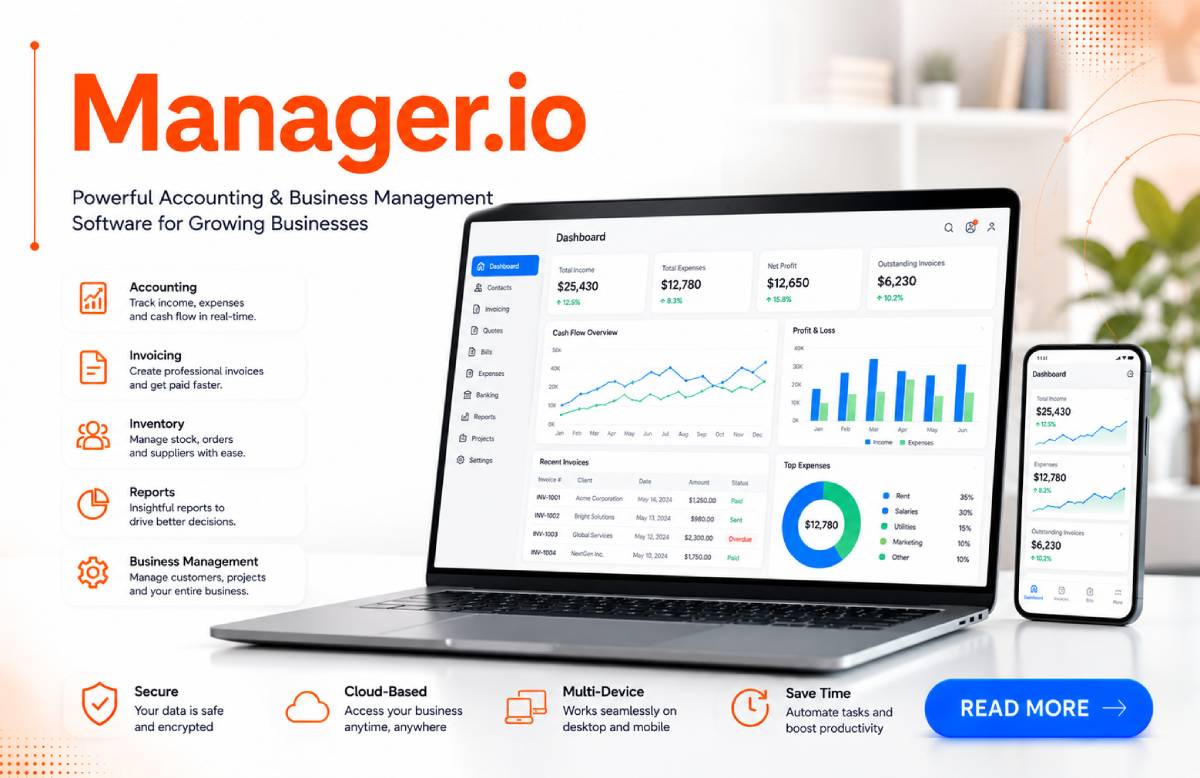
Manager.io is strengthening accessible digital accounting by providing businesses with tools to manage financial records, transactions and reporting through a streamlined accounting environment. Its positioning reflects growing demand for flexible financial-management software, particularly among small and mid-sized businesses seeking greater control over accounting processes without the complexity of traditional enterprise systems.
Manager.io is designed to support core accounting activities including invoicing, expenses, payments, financial reporting and transaction management. The platform aims to provide businesses with a structured environment for maintaining financial records and monitoring business performance.
Its accounting capabilities are particularly relevant to small businesses, independent professionals and organizations seeking an alternative to more complex accounting ecosystems.
The platform's approach reflects a wider shift toward accessible financial-management technology, where businesses increasingly expect accounting systems to combine usability with meaningful reporting capabilities.
For business leaders, digital accounting can improve financial visibility, reduce manual administrative work and create more consistent processes for tracking revenue, expenses and other financial activity.
Accounting technology has undergone a major transformation as businesses move from spreadsheets and desktop-based systems toward digital financial-management platforms. The change has been driven by the need for faster reporting, improved financial visibility and more efficient administrative processes.
Small and mid-sized businesses face particular challenges. They often require reliable accounting capabilities but may lack the resources or technical infrastructure associated with larger enterprise finance systems.
Manager.io operates within this gap by emphasizing a straightforward accounting environment designed around essential financial-management functions. This positioning reflects a broader trend toward software that provides professional financial capabilities without excessive complexity.
The economic relevance is significant. Accurate accounting supports cash-flow management, budgeting, tax preparation and strategic decision-making. In uncertain economic environments, timely financial information can become particularly important as businesses monitor costs and protect margins.
For executives, accounting software is increasingly viewed as part of the company's operational infrastructure. The ability to access accurate financial information can directly influence decisions around hiring, investment, pricing and expansion.
Manager.io's value proposition is closely linked to accessibility and core accounting functionality. For smaller organizations, a system that is easier to understand and manage can reduce the operational burden associated with maintaining financial records.
Financial technology experts generally emphasize that accounting software should be evaluated not only by its feature set but also by reporting accuracy, security, compliance capabilities and integration with other business systems.
Digital accounting can also improve collaboration between business owners, accountants and financial advisers by providing a centralized source of financial information. However, software does not replace professional judgment where complex tax, regulatory or financial matters are involved.
The broader accounting-software market is moving toward automation, real-time reporting, bank integrations and AI-assisted financial analysis. These capabilities are changing expectations around how quickly businesses can understand their financial position.
For executives, the strategic objective is clear: use financial technology to improve visibility and decision-making while maintaining strong controls over sensitive financial data. For businesses, digital accounting can simplify transaction management, invoicing and financial reporting while reducing reliance on manual spreadsheets. Better access to financial information can support cash-flow monitoring and more disciplined decision-making.
For investors and executives, reliable accounting infrastructure can improve transparency and provide a stronger foundation for assessing business performance. Small businesses may particularly benefit from systems that reduce administrative complexity.
The policy dimension includes tax compliance, financial record retention, privacy and cybersecurity. Businesses must ensure that accounting processes meet applicable regulatory requirements and that sensitive financial information is adequately protected.
Executives should evaluate reporting capabilities, data security, scalability, integrations and accounting requirements before adopting or expanding a digital financial-management system.
Accounting software is expected to become increasingly automated, with AI-assisted reporting, transaction categorization, forecasting and financial insights becoming more common. Manager.io is positioned within the broader movement toward accessible digital financial management. Decision-makers should monitor automation accuracy, security, compliance and integration capabilities. The long-term advantage will come from systems that turn accounting data into timely financial intelligence while keeping core financial processes reliable and transparent.
Source: Manager.io and Crozdesk
Date: August 13, 2026


