
Dell NVIDIA DataRobot Launch Enterprise AI Factory

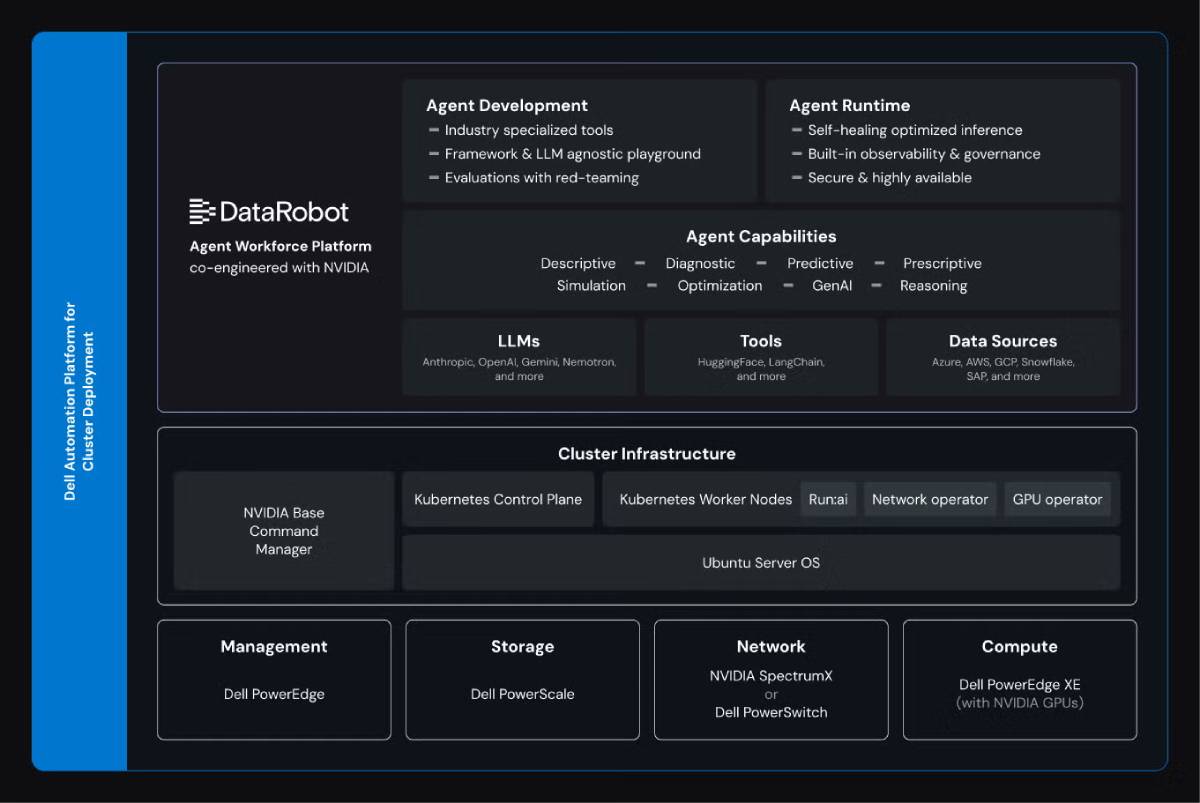
The Dell AI Factory combines hardware, software, and AI orchestration to deliver end-to-end enterprise AI solutions. NVIDIA provides high-performance GPU infrastructure.

March 30, 2026
|
Image credit: https://www.datarobot.com/

A major development unfolded as Dell Technologies, in partnership with NVIDIA and operationalized by DataRobot, unveiled a fully integrated AI Factory. The platform aims to enable secure, scalable agentic AI workforces for enterprises, signalling a strategic shift in operational efficiency, automation, and enterprise AI adoption globally.

The Dell AI Factory combines hardware, software, and AI orchestration to deliver end-to-end enterprise AI solutions. NVIDIA provides high-performance GPU infrastructure, while DataRobot operationalizes AI models for autonomous task execution at scale.

Enterprises can now deploy agentic AI across complex workflows, from data ingestion and predictive analytics to decision automation, reducing operational bottlenecks. The platform emphasizes security, compliance, and governance, catering to regulated industries such as finance, healthcare, and manufacturing. The rollout targets multinational corporations seeking to accelerate AI adoption while maintaining control, transparency, and measurable business outcomes.

The launch of the Dell AI Factory aligns with a broader global trend where enterprises are embracing agentic AI autonomous systems capable of performing complex tasks without human intervention. Traditional AI deployments often struggle with scalability, integration, and governance, challenges this solution directly addresses.

Historically, enterprise AI adoption has been incremental due to infrastructure complexity, model reliability concerns, and regulatory scrutiny. By combining Dell’s hardware, NVIDIA’s compute power, and DataRobot’s operational expertise, the platform provides a unified solution designed for enterprise-scale deployment.

Across sectors, executives are seeking ways to improve efficiency, reduce operational costs, and accelerate innovation. The AI Factory model represents a paradigm shift from piecemeal AI projects to fully managed, secure, and scalable AI workforces. This move also underscores how strategic partnerships between technology providers are becoming central to enterprise digital transformation.

Industry analysts highlight that the Dell AI Factory represents a milestone in operationalizing AI at scale, particularly for complex enterprise workflows. Experts note that integrated platforms like this reduce deployment friction, shorten time-to-value, and enhance governance and compliance, critical in regulated sectors.

Executives from DataRobot emphasize that the solution enables organizations to deploy agentic AI without sacrificing control or security. Officials from Dell Technologies and NVIDIA stress the importance of hardware-software synergy to optimize AI workloads and ensure sustainable scalability.

Analysts caution that adoption success will depend on enterprise readiness, cultural alignment, and continuous oversight. The platform is seen as a blueprint for future AI-powered operational models across global markets, demonstrating how partnerships can accelerate AI adoption.

For global executives, the Dell AI Factory signals a shift toward enterprise-scale AI automation, potentially redefining operational strategies, workforce allocation, and decision-making processes. Companies adopting the platform can enhance productivity, streamline workflows, and accelerate digital transformation initiatives.

Investors may view enterprise AI as a high-growth opportunity, particularly where integrated, secure, and scalable solutions reduce deployment risks. From a policy perspective, regulators will likely examine AI governance, security standards, and compliance frameworks to ensure enterprise AI adoption aligns with data protection and ethical guidelines.

Organizations will need to balance automation gains with workforce considerations, regulatory adherence, and long-term AI strategy. Looking ahead, enterprises are expected to accelerate adoption of integrated AI workforces, leveraging platforms like the Dell AI Factory to achieve operational efficiency at scale. Decision-makers should monitor AI performance metrics, security safeguards, and regulatory compliance.

Key uncertainties include evolving governance standards, integration challenges, and workforce adaptation. As enterprises deploy agentic AI more widely, the success of such initiatives will hinge on careful orchestration, oversight, and strategic alignment across global operations.

Source: DataRobot
Date: 2026

  • Featured tools
WellSaid Ai
Free

WellSaid AI is an advanced text-to-speech platform that transforms written text into lifelike, human-quality voiceovers.

#
Text to Speech
Learn more
Symphony Ayasdi AI
Free

SymphonyAI Sensa is an AI-powered surveillance and financial crime detection platform that surfaces hidden risk behavior through explainable, AI-driven analytics.

#
Finance
Learn more

Learn more about future of AI

Join 80,000+ Ai enthusiast getting weekly updates on exciting AI tools.
Thank you! Your submission has been received!
Oops! Something went wrong while submitting the form.

Dell NVIDIA DataRobot Launch Enterprise AI Factory

March 30, 2026

The Dell AI Factory combines hardware, software, and AI orchestration to deliver end-to-end enterprise AI solutions. NVIDIA provides high-performance GPU infrastructure.

Image credit: https://www.datarobot.com/

A major development unfolded as Dell Technologies, in partnership with NVIDIA and operationalized by DataRobot, unveiled a fully integrated AI Factory. The platform aims to enable secure, scalable agentic AI workforces for enterprises, signalling a strategic shift in operational efficiency, automation, and enterprise AI adoption globally.

The Dell AI Factory combines hardware, software, and AI orchestration to deliver end-to-end enterprise AI solutions. NVIDIA provides high-performance GPU infrastructure, while DataRobot operationalizes AI models for autonomous task execution at scale.

Enterprises can now deploy agentic AI across complex workflows, from data ingestion and predictive analytics to decision automation, reducing operational bottlenecks. The platform emphasizes security, compliance, and governance, catering to regulated industries such as finance, healthcare, and manufacturing. The rollout targets multinational corporations seeking to accelerate AI adoption while maintaining control, transparency, and measurable business outcomes.

The launch of the Dell AI Factory aligns with a broader global trend where enterprises are embracing agentic AI autonomous systems capable of performing complex tasks without human intervention. Traditional AI deployments often struggle with scalability, integration, and governance, challenges this solution directly addresses.

Historically, enterprise AI adoption has been incremental due to infrastructure complexity, model reliability concerns, and regulatory scrutiny. By combining Dell’s hardware, NVIDIA’s compute power, and DataRobot’s operational expertise, the platform provides a unified solution designed for enterprise-scale deployment.

Across sectors, executives are seeking ways to improve efficiency, reduce operational costs, and accelerate innovation. The AI Factory model represents a paradigm shift from piecemeal AI projects to fully managed, secure, and scalable AI workforces. This move also underscores how strategic partnerships between technology providers are becoming central to enterprise digital transformation.

Industry analysts highlight that the Dell AI Factory represents a milestone in operationalizing AI at scale, particularly for complex enterprise workflows. Experts note that integrated platforms like this reduce deployment friction, shorten time-to-value, and enhance governance and compliance, critical in regulated sectors.

Executives from DataRobot emphasize that the solution enables organizations to deploy agentic AI without sacrificing control or security. Officials from Dell Technologies and NVIDIA stress the importance of hardware-software synergy to optimize AI workloads and ensure sustainable scalability.

Analysts caution that adoption success will depend on enterprise readiness, cultural alignment, and continuous oversight. The platform is seen as a blueprint for future AI-powered operational models across global markets, demonstrating how partnerships can accelerate AI adoption.

For global executives, the Dell AI Factory signals a shift toward enterprise-scale AI automation, potentially redefining operational strategies, workforce allocation, and decision-making processes. Companies adopting the platform can enhance productivity, streamline workflows, and accelerate digital transformation initiatives.

Investors may view enterprise AI as a high-growth opportunity, particularly where integrated, secure, and scalable solutions reduce deployment risks. From a policy perspective, regulators will likely examine AI governance, security standards, and compliance frameworks to ensure enterprise AI adoption aligns with data protection and ethical guidelines.

Organizations will need to balance automation gains with workforce considerations, regulatory adherence, and long-term AI strategy. Looking ahead, enterprises are expected to accelerate adoption of integrated AI workforces, leveraging platforms like the Dell AI Factory to achieve operational efficiency at scale. Decision-makers should monitor AI performance metrics, security safeguards, and regulatory compliance.

Key uncertainties include evolving governance standards, integration challenges, and workforce adaptation. As enterprises deploy agentic AI more widely, the success of such initiatives will hinge on careful orchestration, oversight, and strategic alignment across global operations.

Source: DataRobot
Date: 2026

Promote Your Tool

Copy Embed Code

Similar Blogs

June 25, 2026
|

OQ Tech Boosts Satellite Position

The European financing package will support OQ Technology’s expansion of its low Earth orbit (LEO) satellite constellation aimed at providing direct-to-device connectivity.
Read more
June 25, 2026
|

Women Led Startups Show Funding Gap

The startup ecosystem has seen a steady increase in women-founded and women-led companies, particularly in sectors such as digital services, healthtech, fintech, and sustainability-driven innovation.
Read more
June 25, 2026
|

AI Healthcare Unlocks Transformation Potential

AI applications in healthcare are expanding across multiple domains, including clinical decision support, medical imaging, drug discovery, and patient management systems.
Read more
June 25, 2026
|

Helical Raises $10M for AI Drug Lab

The funding round will enable Helical to scale its virtual AI lab infrastructure, which simulates complex biological processes for drug discovery.
Read more
June 25, 2026
|

Digital Healthtech Faces Investor Pressure

The guidance highlights that digital health startups must now demonstrate stronger clinical validation, data security standards, and measurable patient outcomes to secure investor confidence.
Read more
June 25, 2026
|

Luxembourg Space Strategy Turns Decade

Over the past ten years, Luxembourg has systematically developed its space sector through targeted investments, policy frameworks, and partnerships with private space companies.
Read more