



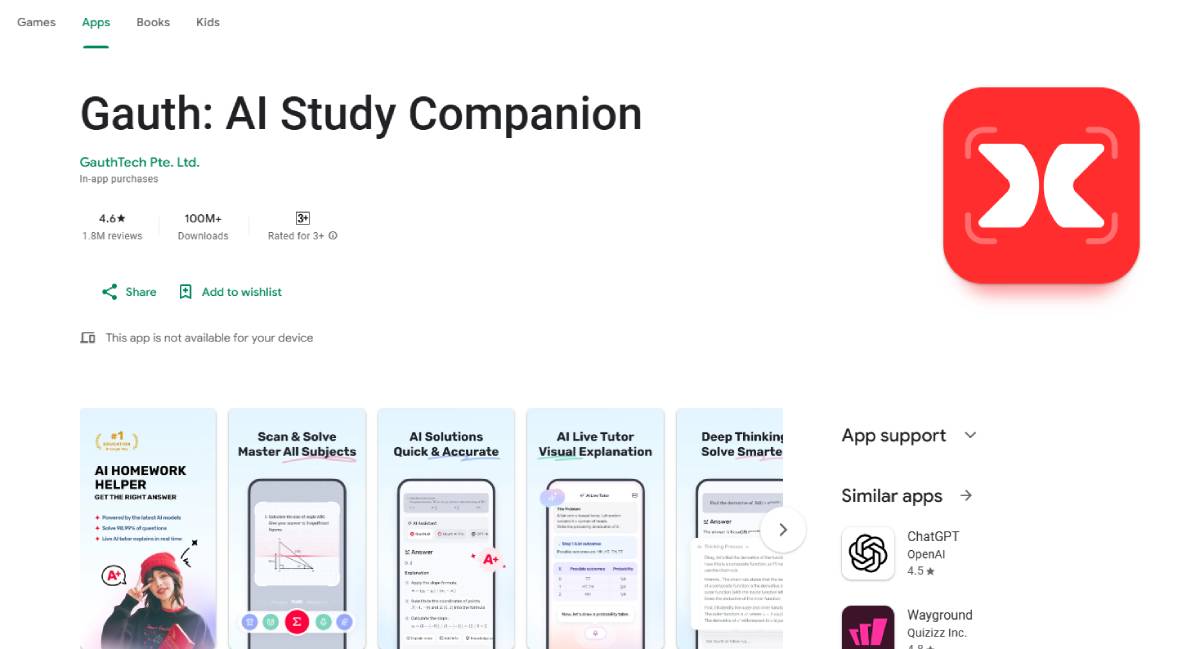
A major development in mobile education technology is unfolding as Gauth: AI Study Companion scales AI-powered academic assistance globally. The platform highlights the rapid shift toward on-demand, smartphone-based tutoring, signaling transformative implications for students, educators, and the future of personalized learning ecosystems.
Gauth AI Study Companion offers a mobile-first AI tutoring solution designed to assist students across subjects such as mathematics, science, and language learning. The app integrates AI-driven problem-solving, step-by-step explanations, and interactive query handling, positioning itself as a real-time academic support tool.
The platform leverages generative AI models to interpret and respond to student queries, often including image-based inputs such as photographed homework problems. Its accessibility via mobile devices makes it particularly relevant in emerging markets where smartphones are the primary digital learning interface. As adoption of AI in education accelerates, Gauth is gaining traction in the competitive global EdTech landscape.
The rise of Gauth: AI Study Companion reflects a broader transformation in education systems worldwide, driven by the convergence of mobile technology and artificial intelligence. Over the past decade, EdTech has evolved from static digital content platforms to interactive, AI-driven learning environments.
This shift has been accelerated by increasing smartphone penetration and the normalization of remote and hybrid learning models. AI tutoring apps now offer scalable alternatives to traditional coaching and tutoring services, particularly in regions with limited access to quality education resources.
Globally, governments and institutions are exploring ways to integrate AI into curricula while maintaining academic standards. The emergence of AI study companions represents a move toward hyper-personalized education, where learning pathways are tailored in real time. This trend is reshaping expectations around accessibility, affordability, and efficiency in education delivery systems.
Education analysts view platforms like Gauth: AI Study Companion as a key driver of “mobile-first AI learning,” where students increasingly rely on handheld devices for real-time academic support. This model is particularly impactful in regions with large student populations and limited access to traditional tutoring.
Learning scientists highlight that AI tutoring systems can enhance understanding by providing instant feedback and personalized explanations. However, they also caution that excessive reliance on AI tools could undermine independent problem-solving skills if not guided properly.
Policy experts emphasize the importance of integrating such tools within structured educational frameworks. Concerns include academic integrity, data privacy, and equitable access. At the same time, proponents argue that AI companions can significantly improve learning outcomes when used responsibly, particularly in underserved communities.
For businesses, Gauth: AI Study Companion highlights the growing demand for scalable, subscription-based AI education services. EdTech companies may increasingly prioritize mobile-first strategies and AI-driven personalization to capture global student markets.
For policymakers and academic institutions, the proliferation of AI tutoring apps raises questions around curriculum alignment, exam integrity, and regulatory oversight. Institutions may need to redesign assessment frameworks to adapt to AI-assisted learning environments.
For investors, the AI-driven education segment represents a high-growth opportunity, particularly in emerging markets where demand for affordable and accessible learning solutions continues to rise.
The AI tutoring market is expected to expand rapidly as mobile adoption and AI capabilities continue to grow. Gauth: AI Study Companion is likely to evolve toward deeper personalization, multilingual support, and integration with formal education systems. However, regulatory clarity and responsible usage frameworks will be critical in shaping long-term adoption. The future of education may increasingly hinge on balancing AI efficiency with human-led learning outcomes.
Source: Google Play Store (Gauth App)
Date: April 10, 2026


