



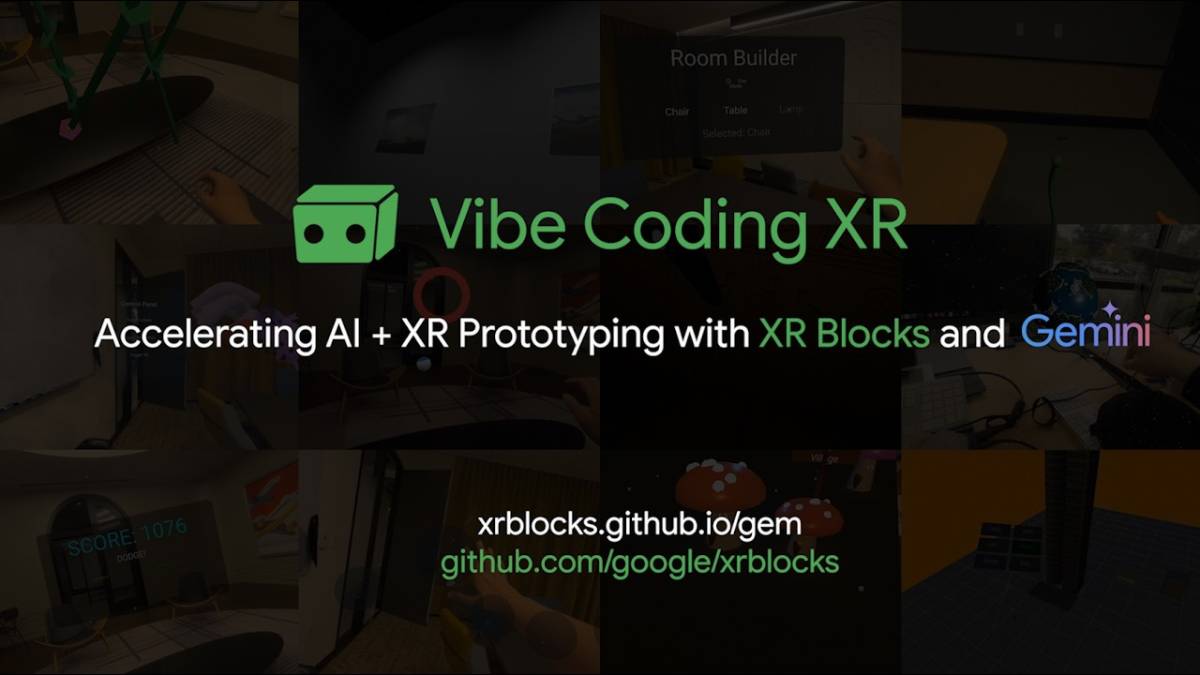
Google today introduced Vibe Coding XR, a rapid prototyping workflow that combines Gemini Canvas with the open-source XR Blocks framework to convert user prompts into fully interactive XR experiences. The platform aims to streamline design-to-deployment cycles for developers and enterprises, signaling a significant step forward in AI-powered immersive technology adoption worldwide.
Vibe Coding XR enables rapid XR prototyping from textual prompts, integrating the capabilities of Gemini Canvas with XR Blocks’ modular, open-source framework. The tool primarily targets XR developers, enterprise innovation teams, and AI researchers. Early access is currently available, with broader enterprise deployment expected later this year. By reducing development cycles, Vibe Coding XR can accelerate commercialization of XR products, potentially reshaping market dynamics in enterprise AR/VR sectors. The platform also emphasizes open-source adoption, aligning with Google’s strategy to make AI tools more accessible while standardizing XR development frameworks across industries.
The launch of Vibe Coding XR comes at a time when AI integration is rapidly transforming the extended reality (XR) landscape. Businesses across education, retail, healthcare, and industrial training are seeking faster ways to deliver immersive experiences. Traditional XR development has been slowed by complex coding requirements and lengthy prototyping cycles, creating barriers to market entry. By combining AI-driven design through Gemini Canvas with XR Blocks’ open-source architecture, Google offers a low-code, no-code path from concept to functional XR prototype. Historically, fragmented tools and high costs have slowed adoption, but Vibe Coding XR could establish a new standard for AI-augmented XR workflows. This development aligns with broader global trends emphasizing AI democratization, open-source collaboration, and the accelerated commercialization of immersive technologies.
Industry analysts have described Vibe Coding XR as a game-changer for enterprise XR development, noting its potential to significantly shorten innovation cycles. A Google spokesperson stated that the workflow bridges the gap between conceptual ideas and fully interactive XR environments, enabling rapid iteration without the need for extensive coding expertise. Experts suggest that organizations adopting the platform could reduce time-to-market for XR solutions by up to 40 percent, enhancing competitiveness in immersive technology sectors. Open-source advocates highlight XR Blocks as a model for collaborative innovation, allowing developers worldwide to build on standardized frameworks. Geopolitical analysts also note that as XR adoption grows, regulators are likely to focus more closely on AI and immersive content governance, particularly regarding copyright, accessibility, and privacy standards.
For enterprises, Vibe Coding XR could redefine operational strategies, enabling faster deployment of XR training, simulation, and customer engagement tools. Investors may see accelerated XR commercialization as a signal of growth opportunities in AI-driven immersive technology markets. Developers benefit from lower barriers to entry, fostering competition and innovation. Governments and regulatory bodies may need to evaluate frameworks for AI-generated immersive content, including copyright, accessibility, and ethical considerations. Analysts caution that companies failing to adopt AI-enhanced XR workflows risk falling behind competitors, while early adopters could gain first-mover advantages in rapidly evolving immersive technology sectors.
Google plans iterative updates to Vibe Coding XR, expanding compatibility with enterprise tools and XR devices. Executives should track adoption rates, interoperability challenges, and regulatory developments as immersive content becomes more prevalent. While uncertainties remain around standardization, data privacy, and integration with legacy systems, the platform positions Google as a leader in AI-driven XR innovation. Decision-makers must evaluate the pace at which they incorporate AI prototyping into their XR strategies.
Source: Google Research Blog – Vibe Coding XR
Date: 26 March 2026


