



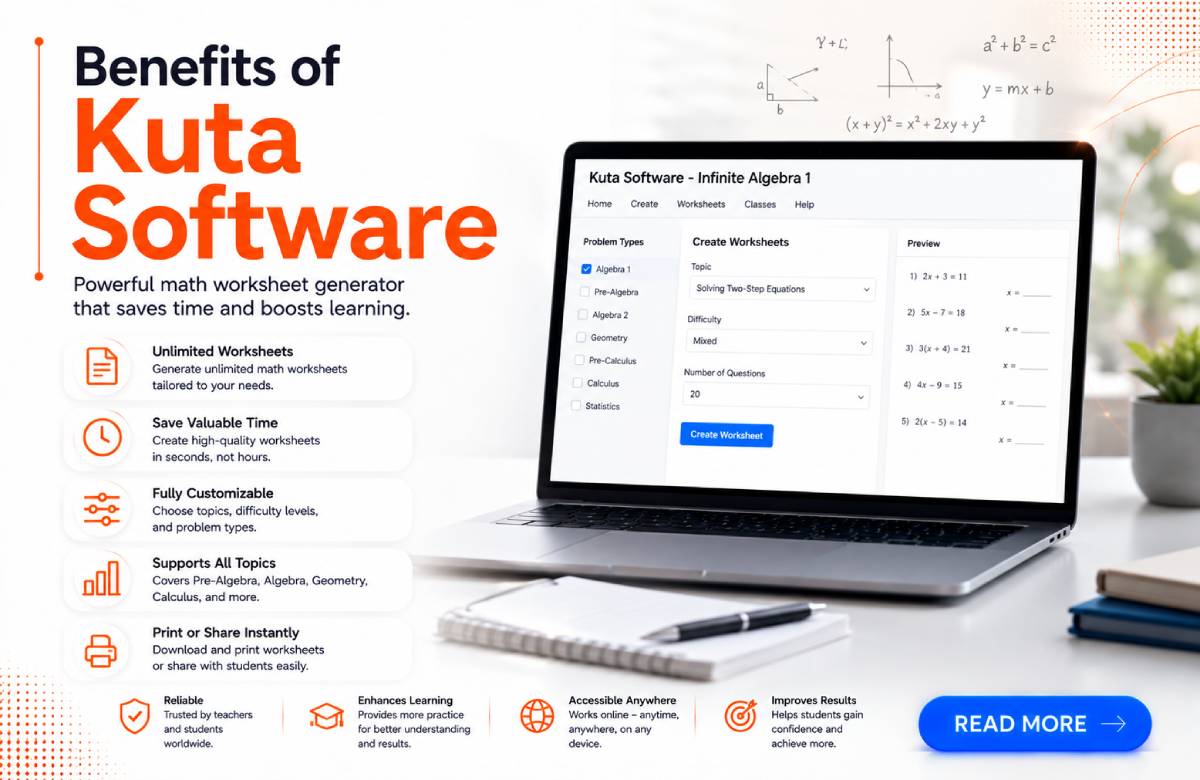
Kuta Software continues to support mathematics education with specialized tools designed to help teachers create worksheets, assignments and assessments across core mathematical subjects. Its focus on customizable practice materials reflects a broader shift in education toward technology-enabled learning, where schools increasingly seek flexible resources that support differentiated instruction and efficient classroom management.
Kuta Software provides educators with mathematics-focused software designed to simplify the creation of customized worksheets and practice assignments. Its product ecosystem covers areas including algebra, geometry, trigonometry, calculus and related mathematics topics.
A central feature of the platform is automated worksheet generation, allowing teachers to create different problem sets while maintaining control over topics, difficulty and question formats. This can reduce the time educators spend preparing repetitive instructional materials.
The platform also supports answer keys and printable resources, making it relevant for classroom instruction, homework and assessment preparation. Its specialized approach distinguishes it from broader learning-management platforms by concentrating heavily on mathematics content and practice.
Education systems worldwide are increasingly adopting digital tools to supplement traditional classroom instruction. However, mathematics remains an area where structured practice, repetition and carefully calibrated difficulty continue to play a significant role in student learning.
Teachers often face the challenge of creating enough differentiated material to meet students with different skill levels. Manual worksheet preparation can consume valuable instructional planning time, particularly when educators need multiple versions of assignments or additional practice for specific concepts.
Kuta Software's approach addresses this operational challenge by automating much of the content-generation process while allowing teachers to retain control over the instructional material.
The broader trend is significant for education leaders. Rather than replacing teachers, specialized educational technology increasingly aims to reduce administrative workload and give educators more time for instruction, intervention and student engagement. Mathematics-focused platforms therefore occupy a practical niche within the expanding education technology ecosystem.
Education technology specialists generally emphasize that effective digital learning tools should complement teaching rather than attempt to replace educator judgment. Mathematics instruction is particularly suited to this model because students often require repeated practice and immediate opportunities to work through variations of the same concept.
Kuta Software's value proposition centers on this practical requirement. By automating worksheet creation, teachers can generate additional practice without repeatedly developing problems manually.
Another advantage is customization. Educators can adjust assignments to reflect specific topics and classroom requirements, supporting differentiated instruction across varying levels of student ability.
The key consideration for schools is how such tools fit within broader instructional strategies. Technology can improve efficiency, but learning outcomes still depend on curriculum alignment, teacher guidance, student engagement and appropriate assessment practices.
For schools and education administrators, specialized mathematics software can potentially reduce teacher preparation time and provide more consistent access to structured practice materials. This may be particularly valuable in environments where educators face heavy workloads or limited instructional resources.
For teachers, automated content generation can support differentiated assignments while allowing greater focus on classroom interaction and student support.
For policymakers, the broader adoption of educational technology raises questions around accessibility, digital equity, curriculum standards and responsible technology use. Schools must ensure that digital resources complement rather than widen disparities between students with different levels of technology access.
Education leaders should therefore evaluate platforms not only on convenience but also on curriculum alignment, usability, teacher adoption and measurable educational value. Kuta Software's future relevance will depend on how effectively specialized mathematics tools adapt to increasingly digital classrooms. Opportunities include deeper personalization, analytics, interactive learning and integration with broader educational platforms. As schools continue balancing technology investment with instructional outcomes, providers that combine teacher control, curriculum relevance and efficient content creation are likely to remain valuable components of modern mathematics education.
Source: Serchen
Date: August 14, 2026


