
MagicSchool Scales AI Across Classrooms

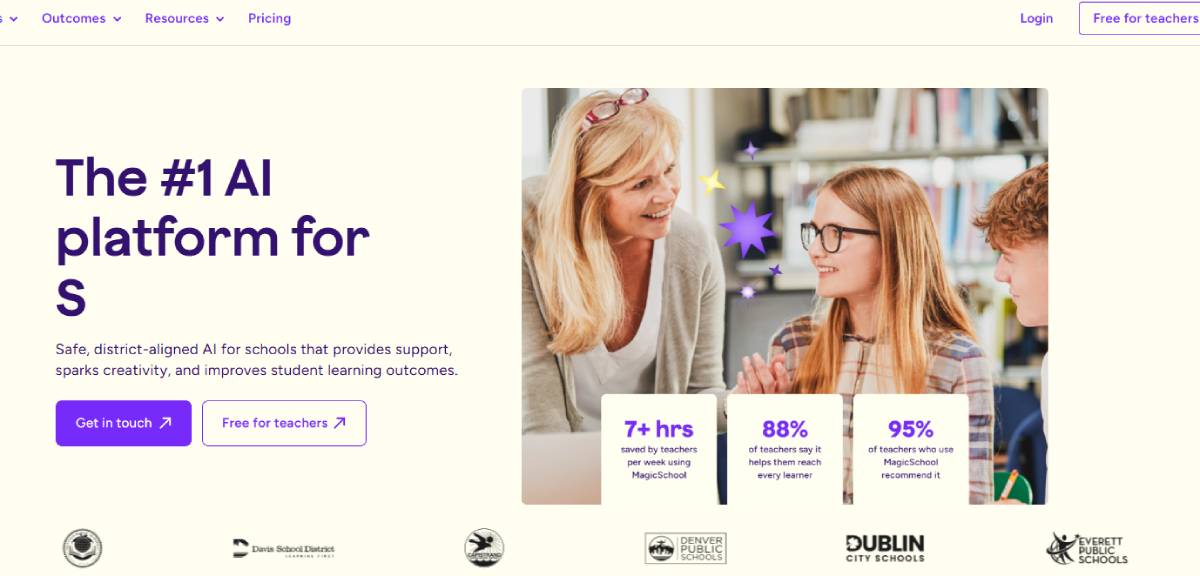
MagicSchool offers a suite of AI-powered tools tailored for educators, including lesson plan generation, differentiated instruction support, grading assistance, and communication templates.

April 13, 2026
|

AI adoption in education is accelerating as MagicSchool positions itself as a dedicated platform for school districts, enabling teachers to automate lesson planning, assessments, and administrative tasks. The shift underscores a broader transformation in K-12 systems, with implications for educators, policymakers, and EdTech investors worldwide.

MagicSchool offers a suite of AI-powered tools tailored for educators, including lesson plan generation, differentiated instruction support, grading assistance, and communication templates. The platform is designed specifically for school districts, emphasizing safety, compliance, and ease of use.

It integrates with existing classroom workflows, allowing teachers to save time on repetitive tasks while focusing more on student engagement. The platform also includes guardrails to ensure responsible AI usage in educational environments.

Key stakeholders include school administrators, teachers, students, EdTech providers, and policymakers. The platform’s rapid adoption reflects increasing institutional demand for scalable AI solutions that address both instructional efficiency and administrative burden in education systems.

The rise of platforms like MagicSchool aligns with a broader trend across global markets where generative AI is being embedded into institutional workflows. In education, this shift is particularly pronounced as schools seek to modernize teaching methods while managing resource constraints and increasing administrative complexity.

Historically, digital transformation in education has been gradual, with tools such as learning management systems and online classrooms paving the way. However, generative AI introduces a new layer of automation and personalization, enabling real-time content creation and adaptive learning experiences.

This evolution comes amid growing pressure on educators to deliver improved outcomes with limited time and resources. Governments and institutions are increasingly exploring AI as a means to enhance productivity, reduce burnout, and address disparities in access to quality education.

Education experts view AI platforms like MagicSchool as a potential catalyst for redefining teaching roles. Analysts suggest that automation of administrative and repetitive tasks could allow educators to focus more on mentorship, critical thinking, and individualized student support.

However, concerns remain around data privacy, algorithmic bias, and over-reliance on AI-generated content. Policymakers and education leaders emphasize the need for robust governance frameworks to ensure ethical and transparent AI usage in classrooms.

Industry stakeholders highlight the importance of teacher training and digital literacy to maximize the benefits of AI tools. Without proper implementation strategies, experts warn that the technology could exacerbate existing inequalities rather than resolve them.

For businesses, MagicSchool represents a growing opportunity in the institutional EdTech segment, where demand for AI-driven productivity tools is expanding rapidly. Companies that can deliver secure, compliant, and scalable solutions are likely to gain traction with school districts and governments.

Investors are increasingly focusing on platforms that address real-world pain points in education, such as teacher workload and resource optimization.

From a policy perspective, regulators must address issues related to student data protection, AI transparency, and equitable access. Education systems may need to establish clear guidelines on AI usage, ensuring that technology enhances not replaces human-led instruction.

AI platforms for education are expected to evolve toward deeper personalization, real-time analytics, and tighter integration with institutional systems. Decision-makers should monitor adoption rates, regulatory developments, and measurable impacts on learning outcomes. The long-term trajectory will depend on how effectively AI tools like MagicSchool balance efficiency with educational integrity and human-centered teaching.

Source: MagicSchool
Date: April 2026

  • Featured tools
Writesonic AI
Free

Writesonic AI is a versatile AI writing platform designed for marketers, entrepreneurs, and content creators. It helps users create blog posts, ad copies, product descriptions, social media posts, and more with ease. With advanced AI models and user-friendly tools, Writesonic streamlines content production and saves time for busy professionals.

#
Copywriting
Learn more
Kreateable AI
Free

Kreateable AI is a white-label, AI-driven design platform that enables logo generation, social media posts, ads, and more for businesses, agencies, and service providers.

#
Logo Generator
Learn more

Learn more about future of AI

Join 80,000+ Ai enthusiast getting weekly updates on exciting AI tools.
Thank you! Your submission has been received!
Oops! Something went wrong while submitting the form.

MagicSchool Scales AI Across Classrooms

April 13, 2026

MagicSchool offers a suite of AI-powered tools tailored for educators, including lesson plan generation, differentiated instruction support, grading assistance, and communication templates.

AI adoption in education is accelerating as MagicSchool positions itself as a dedicated platform for school districts, enabling teachers to automate lesson planning, assessments, and administrative tasks. The shift underscores a broader transformation in K-12 systems, with implications for educators, policymakers, and EdTech investors worldwide.

MagicSchool offers a suite of AI-powered tools tailored for educators, including lesson plan generation, differentiated instruction support, grading assistance, and communication templates. The platform is designed specifically for school districts, emphasizing safety, compliance, and ease of use.

It integrates with existing classroom workflows, allowing teachers to save time on repetitive tasks while focusing more on student engagement. The platform also includes guardrails to ensure responsible AI usage in educational environments.

Key stakeholders include school administrators, teachers, students, EdTech providers, and policymakers. The platform’s rapid adoption reflects increasing institutional demand for scalable AI solutions that address both instructional efficiency and administrative burden in education systems.

The rise of platforms like MagicSchool aligns with a broader trend across global markets where generative AI is being embedded into institutional workflows. In education, this shift is particularly pronounced as schools seek to modernize teaching methods while managing resource constraints and increasing administrative complexity.

Historically, digital transformation in education has been gradual, with tools such as learning management systems and online classrooms paving the way. However, generative AI introduces a new layer of automation and personalization, enabling real-time content creation and adaptive learning experiences.

This evolution comes amid growing pressure on educators to deliver improved outcomes with limited time and resources. Governments and institutions are increasingly exploring AI as a means to enhance productivity, reduce burnout, and address disparities in access to quality education.

Education experts view AI platforms like MagicSchool as a potential catalyst for redefining teaching roles. Analysts suggest that automation of administrative and repetitive tasks could allow educators to focus more on mentorship, critical thinking, and individualized student support.

However, concerns remain around data privacy, algorithmic bias, and over-reliance on AI-generated content. Policymakers and education leaders emphasize the need for robust governance frameworks to ensure ethical and transparent AI usage in classrooms.

Industry stakeholders highlight the importance of teacher training and digital literacy to maximize the benefits of AI tools. Without proper implementation strategies, experts warn that the technology could exacerbate existing inequalities rather than resolve them.

For businesses, MagicSchool represents a growing opportunity in the institutional EdTech segment, where demand for AI-driven productivity tools is expanding rapidly. Companies that can deliver secure, compliant, and scalable solutions are likely to gain traction with school districts and governments.

Investors are increasingly focusing on platforms that address real-world pain points in education, such as teacher workload and resource optimization.

From a policy perspective, regulators must address issues related to student data protection, AI transparency, and equitable access. Education systems may need to establish clear guidelines on AI usage, ensuring that technology enhances not replaces human-led instruction.

AI platforms for education are expected to evolve toward deeper personalization, real-time analytics, and tighter integration with institutional systems. Decision-makers should monitor adoption rates, regulatory developments, and measurable impacts on learning outcomes. The long-term trajectory will depend on how effectively AI tools like MagicSchool balance efficiency with educational integrity and human-centered teaching.

Source: MagicSchool
Date: April 2026

Promote Your Tool

Copy Embed Code

Similar Blogs

April 13, 2026
|

AI Megacap Valuation Reset Sparks Timing Debate

The stock part of the dominant group of large-cap U.S. technology firms often referred to as the “Magnificent Seven” has experienced renewed price pressure despite continued investor interest in artificial intelligence exposure.
Read more
April 13, 2026
|

AI Valuation Concerns Trigger Market Reality Check

A recent analysis from Centre for Economic Policy Research questions whether current AI market valuations are aligned with realistic economic outputs.
Read more
April 13, 2026
|

Amazon Expands AI, Robotics, Space Bet

Amazon is advancing a multi-pronged innovation strategy spanning AI, robotics, satellite internet, and semiconductor design. The company continues to scale its custom AI chips through AWS.
Read more
April 13, 2026
|

Meta’s Muse AI Enters Daily Decision Making

Meta’s Muse Spark AI demonstrates the ability to analyze user inputs such as food choices and provide contextual recommendations, including rating meals and suggesting future options.
Read more
April 13, 2026
|

CFOs Shift from AI Funders to Strategic Operators

CFOs are increasingly embedding AI into core financial functions, including forecasting, budgeting, risk management, and performance analysis. This transition reflects a move from passive capital allocation to active operational leadership in AI adoption.
Read more
April 13, 2026
|

AI Stock Pick Splits Magnificent Seven Sentiment

Recent market corrections have prompted analysts to reassess valuations among the so-called “Magnificent Seven” technology stocks Apple, Microsoft, Alphabet, Amazon, Meta Platforms, Nvidia, and Tesla.
Read more