



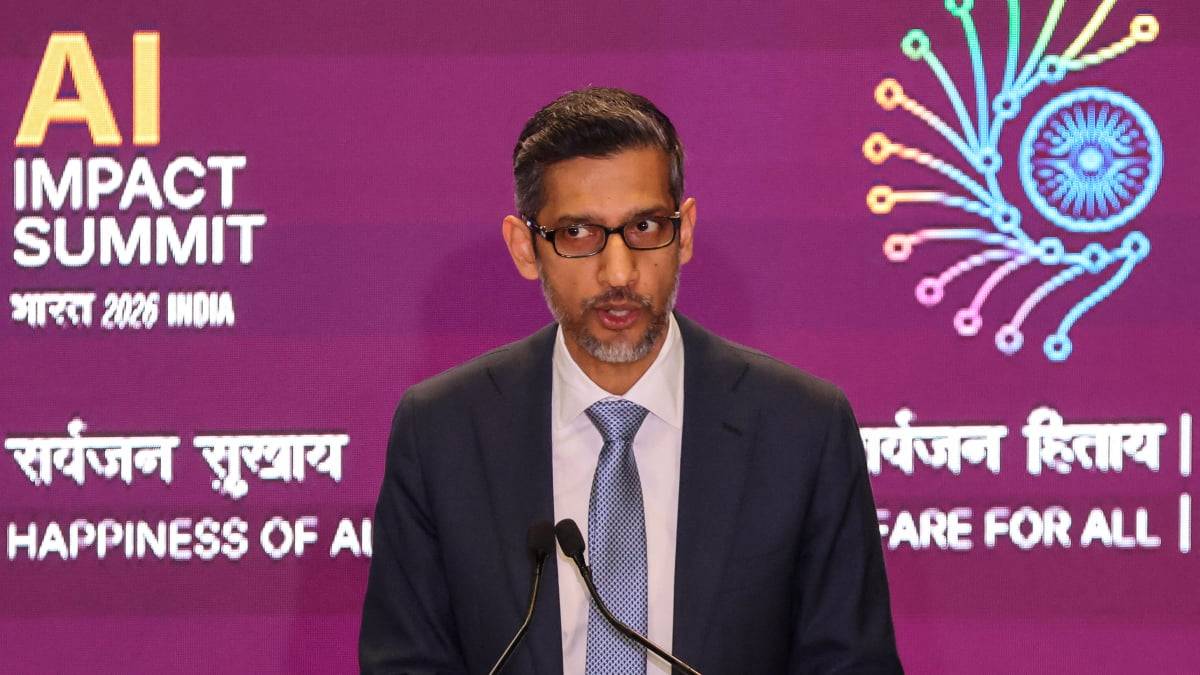
A major signal from the global AI race emerged in India as Google CEO Sundar Pichai outlined the company’s next phase of artificial intelligence expansion at the AI Impact Summit 2026. His remarks underscored India’s strategic importance in AI infrastructure, talent, and policy shaping global technology markets.
Speaking at the AI Impact Summit 2026, Sundar Pichai highlighted four core themes shaping Google’s AI roadmap. First, he emphasised accelerated AI integration across products, particularly in search, productivity tools, and cloud services. Second, he reaffirmed India’s role as a critical AI development hub, citing the country’s developer base and digital scale. Third, he pointed to infrastructure investments including data centres and AI compute expansion. Finally, he stressed responsible AI deployment, focusing on safety, multilingual accessibility, and inclusive growth.
The remarks position India as both a growth market and innovation engine within Google’s broader AI strategy. The development aligns with a broader global shift in which major technology firms are racing to secure AI leadership through infrastructure, model innovation, and regional partnerships. As competition intensifies among US and global tech giants, emerging markets such as India are becoming pivotal battlegrounds.
India offers a unique combination of scale, digital public infrastructure, and a vast engineering workforce. Government initiatives promoting semiconductor manufacturing, cloud infrastructure, and AI research have further strengthened its appeal.
For Google, expanding AI capabilities in India also aligns with efforts to localise services across languages and demographics. Multilingual AI remains a major opportunity, particularly in regions where English is not dominant. The summit reflects a convergence of corporate strategy and national ambition, with India seeking to shape AI governance while attracting foreign technology investment.
Pichai framed AI as a transformative platform shift comparable to the early internet and mobile eras. He reiterated that responsible development remains central to long term adoption and public trust.
Industry analysts view Google’s India emphasis as both strategic and competitive. As rivals expand enterprise AI offerings and cloud integrations, strengthening regional ecosystems provides leverage in securing enterprise and government contracts.
Policy experts note that India’s regulatory environment is still evolving, creating both opportunity and uncertainty. Companies engaging early with policymakers may gain influence in shaping standards around data protection, AI accountability, and digital infrastructure.
Market observers say the messaging signals Google’s intent to embed AI deeply across consumer and enterprise layers while reinforcing India’s role in global product development pipelines.
For global executives, Pichai’s remarks underscore the urgency of aligning AI investment with regional growth strategies. Businesses operating in India may benefit from enhanced cloud infrastructure, AI tooling, and developer ecosystems supported by Google’s expansion.
Investors are likely to interpret the strategy as a long term bet on emerging market demand for AI powered services. At the same time, regulatory clarity will remain critical for scaling enterprise adoption.
Governments may see intensified collaboration between technology firms and public digital platforms, particularly in areas such as healthcare, education, and financial inclusion. Companies must balance innovation speed with compliance and data governance requirements.
As AI competition accelerates globally, India’s role is set to expand further. Decision makers should monitor infrastructure commitments, enterprise adoption metrics, and regulatory developments that shape the operating environment.
Pichai’s address reinforces a central theme in the AI race: future leadership will depend as much on ecosystem depth and geographic alignment as on model performance.
Source: Mashable
Date: February 2026


