
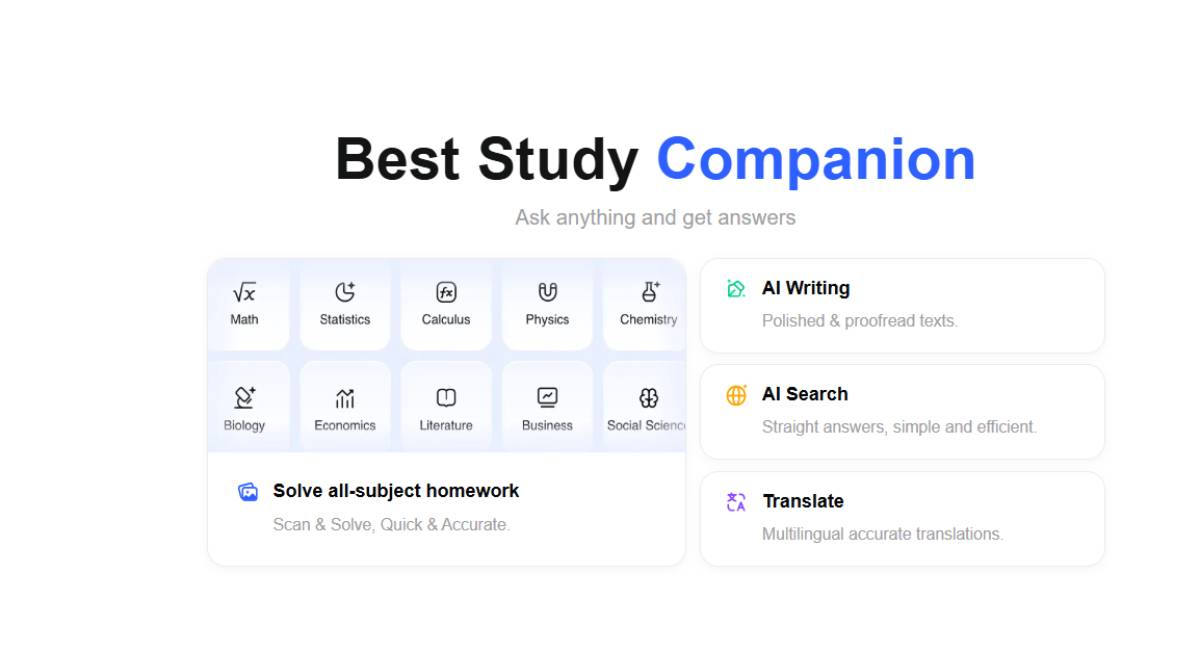
Question AI Accelerates AI-Driven Learning Support

The rise of AI-powered educational tools reflects a significant shift in how knowledge is accessed and consumed. Platforms like Question AI are part of a broader wave of EdTech innovation aimed at improving learning efficiency and accessibility.

April 9, 2026
|

A major development unfolded as Question AI scaled its AI-driven homework assistance platform, offering instant solutions across academic subjects. The move signals a broader transformation in global education technology, with implications for learning models, institutional integrity, and the growing role of AI in student productivity and assessment.

  • Question AI provides AI-powered solutions for academic queries, enabling students to receive instant answers and explanations.
  • The platform supports multiple subjects, including mathematics, science, and language-based assignments.
  • It leverages AI to interpret and solve questions, often through text or image-based inputs.
  • The tool targets students, educators, and self-learners seeking efficient academic support.
  • Its accessibility and ease of use position it as a scalable solution in global EdTech markets.
  • Analysts highlight its potential to reshape traditional study methods and reduce reliance on conventional tutoring services.

The rise of AI-powered educational tools reflects a significant shift in how knowledge is accessed and consumed. Platforms like Question AI are part of a broader wave of EdTech innovation aimed at improving learning efficiency and accessibility.

Globally, education systems are undergoing transformation as digital tools become integral to both formal and informal learning environments. The COVID-19 pandemic accelerated adoption of online learning, creating fertile ground for AI-driven solutions.

However, the increasing use of AI in education also raises questions about academic integrity, assessment standards, and the role of educators. Institutions are grappling with how to integrate these tools while maintaining rigorous evaluation processes. The development underscores the growing influence of AI in shaping the future of education and workforce readiness.

Education and technology experts view AI homework assistants as both an opportunity and a challenge. “AI tools can democratize access to knowledge, but they also require careful integration into academic systems,” noted an EdTech analyst.

Platforms like Question AI are praised for improving accessibility, particularly in regions with limited access to quality educational resources. However, experts caution that over-reliance on AI could impact critical thinking and problem-solving skills.

Educators emphasize the need for balanced adoption, where AI complements rather than replaces traditional learning methods. Analysts also highlight the competitive landscape, with multiple AI-driven platforms entering the education sector. The ability to combine accuracy, usability, and ethical considerations will be critical in determining

For global executives, the rise of AI-powered education tools signals significant opportunities in the EdTech sector. Companies may explore partnerships, integrations, and new business models to capitalize on growing demand.

Investors could view this as a high-growth segment, driven by increasing adoption of digital learning solutions. However, concerns around academic integrity and regulatory compliance may influence market dynamics.

From a policy perspective, governments and educational institutions may need to establish guidelines for the use of AI in academic settings. This could include frameworks for ethical use, assessment standards, and data privacy, ensuring that AI enhances rather than undermines educational outcomes.

Decision-makers should monitor adoption trends, institutional responses, and regulatory developments in AI-driven education. Future advancements may include more personalized learning experiences and deeper integration into formal education systems.

Key uncertainties include the balance between innovation and academic integrity, as well as long-term impacts on learning outcomes. For executives and policymakers, the evolution of AI in education will be a defining factor in shaping future talent ecosystems.

Source: Question AI
Date: April 9, 2026

  • Featured tools
Ai Fiesta
Paid

AI Fiesta is an all-in-one productivity platform that gives users access to multiple leading AI models through a single interface. It includes features like prompt enhancement, image generation, audio transcription and side-by-side model comparison.

#
Copywriting
#
Art Generator
Learn more
Figstack AI
Free

Figstack AI is an intelligent assistant for developers that explains code, generates docstrings, converts code between languages, and analyzes time complexity helping you work smarter, not harder.

#
Coding
Learn more

Learn more about future of AI

Join 80,000+ Ai enthusiast getting weekly updates on exciting AI tools.
Thank you! Your submission has been received!
Oops! Something went wrong while submitting the form.

Question AI Accelerates AI-Driven Learning Support

April 9, 2026

The rise of AI-powered educational tools reflects a significant shift in how knowledge is accessed and consumed. Platforms like Question AI are part of a broader wave of EdTech innovation aimed at improving learning efficiency and accessibility.

A major development unfolded as Question AI scaled its AI-driven homework assistance platform, offering instant solutions across academic subjects. The move signals a broader transformation in global education technology, with implications for learning models, institutional integrity, and the growing role of AI in student productivity and assessment.

  • Question AI provides AI-powered solutions for academic queries, enabling students to receive instant answers and explanations.
  • The platform supports multiple subjects, including mathematics, science, and language-based assignments.
  • It leverages AI to interpret and solve questions, often through text or image-based inputs.
  • The tool targets students, educators, and self-learners seeking efficient academic support.
  • Its accessibility and ease of use position it as a scalable solution in global EdTech markets.
  • Analysts highlight its potential to reshape traditional study methods and reduce reliance on conventional tutoring services.

The rise of AI-powered educational tools reflects a significant shift in how knowledge is accessed and consumed. Platforms like Question AI are part of a broader wave of EdTech innovation aimed at improving learning efficiency and accessibility.

Globally, education systems are undergoing transformation as digital tools become integral to both formal and informal learning environments. The COVID-19 pandemic accelerated adoption of online learning, creating fertile ground for AI-driven solutions.

However, the increasing use of AI in education also raises questions about academic integrity, assessment standards, and the role of educators. Institutions are grappling with how to integrate these tools while maintaining rigorous evaluation processes. The development underscores the growing influence of AI in shaping the future of education and workforce readiness.

Education and technology experts view AI homework assistants as both an opportunity and a challenge. “AI tools can democratize access to knowledge, but they also require careful integration into academic systems,” noted an EdTech analyst.

Platforms like Question AI are praised for improving accessibility, particularly in regions with limited access to quality educational resources. However, experts caution that over-reliance on AI could impact critical thinking and problem-solving skills.

Educators emphasize the need for balanced adoption, where AI complements rather than replaces traditional learning methods. Analysts also highlight the competitive landscape, with multiple AI-driven platforms entering the education sector. The ability to combine accuracy, usability, and ethical considerations will be critical in determining

For global executives, the rise of AI-powered education tools signals significant opportunities in the EdTech sector. Companies may explore partnerships, integrations, and new business models to capitalize on growing demand.

Investors could view this as a high-growth segment, driven by increasing adoption of digital learning solutions. However, concerns around academic integrity and regulatory compliance may influence market dynamics.

From a policy perspective, governments and educational institutions may need to establish guidelines for the use of AI in academic settings. This could include frameworks for ethical use, assessment standards, and data privacy, ensuring that AI enhances rather than undermines educational outcomes.

Decision-makers should monitor adoption trends, institutional responses, and regulatory developments in AI-driven education. Future advancements may include more personalized learning experiences and deeper integration into formal education systems.

Key uncertainties include the balance between innovation and academic integrity, as well as long-term impacts on learning outcomes. For executives and policymakers, the evolution of AI in education will be a defining factor in shaping future talent ecosystems.

Source: Question AI
Date: April 9, 2026

Promote Your Tool

Copy Embed Code

Similar Blogs

April 9, 2026
|

Citigroup Boosts Accounts with AI Upgrades

Citigroup has implemented AI-powered solutions to accelerate account onboarding, reduce manual processing, and optimize IT systems upgrades.
Read more
April 9, 2026
|

Nvidia vs. Micron: AI Chip Growth Showdown

Nvidia, the GPU powerhouse, continues to dominate AI workloads with its advanced GPU architectures, while Micron is expanding its footprint in high-bandwidth memory critical for AI training and inference.
Read more
April 9, 2026
|

Poke Makes AI Agents as Easy as Texting

The tool focuses on accessibility, targeting both non-technical users and enterprises seeking scalable automation solutions. It reflects a growing emphasis on user-friendly AI interfaces that integrate seamlessly into daily workflows.
Read more
April 9, 2026
|

Healthcare Innovation Drives Balanced AI Regulation

Regulators and healthcare stakeholders are increasingly aligning around structured frameworks to oversee AI deployment in clinical environments.
Read more
April 9, 2026
|

AI Governance Gains Ground at IAPP Summit

The integration of AI governance into major global forums like the International Association of Privacy Professionals Global Summit reflects a broader shift toward institutionalizing responsible AI practices.
Read more
April 9, 2026
|

Meta AI Strategy Gains from Muse Spark

The surge in Meta Platforms stock underscores the central role of artificial intelligence in shaping the future of technology companies.
Read more