
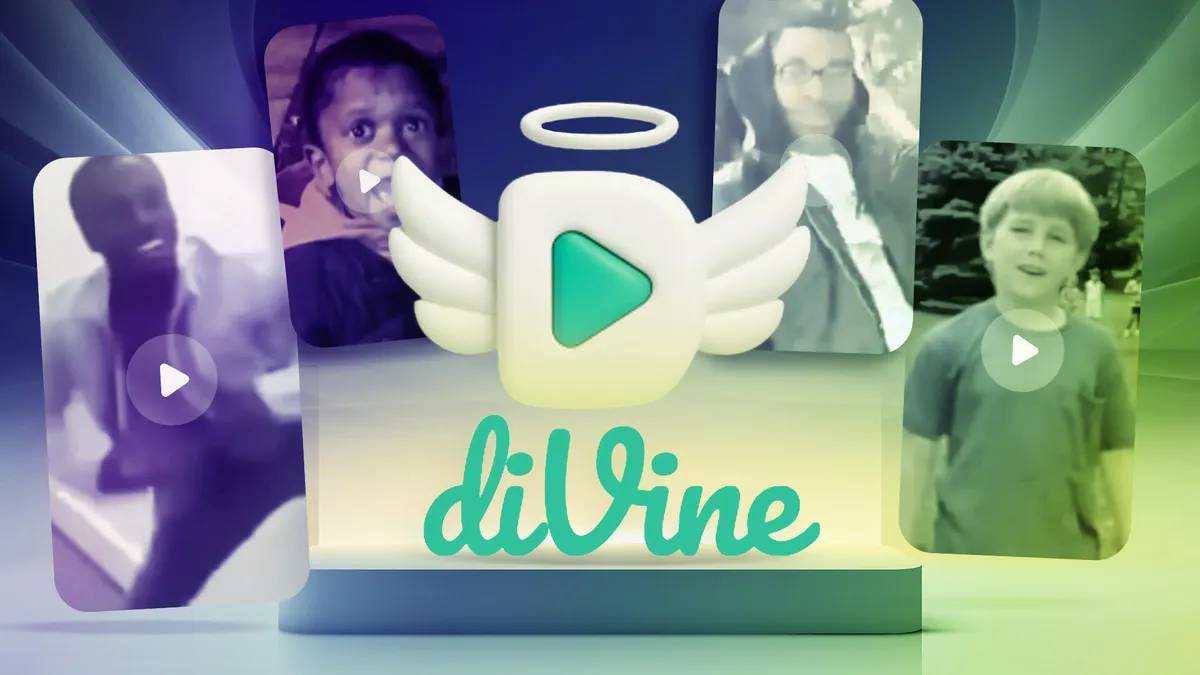
Vine Legacy Revived with Divine Video Platform

Divine has officially launched as a video-sharing platform built around the archived content of the defunct Vine ecosystem, aiming to restore access to millions of six-second clips that defined early viral culture.

May 4, 2026
|
Image Source: Cnet

A new chapter in short-form video has opened with the launch of Divine, an AI-free social platform designed to preserve and revive the legacy of Vine. The initiative, led by early internet technologists, signals growing demand for nostalgic, human-curated digital spaces amid increasing concerns over AI-generated social content.

Divine has officially launched as a video-sharing platform built around the archived content of the defunct Vine ecosystem, aiming to restore access to millions of six-second clips that defined early viral culture. Unlike modern social platforms, Divine explicitly excludes AI-generated content, focusing instead on human-uploaded and historically preserved media.

The platform is associated with internet pioneer Evan Henshaw-Plath, one of the early contributors to social media infrastructure. Its rollout comes at a time when major platforms are increasingly integrating generative AI tools into content creation, sparking debate over authenticity and digital originality.

Divine positions itself as both a cultural archive and a functional social feed. The launch of Divine reflects a broader recalibration in the social media industry, where AI integration has rapidly transformed content production, moderation, and distribution. Platforms such as TikTok, Instagram, and YouTube have increasingly embedded generative AI tools to enhance engagement and automate content creation.

However, this shift has also triggered concerns around authenticity, misinformation, and creator displacement. Vine, originally launched in 2013 and discontinued in 2017, became a cultural landmark for short-form creativity before being absorbed into newer platforms.

Divine emerges against this backdrop as a counter-movement prioritising archival preservation and human expression over algorithmically generated media. The platform taps into nostalgia while also addressing growing user fatigue with AI-saturated feeds, positioning itself within a niche but emotionally resonant segment of digital culture.

Industry observers suggest Divine represents a “retro-digital” trend, where platforms attempt to reclaim pre AI internet experiences. Analysts argue that the demand for curated, human-centric content is rising as users become more aware of algorithmic manipulation and synthetic media proliferation.

Digital culture researchers note that Vine’s cultural footprint remains disproportionately large compared to its lifespan, making it a valuable archive for studying early viral behaviour. While official statements from the Divine team emphasize “preserving human creativity in its purest form,” broader tech commentary frames the project as both a cultural experiment and a critique of AI-driven platform economics.

Some experts caution, however, that scaling an AI-free ecosystem may pose moderation and sustainability challenges in a competitive attention economy dominated by automated recommendation systems.

For technology firms, Divine underscores a growing market segment seeking alternatives to AI-heavy ecosystems. This could influence product strategy decisions around content authenticity, archival services, and user control features. Investors may view such platforms as niche but culturally significant assets within the broader creator economy.

From a policy standpoint, the platform adds momentum to ongoing debates about AI transparency, digital provenance, and content ownership. Regulators in multiple regions are already examining how synthetic media should be labeled and governed. Divine’s positioning may strengthen arguments for clearer separation between human and AI-generated content in social feeds, potentially shaping future compliance frameworks.

The success of Divine will depend on its ability to sustain user engagement without algorithmic amplification or AI-driven personalization. Future growth may hinge on partnerships, archival expansion, and creator participation. Market watchers will closely monitor whether nostalgia-driven platforms can compete with AI-native ecosystems or remain culturally significant but commercially limited. The broader question remains: can human-only social media survive in an increasingly automated digital landscape?

Source: Cnet
Date: May 4, 2026

  • Featured tools
Writesonic AI
Free

Writesonic AI is a versatile AI writing platform designed for marketers, entrepreneurs, and content creators. It helps users create blog posts, ad copies, product descriptions, social media posts, and more with ease. With advanced AI models and user-friendly tools, Writesonic streamlines content production and saves time for busy professionals.

#
Copywriting
Learn more
Twistly AI
Paid

Twistly AI is a PowerPoint add-in that allows users to generate full slide decks, improve existing presentations, and convert various content types into polished slides directly within Microsoft PowerPoint.It streamlines presentation creation using AI-powered text analysis, image generation and content conversion.

#
Presentation
Learn more

Learn more about future of AI

Join 80,000+ Ai enthusiast getting weekly updates on exciting AI tools.
Thank you! Your submission has been received!
Oops! Something went wrong while submitting the form.

Vine Legacy Revived with Divine Video Platform

May 4, 2026

Divine has officially launched as a video-sharing platform built around the archived content of the defunct Vine ecosystem, aiming to restore access to millions of six-second clips that defined early viral culture.

Image Source: Cnet

A new chapter in short-form video has opened with the launch of Divine, an AI-free social platform designed to preserve and revive the legacy of Vine. The initiative, led by early internet technologists, signals growing demand for nostalgic, human-curated digital spaces amid increasing concerns over AI-generated social content.

Divine has officially launched as a video-sharing platform built around the archived content of the defunct Vine ecosystem, aiming to restore access to millions of six-second clips that defined early viral culture. Unlike modern social platforms, Divine explicitly excludes AI-generated content, focusing instead on human-uploaded and historically preserved media.

The platform is associated with internet pioneer Evan Henshaw-Plath, one of the early contributors to social media infrastructure. Its rollout comes at a time when major platforms are increasingly integrating generative AI tools into content creation, sparking debate over authenticity and digital originality.

Divine positions itself as both a cultural archive and a functional social feed. The launch of Divine reflects a broader recalibration in the social media industry, where AI integration has rapidly transformed content production, moderation, and distribution. Platforms such as TikTok, Instagram, and YouTube have increasingly embedded generative AI tools to enhance engagement and automate content creation.

However, this shift has also triggered concerns around authenticity, misinformation, and creator displacement. Vine, originally launched in 2013 and discontinued in 2017, became a cultural landmark for short-form creativity before being absorbed into newer platforms.

Divine emerges against this backdrop as a counter-movement prioritising archival preservation and human expression over algorithmically generated media. The platform taps into nostalgia while also addressing growing user fatigue with AI-saturated feeds, positioning itself within a niche but emotionally resonant segment of digital culture.

Industry observers suggest Divine represents a “retro-digital” trend, where platforms attempt to reclaim pre AI internet experiences. Analysts argue that the demand for curated, human-centric content is rising as users become more aware of algorithmic manipulation and synthetic media proliferation.

Digital culture researchers note that Vine’s cultural footprint remains disproportionately large compared to its lifespan, making it a valuable archive for studying early viral behaviour. While official statements from the Divine team emphasize “preserving human creativity in its purest form,” broader tech commentary frames the project as both a cultural experiment and a critique of AI-driven platform economics.

Some experts caution, however, that scaling an AI-free ecosystem may pose moderation and sustainability challenges in a competitive attention economy dominated by automated recommendation systems.

For technology firms, Divine underscores a growing market segment seeking alternatives to AI-heavy ecosystems. This could influence product strategy decisions around content authenticity, archival services, and user control features. Investors may view such platforms as niche but culturally significant assets within the broader creator economy.

From a policy standpoint, the platform adds momentum to ongoing debates about AI transparency, digital provenance, and content ownership. Regulators in multiple regions are already examining how synthetic media should be labeled and governed. Divine’s positioning may strengthen arguments for clearer separation between human and AI-generated content in social feeds, potentially shaping future compliance frameworks.

The success of Divine will depend on its ability to sustain user engagement without algorithmic amplification or AI-driven personalization. Future growth may hinge on partnerships, archival expansion, and creator participation. Market watchers will closely monitor whether nostalgia-driven platforms can compete with AI-native ecosystems or remain culturally significant but commercially limited. The broader question remains: can human-only social media survive in an increasingly automated digital landscape?

Source: Cnet
Date: May 4, 2026

Promote Your Tool

Copy Embed Code

Similar Blogs

June 24, 2026
|

Denmark Launches €7M AI Lab

The Danish government has committed €7 million to establish a national AI Lab focused on accelerating real-world AI adoption.
Read more
June 24, 2026
|

Avrea Emerges With CI/CD Bet

Avrea has raised $4.7 million in pre-seed funding to modernize continuous integration and continuous deployment (CI/CD) systems for environments dominated by AI-generated code.
Read more
June 24, 2026
|

Atech Backs Lovable Hardware Moment

Atech is advocating a new approach to hardware development where AI tools streamline design, prototyping, and iteration cycles.
Read more
June 24, 2026
|

A16z Backs Endra Engineering Automation

Endra’s $50 million Series A round, led by Andreessen Horowitz, marks one of the largest early-stage investments in AI-driven engineering design tools in Europe.
Read more
June 24, 2026
|

Netcompany Expands Smart Airport Play

Netcompany’s acquisition of full control over Smarter Airports marks a strategic expansion into intelligent aviation infrastructure systems. The platform, integrated with AIRHART technology, is already being deployed at major hubs.
Read more
June 24, 2026
|

Swiss VC Market Enters Maturity Phase

The Swiss venture landscape is showing increased exit momentum through acquisitions and secondary sales, indicating healthier liquidity cycles for early-stage investors.
Read more