
AI Robotics Breakthrough Advances Sports Precision Automation

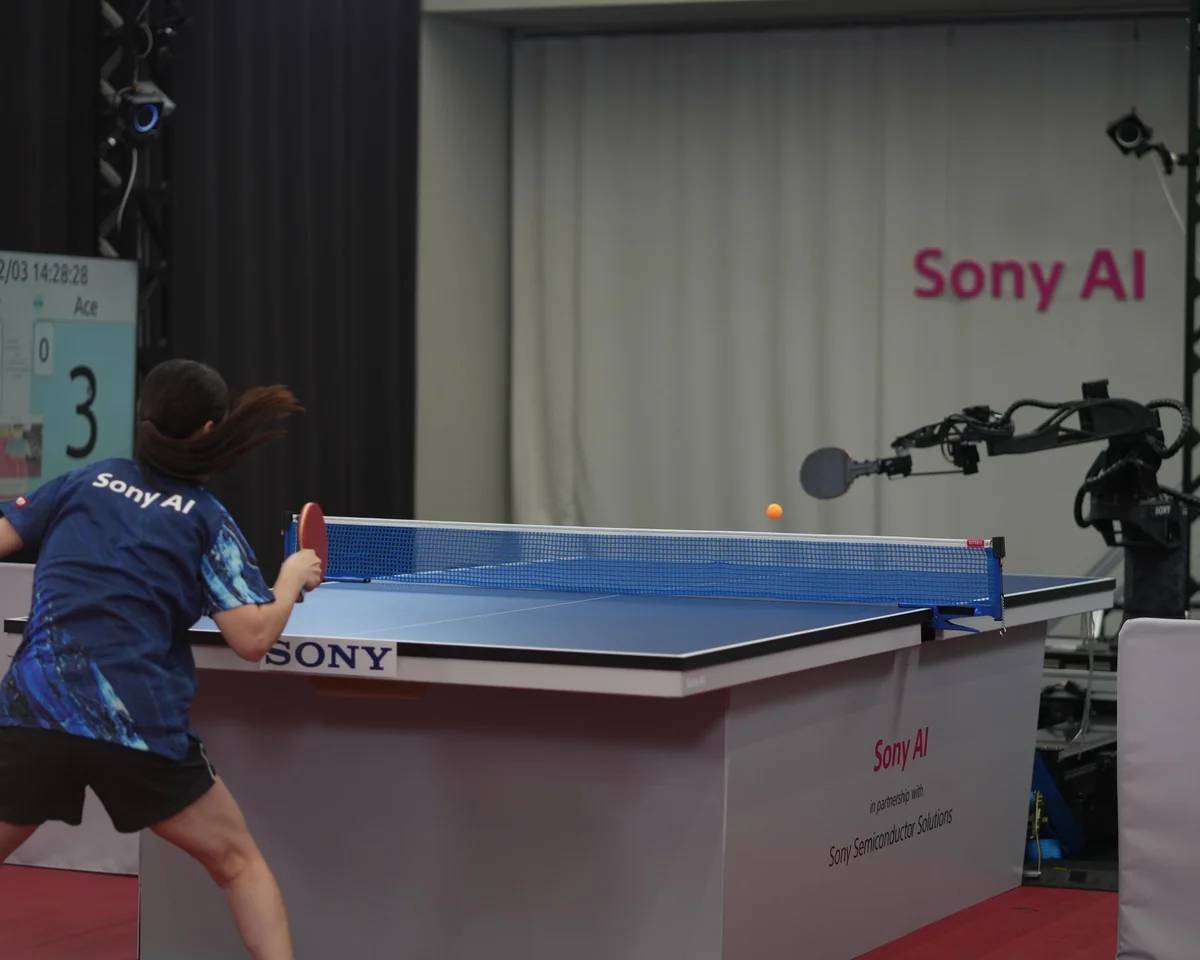
The AI-driven robotic system demonstrated the ability to compete against professional-level table tennis players, successfully reacting to high-speed shots and executing precise returns.

April 23, 2026
|
Image Source: The Guardian

A newly developed AI-powered robot has defeated elite human table tennis players, marking a significant milestone in robotics and machine learning capabilities. The achievement underscores rapid advancements in real-time decision-making systems, with implications extending beyond sport into industrial automation, defense systems, and human-machine interaction technologies.

The AI-driven robotic system demonstrated the ability to compete against professional-level table tennis players, successfully reacting to high-speed shots and executing precise returns. The system integrates advanced motion prediction, reinforcement learning, and real-time sensor feedback.

Key stakeholders include robotics researchers, AI developers, and institutions advancing human-machine interaction technologies. The timeline reflects accelerating progress in embodied AI systems capable of operating in dynamic, high-speed environments. Economically, the breakthrough highlights potential applications in manufacturing automation, precision robotics, and logistics systems where rapid decision-making and physical dexterity are increasingly valuable.

The development reflects a broader global acceleration in robotics and embodied artificial intelligence, where machines are increasingly capable of interacting with complex physical environments. Traditionally, AI systems have excelled in digital domains such as language processing and data analysis, but physical-world applications present significantly higher complexity.

Advancements in reinforcement learning, computer vision, and sensor fusion have enabled robots to perform tasks requiring real-time adaptability. Similar progress has been observed in industrial robotics and autonomous systems.

Historically, robotic performance has been limited by latency and environmental unpredictability. However, recent breakthroughs indicate a shift toward systems that can learn and adapt in real time. This evolution positions robotics as a key frontier in the broader AI transformation across global industries, including manufacturing, logistics, and defense.

Robotics experts describe the achievement as a demonstration of narrowing performance gaps between human reflexes and machine reaction capabilities in controlled environments. Analysts note that table tennis serves as a high-complexity benchmark due to its speed, precision, and continuous decision-making requirements.

Industry researchers emphasize that such systems are not merely sport-oriented but serve as testbeds for industrial automation technologies. Experts suggest that breakthroughs in real-time physical AI could accelerate adoption in sectors requiring fine motor control and rapid adaptive responses.

However, specialists caution that transferring performance from controlled environments to unpredictable real-world settings remains a significant challenge. Variability in physical conditions, object dynamics, and environmental noise continues to limit deployment scalability.

For global executives, the breakthrough signals accelerating convergence between AI research and real-world automation applications. Industries such as manufacturing, warehousing, and logistics may benefit from more adaptive robotic systems capable of handling complex tasks.

Investors are likely to increase attention toward robotics and embodied AI companies as commercialization pathways expand. From a policy perspective, governments may need to evaluate workforce displacement risks and regulatory frameworks for advanced automation technologies. The growing capability of AI-driven robotics could reshape labor dynamics in precision-based industries while creating new demand for human oversight and system management roles.

Looking ahead, advancements in embodied AI are expected to move rapidly from experimental demonstrations to industrial applications. Decision-makers should monitor deployment in logistics, manufacturing, and service robotics. The key uncertainty lies in scalability transitioning from controlled environments to real-world operational complexity will determine the pace of adoption.

Source: The Guardian
Date: April 22, 2026

  • Featured tools
Copy Ai
Free

Copy AI is one of the most popular AI writing tools designed to help professionals create high-quality content quickly. Whether you are a product manager drafting feature descriptions or a marketer creating ad copy, Copy AI can save hours of work while maintaining creativity and tone.

#
Copywriting
Learn more
Writesonic AI
Free

Writesonic AI is a versatile AI writing platform designed for marketers, entrepreneurs, and content creators. It helps users create blog posts, ad copies, product descriptions, social media posts, and more with ease. With advanced AI models and user-friendly tools, Writesonic streamlines content production and saves time for busy professionals.

#
Copywriting
Learn more

Learn more about future of AI

Join 80,000+ Ai enthusiast getting weekly updates on exciting AI tools.
Thank you! Your submission has been received!
Oops! Something went wrong while submitting the form.

AI Robotics Breakthrough Advances Sports Precision Automation

April 23, 2026

The AI-driven robotic system demonstrated the ability to compete against professional-level table tennis players, successfully reacting to high-speed shots and executing precise returns.

Image Source: The Guardian

A newly developed AI-powered robot has defeated elite human table tennis players, marking a significant milestone in robotics and machine learning capabilities. The achievement underscores rapid advancements in real-time decision-making systems, with implications extending beyond sport into industrial automation, defense systems, and human-machine interaction technologies.

The AI-driven robotic system demonstrated the ability to compete against professional-level table tennis players, successfully reacting to high-speed shots and executing precise returns. The system integrates advanced motion prediction, reinforcement learning, and real-time sensor feedback.

Key stakeholders include robotics researchers, AI developers, and institutions advancing human-machine interaction technologies. The timeline reflects accelerating progress in embodied AI systems capable of operating in dynamic, high-speed environments. Economically, the breakthrough highlights potential applications in manufacturing automation, precision robotics, and logistics systems where rapid decision-making and physical dexterity are increasingly valuable.

The development reflects a broader global acceleration in robotics and embodied artificial intelligence, where machines are increasingly capable of interacting with complex physical environments. Traditionally, AI systems have excelled in digital domains such as language processing and data analysis, but physical-world applications present significantly higher complexity.

Advancements in reinforcement learning, computer vision, and sensor fusion have enabled robots to perform tasks requiring real-time adaptability. Similar progress has been observed in industrial robotics and autonomous systems.

Historically, robotic performance has been limited by latency and environmental unpredictability. However, recent breakthroughs indicate a shift toward systems that can learn and adapt in real time. This evolution positions robotics as a key frontier in the broader AI transformation across global industries, including manufacturing, logistics, and defense.

Robotics experts describe the achievement as a demonstration of narrowing performance gaps between human reflexes and machine reaction capabilities in controlled environments. Analysts note that table tennis serves as a high-complexity benchmark due to its speed, precision, and continuous decision-making requirements.

Industry researchers emphasize that such systems are not merely sport-oriented but serve as testbeds for industrial automation technologies. Experts suggest that breakthroughs in real-time physical AI could accelerate adoption in sectors requiring fine motor control and rapid adaptive responses.

However, specialists caution that transferring performance from controlled environments to unpredictable real-world settings remains a significant challenge. Variability in physical conditions, object dynamics, and environmental noise continues to limit deployment scalability.

For global executives, the breakthrough signals accelerating convergence between AI research and real-world automation applications. Industries such as manufacturing, warehousing, and logistics may benefit from more adaptive robotic systems capable of handling complex tasks.

Investors are likely to increase attention toward robotics and embodied AI companies as commercialization pathways expand. From a policy perspective, governments may need to evaluate workforce displacement risks and regulatory frameworks for advanced automation technologies. The growing capability of AI-driven robotics could reshape labor dynamics in precision-based industries while creating new demand for human oversight and system management roles.

Looking ahead, advancements in embodied AI are expected to move rapidly from experimental demonstrations to industrial applications. Decision-makers should monitor deployment in logistics, manufacturing, and service robotics. The key uncertainty lies in scalability transitioning from controlled environments to real-world operational complexity will determine the pace of adoption.

Source: The Guardian
Date: April 22, 2026

Promote Your Tool

Copy Embed Code

Similar Blogs

April 27, 2026
|

Global AI Race Intensifies With New Model Releases

Multiple frontier AI companies are accelerating the release of next-generation models aimed at improving reasoning, multimodal capabilities, and enterprise integration.
Read more
April 27, 2026
|

Budget Tablet Competition Intensifies as TCL Hits $150 Price Point

A TCL tablet is currently available on Amazon for as low as $150 as part of a limited-time promotional discount. The deal positions the device within the highly competitive entry-level tablet category, targeting students, casual users, and cost-conscious consumers.
Read more
April 27, 2026
|

Apple Enables Default iPhone Security in iOS 26.4.1

The iOS 26.4.1 update includes a bug fix that results in an important iPhone security feature being automatically enabled for users. This adjustment reduces the need for manual activation and ensures broader baseline protection across supported devices.
Read more
April 27, 2026
|

Microsoft Adds 35-Day Windows Update Pause Option

Microsoft has introduced an expanded update control feature allowing Windows users to pause system updates for up to 35 days, according to The Verge.
Read more
April 27, 2026
|

Linux Gains Ground as Users Rethink Windows Dependence

A user experience transition after three months of daily Linux usage, with no perceived loss in productivity or functionality compared to Windows.
Read more
April 27, 2026
|

Project Maven and the Militarization of AI Strategy

Project Maven was launched as a U.S. Department of Defense initiative to deploy AI for analyzing vast amounts of drone and surveillance imagery.
Read more