
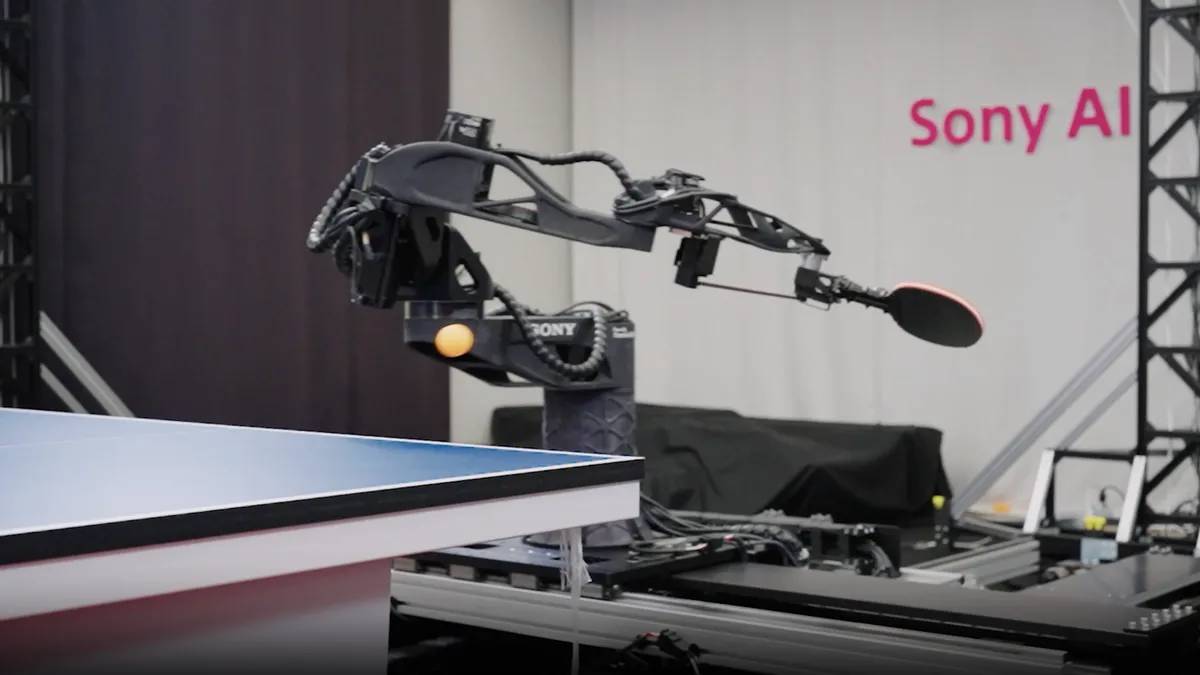
Sony Advances AI Table Tennis Robotics

Sony has developed an AI-enabled robotic system designed to play table tennis at a highly competitive level, demonstrating advanced precision, reaction speed, and adaptive learning capabilities.

May 5, 2026
|
Image Source: CNET

A notable advancement in robotics has emerged as Sony unveils an AI-powered robot capable of high-level table tennis play. The development underscores rapid progress in machine perception, motion control, and real-time decision-making, highlighting how robotics is transitioning from industrial applications into dynamic human-competitive environments.

Sony has developed an AI-enabled robotic system designed to play table tennis at a highly competitive level, demonstrating advanced precision, reaction speed, and adaptive learning capabilities.

The robot integrates real-time vision processing, predictive modeling, and rapid motion control systems to track and respond to fast-moving balls. It is designed not only for performance but also as a research platform for refining robotics agility and human-like responsiveness.

The system represents a broader push by Sony into AI-driven robotics, with applications extending beyond entertainment into training environments, simulation systems, and advanced automation research.

The development of competitive AI robotics reflects a broader evolution in machine intelligence, where systems are increasingly capable of operating in dynamic, unpredictable environments. Table tennis, in particular, is considered a benchmark for robotic agility due to its rapid pace, precision requirements, and continuous real-time decision-making demands.

Historically, robotics has excelled in structured industrial environments such as manufacturing and logistics. However, recent advancements in AI, sensor fusion, and motion control have enabled robots to operate in more fluid, human-like contexts.

Sony has been actively investing in robotics and entertainment technology, positioning itself at the intersection of AI research and consumer-facing innovation. The table tennis robot reflects a growing industry trend where robotics companies are using sports and gaming environments as testbeds for refining machine intelligence, coordination, and adaptive response systems.

Robotics researchers view high-speed sports-based systems as critical benchmarks for evaluating AI performance in real-world conditions. Analysts note that table tennis requires split-second decision-making, spatial awareness, and predictive modeling capabilities essential for next-generation autonomous systems.

Experts suggest that Sony is leveraging such platforms to advance research in dynamic motion planning and human-robot interaction. While primarily a demonstration system, the underlying technologies are expected to influence broader applications in manufacturing automation, rehabilitation robotics, and interactive entertainment.

Industry observers also highlight that competitive robotics showcases are increasingly used to attract investment and talent in the AI hardware ecosystem. However, they caution that translating lab-based performance into real-world utility remains a significant engineering challenge, particularly in uncontrolled environments.

For businesses, AI-driven robotics systems could accelerate automation in precision-based industries such as electronics manufacturing, logistics sorting, and training simulations. The ability of robots to operate in dynamic environments opens new opportunities for productivity gains and operational efficiency.

For investors, advancements in robotic intelligence signal long-term growth potential in the AI hardware sector, particularly for companies integrating vision systems and adaptive control algorithms.

From a policy perspective, the increasing sophistication of autonomous systems may raise questions around safety standards, human-robot interaction protocols, and deployment guidelines in shared environments. Regulators may need to anticipate broader integration of adaptive robotics into public and commercial spaces.

The robotics sector is expected to continue advancing toward greater real-world adaptability and human-like responsiveness. Future iterations of AI sports robots may expand into training tools, industrial simulation platforms, and interactive consumer applications. Industry attention will focus on whether such systems can transition from controlled demonstrations to scalable, practical deployments across commercial environments.

Source: CNET
Date: May 2026

  • Featured tools
Symphony Ayasdi AI
Free

SymphonyAI Sensa is an AI-powered surveillance and financial crime detection platform that surfaces hidden risk behavior through explainable, AI-driven analytics.

#
Finance
Learn more
Hostinger Horizons
Freemium

Hostinger Horizons is an AI-powered platform that allows users to build and deploy custom web applications without writing code. It packs hosting, domain management and backend integration into a unified tool for rapid app creation.

#
Startup Tools
#
Coding
#
Project Management
Learn more

Learn more about future of AI

Join 80,000+ Ai enthusiast getting weekly updates on exciting AI tools.
Thank you! Your submission has been received!
Oops! Something went wrong while submitting the form.

Sony Advances AI Table Tennis Robotics

May 5, 2026

Sony has developed an AI-enabled robotic system designed to play table tennis at a highly competitive level, demonstrating advanced precision, reaction speed, and adaptive learning capabilities.

Image Source: CNET

A notable advancement in robotics has emerged as Sony unveils an AI-powered robot capable of high-level table tennis play. The development underscores rapid progress in machine perception, motion control, and real-time decision-making, highlighting how robotics is transitioning from industrial applications into dynamic human-competitive environments.

Sony has developed an AI-enabled robotic system designed to play table tennis at a highly competitive level, demonstrating advanced precision, reaction speed, and adaptive learning capabilities.

The robot integrates real-time vision processing, predictive modeling, and rapid motion control systems to track and respond to fast-moving balls. It is designed not only for performance but also as a research platform for refining robotics agility and human-like responsiveness.

The system represents a broader push by Sony into AI-driven robotics, with applications extending beyond entertainment into training environments, simulation systems, and advanced automation research.

The development of competitive AI robotics reflects a broader evolution in machine intelligence, where systems are increasingly capable of operating in dynamic, unpredictable environments. Table tennis, in particular, is considered a benchmark for robotic agility due to its rapid pace, precision requirements, and continuous real-time decision-making demands.

Historically, robotics has excelled in structured industrial environments such as manufacturing and logistics. However, recent advancements in AI, sensor fusion, and motion control have enabled robots to operate in more fluid, human-like contexts.

Sony has been actively investing in robotics and entertainment technology, positioning itself at the intersection of AI research and consumer-facing innovation. The table tennis robot reflects a growing industry trend where robotics companies are using sports and gaming environments as testbeds for refining machine intelligence, coordination, and adaptive response systems.

Robotics researchers view high-speed sports-based systems as critical benchmarks for evaluating AI performance in real-world conditions. Analysts note that table tennis requires split-second decision-making, spatial awareness, and predictive modeling capabilities essential for next-generation autonomous systems.

Experts suggest that Sony is leveraging such platforms to advance research in dynamic motion planning and human-robot interaction. While primarily a demonstration system, the underlying technologies are expected to influence broader applications in manufacturing automation, rehabilitation robotics, and interactive entertainment.

Industry observers also highlight that competitive robotics showcases are increasingly used to attract investment and talent in the AI hardware ecosystem. However, they caution that translating lab-based performance into real-world utility remains a significant engineering challenge, particularly in uncontrolled environments.

For businesses, AI-driven robotics systems could accelerate automation in precision-based industries such as electronics manufacturing, logistics sorting, and training simulations. The ability of robots to operate in dynamic environments opens new opportunities for productivity gains and operational efficiency.

For investors, advancements in robotic intelligence signal long-term growth potential in the AI hardware sector, particularly for companies integrating vision systems and adaptive control algorithms.

From a policy perspective, the increasing sophistication of autonomous systems may raise questions around safety standards, human-robot interaction protocols, and deployment guidelines in shared environments. Regulators may need to anticipate broader integration of adaptive robotics into public and commercial spaces.

The robotics sector is expected to continue advancing toward greater real-world adaptability and human-like responsiveness. Future iterations of AI sports robots may expand into training tools, industrial simulation platforms, and interactive consumer applications. Industry attention will focus on whether such systems can transition from controlled demonstrations to scalable, practical deployments across commercial environments.

Source: CNET
Date: May 2026

Promote Your Tool

Copy Embed Code

Similar Blogs

May 5, 2026
|

iOS 27 Enables Custom Wallet Passes

The rumored iOS 27 update is expected to allow users to create and manage custom digital passes within Apple’s Wallet ecosystem.
Read more
May 5, 2026
|

Google Pixel 11 Camera-First Strategy Shift

The Pixel 11 is expected to feature a significant upgrade in camera hardware, including a higher-resolution 50MP sensor, signaling a continued focus on computational photography leadership by Google.
Read more
May 5, 2026
|

Digital Polaroids Redefine Smart Memory Displays

The product introduces reusable digital photo tiles that function like modern Polaroids, allowing users to display, replace, and refresh images on surfaces such as refrigerators.
Read more
May 5, 2026
|

Squirrel Dad Launches Viral AI Camera App

The new iPhone camera app, designed and promoted by Derrick Downey Jr., has gained rapid traction in the consumer tech space for its intuitive dual-capture functionality and AI-assisted recording features.
Read more
May 5, 2026
|

AI Vibe Coding Revives Retro Gaming

The concept of “vibe coding” involves using AI models to rapidly generate, modify, and reconstruct software experiences based on intuitive prompts rather than traditional programming workflows.
Read more
May 5, 2026
|

Sony Advances AI Table Tennis Robotics

Sony has developed an AI-enabled robotic system designed to play table tennis at a highly competitive level, demonstrating advanced precision, reaction speed, and adaptive learning capabilities.
Read more