



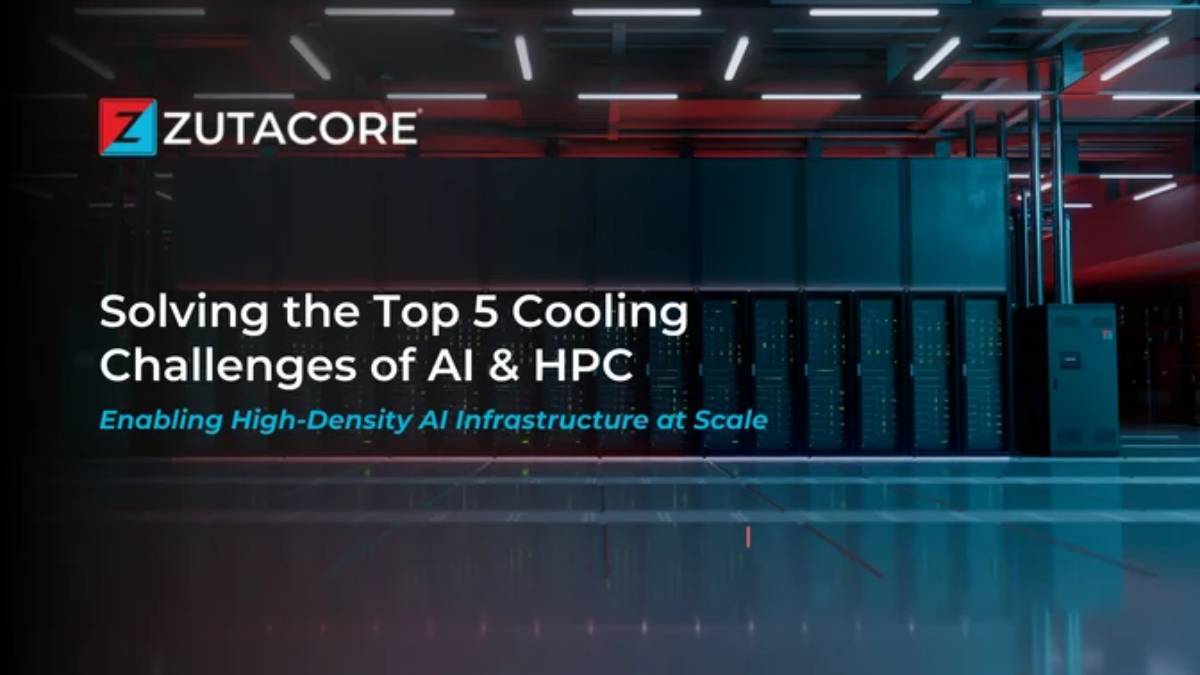
A major development in AI infrastructure unfolded as ZutaCore raised $100 million in fresh funding to scale its waterless cooling technology for high-density AI data centers. The investment highlights growing urgency around sustainable thermal management as AI workloads surge globally, intensifying pressure on power and water resources across digital infrastructure ecosystems.
ZutaCore announced a $100 million funding round aimed at expanding deployment of its direct-to-chip, waterless cooling systems designed for AI-driven data centers. The capital will support global commercialization, R&D expansion, and manufacturing scale-up.
The funding comes at a time when hyperscale cloud providers and enterprise AI operators are struggling with rising energy density in GPU-intensive workloads. Investors are increasingly backing alternative cooling technologies that reduce water dependency and improve energy efficiency. The company plans to target data center hubs across North America, Europe, and Asia, where AI infrastructure demand is accelerating rapidly.
The rise of ZutaCore reflects a broader structural shift in the global data center industry, driven by the explosive growth of artificial intelligence workloads. Modern AI training clusters require significantly higher compute densities, generating extreme heat loads that traditional air and water-based cooling systems increasingly struggle to manage.
Globally, data center operators are facing mounting constraints around water usage, energy consumption, and environmental sustainability. Regions such as the United States, the Middle East, and parts of Asia are already experiencing regulatory scrutiny over water-intensive cooling infrastructure.
In response, next-generation cooling technologies particularly liquid and waterless solutions are gaining traction. These innovations aim to decouple performance scaling from environmental impact, enabling higher GPU densities without proportional increases in water consumption or carbon emissions. This shift is becoming critical as AI infrastructure expands across cloud providers, sovereign AI initiatives, and enterprise deployments.
Industry analysts note that the funding round positions ZutaCore at the forefront of a rapidly evolving AI infrastructure bottleneck: thermal management. Experts argue that cooling efficiency is becoming as strategically important as chip performance itself in determining AI scalability.
Data center specialists highlight that waterless cooling could significantly reduce operational risks in regions facing water scarcity, while also improving power usage effectiveness (PUE) metrics across hyperscale facilities. Some analysts suggest that adoption of such technologies could reshape site selection strategies for future AI data centers.
However, industry voices also caution that large-scale deployment will depend on interoperability with existing infrastructure and long-term reliability under extreme workloads. While the company has not disclosed customer-specific expansion timelines, stakeholders in the cloud and semiconductor ecosystem are closely monitoring pilot deployments and early commercial integrations.
For businesses, the development signals a shift toward infrastructure-first AI strategies, where cooling efficiency becomes a core determinant of scalability and cost optimization. Hyperscalers and enterprise operators may increasingly evaluate data center partners based on thermal innovation rather than just compute capacity.
Investors are likely to view companies like ZutaCore as critical enablers of the AI economy, with infrastructure bottlenecks emerging as a key investment theme. For governments, the rise of waterless cooling technologies could influence data center regulations, particularly in regions facing water stress or energy constraints. Consumers may indirectly benefit from more efficient AI services, lower latency, and improved cloud reliability as infrastructure efficiency improves across the stack.
The next phase for ZutaCore will hinge on scaling deployments across hyperscale and edge data centers. Key indicators to watch include enterprise adoption rates, integration partnerships with cloud providers, and performance benchmarks under real-world AI workloads. As AI infrastructure demand accelerates, cooling innovation is expected to become a defining competitive factor in global data center expansion strategies.
Source: SiliconANGLE
Date: June 3, 2026


