



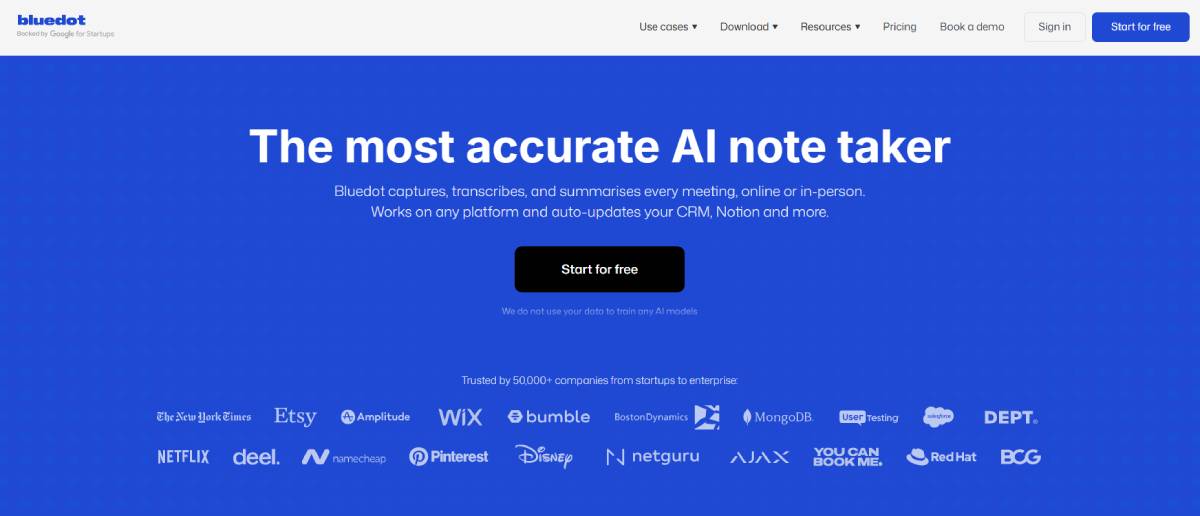
A new shift in workplace AI automation is emerging as Bluedot introduces a bot-free AI note-taking solution for enterprise meetings. The platform aims to eliminate intrusive meeting bots while maintaining automated transcription and summarization an innovation with implications for corporate privacy, compliance, and digital productivity strategies.
Bluedot’s AI note taker records and transcribes meetings without deploying visible bots into video calls. The system integrates with common conferencing platforms, enabling seamless capture of conversations while minimizing disruption to participants.
It generates summaries, highlights key decisions, and organizes meeting insights into shareable formats. The “bot-free” positioning addresses concerns among enterprises wary of third-party AI agents joining sensitive discussions. Target customers include remote teams, sales organizations, and corporate departments handling confidential information. By prioritizing discreet integration and data security, Bluedot differentiates itself in an increasingly crowded AI meeting assistant market.
The development aligns with a broader surge in AI-powered workplace productivity tools. As remote and hybrid work models become permanent across global enterprises, automated meeting documentation has transitioned from convenience feature to operational necessity. AI note-taking tools reduce administrative workload and improve institutional memory.
However, the widespread deployment of meeting bots has raised security and compliance concerns. Organizations operating in regulated sectors—including finance, healthcare, and government face strict requirements regarding data handling and third-party access. In parallel, enterprises are reassessing digital trust frameworks amid rising cybersecurity risks.
Bluedot’s bot-free approach reflects an industry pivot toward less intrusive AI integrations that maintain productivity gains while addressing privacy expectations. For executives, balancing automation efficiency with governance safeguards is now central to digital transformation strategies.
Technology analysts suggest that AI meeting documentation is becoming foundational to enterprise knowledge management systems. Productivity consultants argue that eliminating visible bots could increase employee comfort and adoption rates. Cybersecurity experts emphasize that discreet AI recording mechanisms must still meet stringent encryption and compliance standards.
Data governance specialists note that regulatory scrutiny particularly in regions enforcing strict privacy frameworks may shape how AI meeting tools are deployed. Enterprise IT leaders highlight that integration capabilities and data ownership transparency will determine vendor selection in competitive procurement processes. Bluedot’s market positioning signals an industry recalibration toward security-first automation in digital collaboration ecosystems.
For businesses, bot-free AI note-taking could streamline documentation while reducing perceived surveillance concerns among employees. Executives may prioritize vendors offering compliant, enterprise-grade data management.
Investors monitoring workplace AI trends may view privacy-centric solutions as more sustainable in regulated markets. Governments and regulators, meanwhile, may increase oversight around AI-generated transcripts, data retention, and cross-border information transfers.
Corporate boards will likely demand clear audit trails and contractual safeguards when integrating AI systems into high-stakes operational environments. Decision-makers should monitor evolving compliance standards and integration capabilities across collaboration platforms.
Future growth will depend on security certifications, interoperability, and user trust. Bluedot’s innovation underscores a larger trend: enterprise AI adoption is maturing beyond experimentation, with privacy-conscious automation emerging as the new competitive differentiator.
Source: Bluedot Official Website
Date: March 2, 2026


